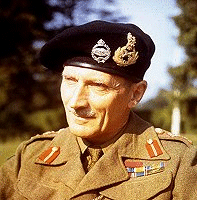
The Military Philosophers is unique in Dance to the Music of Time as the only book containing actual people who function as characters in the work. (Lots of other real people are mentioned, such as Winston Churchill and Wallace Simpson, but very few appear on stage and actually speak.) One is the CIGS ( Vicount Alanbrook), who produced an “extraordinary current of physical energy” (53). Most important among these is, however, “The Field-Marshal.”
“Bernard Law Montgomery, arguably the most celebrated British military commander of the twentieth century, began his army career in 1908 and by the date of his retirement in 1958 had risen to the rank of Field Marshal, as well as being created Viscount Montgomery of Alamein.

“In August 1942 he was sent to Egypt to take over the 8th Army and, following the victory at El Alamein, spearheaded the steady push through North Africa, before continuing it first into Sicily and then Italy itself. In early 1944 he was given command of the 21st Army Group for the invasion of mainland Europe and after the fighting in Normandy guided them through the liberation of North West Europe in a successful but controversial advance which culminated in the surrender ceremony in May 1945 on Lüneburg Heath.

“After commanding the British Army on the Rhine, Montgomery served as Chief of the Imperial General Staff between 1946 and 1948 before playing an important role in the formation and development of NATO until 1958.”

http://www.iwm.org.uk/collections/docs/monty.htm. 3/28/02

“Photography at an end, we were taken over the caravans, a visit personally conducted by the Field-Marshal, whose manner perfectly fused the feelings of a tenant justly proud of a perfectly equipped luxury flat with those of the lord of an ancient though still inhabited historical monument…. When this was over, the military attaches were led to a spot where a large map hung on a kind of easel.

“‘You’ll want me to put you in the picture.'” The Military Philosophers, 181.

The Military Philosophers begins in 1942. Jenkins is working with Pennistone under Finn as liason with the Poles. At a meeting to discuss the release of thousands of Polish officers from Russia, he runs into Widmerpool, Farebrother, and Templer. Through work he later has dealings with Blackhead, a bureaucrat of the highest degree. Pamela Flitton, an AT driver, takes Jenkins to various meetings around London. From her we learn of Stringham’s death as a POW in Singapore.

Norah Tolland brings Pamela to Ted Jeavons’s party. At work, Jenkins meets Kucherman, the Belgian attache, and learns that Szymanski – a mythologically difficult Polish officer – has escaped from dentention barracks. With Isobel, he attends The Bartered Bride, where Pamela turns up. Widmerpool, also present, asks about her. Others speak of her notoriety, numerous sexual conquests. Widmerpool becomes a full colonel.

Jenkins meets Pamela and Odo Stevens at an air raid shelter. Mrs. Erdleigh turns up and is eager to read Pamela’s palm, predicting marriage to “a man a little older.” When Stevens tries to stop Pamela from going outside during the raid, she slaps him. Mrs. Erdleigh reports the death of Dr. Trelawney.

Finn and Jenkins conduct the various military attaches to France for a tour. When Maj. Prasad says he requires a bathroom “for religious reasons,” Jenkins must request that Gen. Asborjornsen yield his room. Jenkins runs into his former unit, commanded now by Kedward, who remembers him with difficulty. The Field-Marshal gives the attaches an audience, and lectures the Belgians about their Resistance fighters, who are causing the Allies difficulty. Jenkins has a drink with Bob Duport, and learns that Templer has been killed.

As the War winds down in the Pacific theater, Jenkins’s fellow officers begin to return to civilian life. He reads of the engagement between Pamela Flitton and Widmerpool and later attends a party at Prasad’s Embassy with Isobel, where he meets Widmerpool and Pamela, Sunny Farebrother and his new wife “Tuffy” Weedon (widow of General Conyers), and Matilda Wilson with her husband Sir Magnus Donners. Pamela and Widmerpool argue whether Widmerpool was responsible for Templer’s death. At the St. Paul’s celebration of the end of the war, Nick allows Colonel Flores to take his seat and meets Jean Templer (Mrs. Flores) again for the first time in several years. The book ends with an unexpected meeting with Archie Gilbert, the cosmopolitan partygoer from ABM.
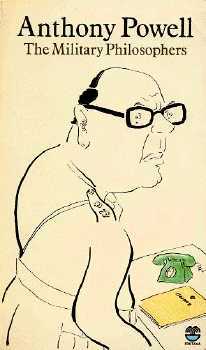
The cover depicts Col. Widmerpool, drawn by Marc Boxer.

These are the major characters in this volume, organized by chapter.
The military abbreviations may be determined by consulting Will Story’s
list of abbreviations, below.

Chapter 1

Lt. Col. (Lysander) Finn – head of military liason at the War Office
Maj. David Penniston – colleague of Jenkins in military liason
Blackhead – obstructionist civil servant
Lt. Col. Kenneth Widmerpool – himself, in charge of a committee in Cabinet Office
Lt. Col. Sunny Farebrother – attached to a “secret show” in military espionage
Peter Templer – old friend of Jenkins, working in MEW
Pamela Flitton – AT driver, niece of Charles Stringham
Prince Theodoric – Baltic prince

Chapter 2

Ted Jeavons – ARP warden, widower of one of Jenkins’s in-laws
Norah Tolland – Jenkins’s sister-in-law
Major Kutcherman – Belgian military attache
Isobel Jenkins – Jenkins’s wife

Chapter 3

Maj. Odo Stevens – “secret show” officer, acquaintance of Jenkins
Mrs. Myra Erdleigh – fortune-teller, old friend of Jenkins’s late uncle

Chapter 4

Major Prasad – Indian military attache
Gen. Asborjornsen – Scandinavian military attache
Field-Marshal – Montgomery
Capt. Idwal Kedward – CO of Jenkins’s former company
Capt. Bob Duport – old friend and former brother-in-law of Peter Templer

Chapter 5

Geraldine “Tuffy” Weedon Farebrother – Sunny’s new wife, works in MI5
Col. Flores – South American military attache
Jean Templer Duport Flores – among other things, Jenkin’s old heart-throb

Nick did not expect
That on that day he would see
Senora Flores.

      — Madeleine Fawcett

Banana in eyes,
Widmerpool’s face is slavish:
Now it’s Barbara’s turn.

      — Gauri Kirloskar

High up in the eves
Bureaucrat extraordinaire
Blackhead waits for prey

      — Doug Presley

A polite request:
Please amplify, notes on soap:
Blackhead is not pleased.

Whining Widmerpool
Receives Barbara’s good graces:
Sugar on his head.

      — Luke Spears

Sillery has dreams,
He plots to have influence,
But stays powerless.

      — Will Story

Languid snake in black —
Icy motion by the vase:
Pam, in passing, pukes.

A swirl of blue robes,
As Trelawney’s flock runs past:
Vision of Visions.

      — John Gould

John–Finally read the war papers–my favorites were `D. Presley’s on continuity between military and civilian life (exactly diagnosed Gwatkin’s soldierly illusions)…Katherine Leonard’s paper on Stringham and Tuffy (which I thought was slightly too tough on Tuffy, as it were, but provided an interesting angle), and Luke Spears’ excellent essay on the effect of the war, although I think the ultimate point is that Jenkins and the narrative e come through the war years intact. I also thought the basement essay was an interesting, and original, take on the book.

best
Nick

–0–

I was impressed by Will Story’s ABC in the Military Philosophers section and especially by his getting CBE right, viz. Commander of the Order of the British Empire; this sort of thing is often got wrong in this country (England). However, I was then disappointed that he made the usual sort of mistake regarding the equivalent OBE and MBE. Just in case anyone’s interested, it goes like this (from lowest to highest rank):

MBE Member of the Order of the British Empire
OBE Officer of the Order of the British Empire
CBE Commander of the Order of the British Empire
KBE or DBE Knight Commander or Dame Commander of the Order of the British Empire
GBE Knight Grand Cross or Dame Grand Cross of the Order of the British Empire

There are similar (though not identical) gradations for other orders.

(I can take some comfort in presuming to correct you on this sort of thing, from the fact that AP was evidently also liable to be annoyed by mistakes of this sort!)

With best wishes and in admiration of what I’ve seen of the site and certainly of the enterprise as a whole,

Michael Skaife d’Ingerthorpe

(Note: Michael’s corrections to Will’s “Learning the ABC of Military Affairs” have been added to his text. Will, the rest of the class, and I are grateful for Michael’s expertise.)

Essays: 2001-2

This glossary of all the military abbreviations in the war trilogy of Dance is set up in alphabetical order. The abbreviations, each with definition. are given, followed by the first book and page number that it appears.

ACI-Army Council Instruction, The Soldier’s Art-P 60
ADC-Aide-de-Camp, The Valley of Bones-P 93
A & Q-Adjutant & Quartermaster, The Soldier’s Art-P 22
ARP-Air Raid Precautions, The Military Philosophers-P 75

AT-Auxiliary Territorial, The Military Philosophers-P 33
ATS-Auxiliary Territorial Service, The Military Philosophers-P 34

Battalion HQ-Battalion Head Quarter, The Valley of Bones-P 80

CB-Confined to barracks, The Valley of Bones-P 62

CBE-Commander of the Order of the British Empire, The Military Philosophers-P 228
CD-Corps Diplomat, The Military Philosophers-P 232
C. of E.- Church of England, The Valley of Bones-P 20
CIGS-Chief of Imperial General Staff, The Soldier’s Art-P 80
CO-Commanding Officer, The Valley of Bones-P 15

CRA-Commander, Royal Artillery, The Soldier’s Art-P 28
CRASC-Commanding Royal Army Service Corps, The Soldier’s Art-P 62
CQMS-Company Quartermaster Sergeant, The Valley of Bones-P 176
CSM-Company Sergeant-Major, The Valley of Bones-P 6

DAAG-Deputy Assistant Adjutant General, The Valley of Bones-P 222
DADMS-Deputy Assistant Director Medical Services, The Soldier’s Art-P 65
DAPM-Deputy Assistant Provost Marshal, The Soldier’s Art-P 54
DCO-Divisional Catering Officer, The Soldier’s Art-P 64
Div HQ-Divisional Headquarters, The Valley of Bones-P 194

DR-Dispatch Rider, The Soldier’s Art-P 55
DSC-Distinguished Service Cross, The Valley of Bones-P 162
DSD-Director of Staff Duties, The Military Philosophers-P 195
DSO-Distinguished Service Order, The Soldier’s Art-P 196

ENSA-Entertainment’s National Service Association, The Soldier’s Art-P 116

FSO-Field Security Officer, The Soldier’s Art-P 59

GHQ-General Headquarters, The Military Philosophers-P 46
GOC-General Officer Commanding, The Military Philosophers-P 17

ITC-Infantry training Centre, The Valley of Bones-P 169

LAD-Light Aid Detachment, The Soldier’s Art-P 57
L. of C. Captain-Lines of Communication Captain, The Military Philosophers-P 172

MA-Military Attaché, The Military Philosophers-P 86

MBE- Member of the Order of the British Empire, The Military Philosophers-P 239
MC-Military Cross, The Valley of Bones-P 50
MEW-Ministry of Economic Warfare, The Military Philosophers-P 15
MI5-Military Intelligence 5 (secret service), The Military Philosophers-P 73
MGA-Major-General in charge of Administration at Corps HQ, The Soldier’s Art-P 199

MM-Military Medal, The Soldier’s Art-P 60
MO-Medical Officer, The Valley of Bones-P 82
MP-Military Police, The Valley of Bones-P 112
MS officer-Military Secretariat Officer, The Military Philosophers-P 240
MT-Motor Transport, The Valley of Bones-P 10

NCO-Non-commissioned Officer, The Valley of Bones-P 18

OBE- Officer of the Order of the British Empire, The Soldier’s Art-P196
OC-Officer in Charge, The Soldier’s Art-P 217
OCTU-Officer Cadet Training Unit, The Soldier’s Art-P 44

PM-Prime Minister, The Military Philosophers-P 20
POW-Prisoner of War, The Military Philosophers-P 204
PT-Physical Training The Valley of Bones-P 71

QM-Quartermaster The Valley of Bones-P 10

Q (Ops.)- Quartermaster Operations, The Military Philosophers-P 30

RAF-Royal Air Force, The Valley of Bones-P 19
RAOC-Royal Army Ordnance Corps, The Valley of Bones-P 157
RASC-Royal Army Service Corps, The Soldier’s Art-P 62

RC-Roman catholic, The Valley of Bones-P 20
RAMC-Royal Army Medical Corps, The Military Philosophers-P 103
RMC-Royal Military College, The Military Philosophers-P 55
RTO-Railway Transport Officer, The Valley of Bones-P 142
RV-Rendezvous, The Valley of Bones-P 77

SOPT-Staff Officer, Physical Training, The Soldier’s Art-P 69

TA Reservist-Territorial Army Reservist, The Valley of Bones-P 35

VC-Victoria Cross, The Valley of Bones-P 14
VD-Venereal Disease, The Soldier’s Art-P 66

WOASAWL-While-On-Active-Service-Absent-Without-Leave, The Soldier’s Art-P 149
W/T-Wireless Telephony, The Soldier’s Art-P 42

Thanks to the following for their contributions:
Julian Allason, Nick Birns, John Gilks, Dr. Keith C. Marshall, Nick Nash, Philip Stokes

The basements in The Military Philosophers seem to be where all of the real action takes place. Repeatedly throughout the novel, Powell describes the basements, catacombs, and crypts of various locations as the realms of action, places where things get done quickly and efficiently. In contrast, as altitude rises the efficiency level of the inhabitants drops. Nick’s place in this all, with a second floor office, illustrates his rank in the military hierarchy of importance: above, and therefore below, the likes of Finn, Farebrother, and Widmerpool.

When Nick is sent to the Cabinet Office meeting in place of Pennistone, he is led down “flight after flight of stairs” into “a room in the bowels of the earth” (11). He describes the office as “a brightly lit dungeon” in which “lurked a sense that no one could spare a word, not a syllable, far less gesture, not of direct value in implementing the matter in hand” (12). At the conclusion of the meeting, Widmerpool not so politely requests that Nick remove himself from the room, insisting that he has “some highly secret matter to deal with,” (19), further augmenting the atmosphere of “extreme pressure” (12) in the basement room .

Other references to different subterranean nerve centers abound throughout the book. The Combined Operations Headquarters, also given the imposing name “the Fortress,” is described as “more or less underground” (119). After the war is over and its functionality has been lost, however, the fortress is “covered by a building of many stories” (119). Widmerpool, in reference to his office, describes it as “that basement where [he] work[s] night and day” (203). Finally, during the Victory Day service at St. Paul’s, the ambulance and medical services are set up in the crypt below the cathedral. Once again the duties of vital importance have been stationed below ground level.

While the lower levels are filled with efficiency, the upper reaches of the same offices seem to undo the diligent work going on beneath them. One night Nick and Corporal Curtis are relegated to fire-duty on the upper level of the iron gangway that sits atop the building. Through the course of the raid, all they can do is sit and watch as the V.1s crash into the city, acting merely as spectators in the war (147-8).

On the higher levels of Nick’s building “dwelt the Civil branches and their subsidiaries… all diminishing in official prestige as the altitude steepened” (38). Proceeding further towards the roof, Nick finally reaches the offices “under the eaves” (38) where Blackhead, the ultimate antithesis of the hard-working denizens of the lower floors, works and lives. “The essence incarnate of arguing, encumbering, delaying, [and] hairsplitting,” Blackhead perfectly demonstrates the inverse relation between physical location and importance to the army, his rank having been forgotten over the years (40).

The contrast between the various floors is striking. On one end of the spectrum lie the underground, yet permanently bright nonetheless, offices of the upper echelons of the military machine. High above them, the dark and cramped rooms of Blackhead and his kind seem perfectly situated, far from anything important, where they can do the least damage. Quite appropriately, as the war draws to a close, Nick goes to say goodbye to the Belgians and has a drink in one of the “upper rooms” (238). The war is over, wine is plentiful, and the basement is no longer needed.

Though Nick himself does not explicitly say so, the Second World War represents a dramatic, unfavorable, and in some ways permanent change in his life. As he is thrust into a rigorous, unfamiliar military world, he loses most of the things that characterized his life throughout the first two movements of The Dance. First of all, his literary career is put on hold for six years. In addition, he is estranged from his friends and family; indeed, the regular social interactions that played such a large role in the first two movements of The Dance are all but nonexistent during the War. Also, by the end of The Military Philosophers, Nick has lost many friends and acquaintances from his pre-war life, either to the war itself or to old age. Beyond limiting the scope of his social sphere, this loss of friends and relations also effectively wipes out many of his connections to the past. He comments on the residual effects of such a powerful change in his life at the beginning of Books Do Furnish A Room-how “depressive symptoms
… were … to be accepted as delayed action of the last six years,” and how he is forced to patch together the “traditional textures of existence … in an attempt to reaffirm some sort of personal identity, however blurred” (1-2). Ultimately, the War gives Nick his first taste of old age.

Though we see little of Nick’s own personal life throughout The Dance (except as it interacts with the other characters), it is apparent that he is a relatively well-known literary figure, and also a man with extensive social connections. With the outbreak of war, however, he does all he can to get into the army, despite the radical change in lifestyle that the army will mean. Because Nick never expresses his feelings on whether he enjoys or despises army life, it is difficult to say exactly how the war affects him. It is clear, however-through the “mystic sense of relief” he feels when he hears Germany has invaded Russia, and through the constant fear of being bombed-that the overall tension of the war with the Nazis affects him just as it affects everyone else (227, TSA). In addition, he certainly doesn’t relish being under the direct authority of Widmerpool, and expressly mentions, in The Valley of Bones, that he finds it impossible to write anything while in the army (113).. What is probably the worst part of army life and the war for Nick is how little time he is able to spend with his friends and, more specifically, with Isobel and (once he is born) his son.

In the first two movements of The Dance, relatively few characters die, and those that do (with the exception of Maclintick), die peacefully, from old age. Mr. Deacon, St. John Clarke, Lady Warminster, and Uncle Giles are the most notable of these. In the third movement, not only does the older generation continue to pass away, and in greater numbers, but we also see Nick’s contemporaries become casualties of war. Nick does not offer us any insight into his feelings on the plethora of deaths that occur during the third movement, but I think that, beyond a general grief, his feelings vary according to generation and cause of death. Among the deceased of the older generation are Mrs. Foxe, General Conyers, Albert, Lady Molly, and Dr. Trelawney. Nick had fairly close relationships with all of these people, but though their passing is surely hard for him, it is also somewhat expected (with the exception of Lady Molly). As the elderly gradually die, Nick becomes more and more aware of his own steadily increasing age.

More difficult for him to bear, however, are the deaths of his two schoolmates Stringham and Templer, and of his family members Chips Lovell, Priscilla Lovell, Robert Tolland, and George Tolland. Lost in the horror of war are Nick’s two oldest friends and a significant percentage of his extended family. These deaths are not expected; they are not part of the “natural order”-they are the sad cost of war, and as such undoubtedly evoke much more grief in Nick than do the deaths of his elderly friends. When Pamela Flitton informs him that Stringham was at Singapore in The Military Philosophers, he gives us no description of his shock, horror, or grief. But what he does say – “Oh, God…. He used to be a great friend of mine” – is enough to show that he feels all of the latter emotions (59). He may not reveal much to Pamela (who he has, after all, just met), but for the reader accustomed to his characteristic understatement, his pain is evident. When he hears of Templer’s death from Duport, he makes absolutely no references to his feelings or his fondness for Templer. Instead, he questions Duport about the reliability of such a report for almost two pages, as if he cannot quite accept that Templer is finally gone (187-189, TMP). Rather than leave Nick feeling old, the deaths of his friends leave him feeling cheated by and angry at Hitler, the Nazis, and war in general. It is this loss that permanently changes his life.

World War II undeniably has meant a drastic change for Nick. For all intents and purposes, his life – his writing, his friends, his family – has been put on hold because of duty to his country. But by the end of The Military Philosophers he is ready to get on with his life. He has a family and is ready to return to writing. What he is missing are friends. The only good friend still standing is an increasingly dispirited Moreland. The social sphere that has been growing for so much of The Dance is cut in half, and though Nick may make new friends, nothing can negate this loss. Also, his physical connection with times-gone-by has been severed. The only living remnant of his career at Eton is the abrasive Widmerpool, and no one is around to help him recall the days when he and Chips wrote low-budget film scripts. In the end, World War II has taken a part of Nick’s life – his friends, his memories, and his youth.

Pamela Flitton is a dangerously striking predator of men. She uses her good looks to seduce them, no matter what their status is, and proceeds to make living hells of their lives. One can’t help but wonder where the great resentment she feels for men comes from. We know that Pamela is the daughter of Flavia Wisebite and the niece of Charles Stringham. Although these two characters are fairly familiar, we do not know anything about her father, Cosmo Flitton, other than that he is a drunk gambler. Because a father is the first significant male figure in a woman’s life, they usually have a large impact on how women feel towards other men for the rest of their lives. Pamela clearly has a deranged view of men, which could be partly due to the fact that she never had a positive father figure in her life.

Nick first meets Pamela when she is his AT driver. One of the first traits he notes about Pamela is her “rankling animosity against the world” (57). He tries to make conversation with her, but she is disinterested until finally, she brings up his aquaintance with Stringham. The conversation is short-lived. She remains very distant, almost mysterious.

Stories of Pamela’s notorious conquests with men continue to be mentioned. Nick discovers that she has had an affair with one of her relations, Milton Wisebite; she has caused two RAF officers to be court-martialed; she caused a married, senior official in the Treasury to be transferred because of suspicions; and she emptied a bottle of wine over Howard Cragg’s head once when he took her out to dinner.

These are just a few of the stories people have spoken of. She is very notorious and almost any time her name is mentioned in The Military Philosophers, someone has something negative to say about her. Any interaction she has had with a man has ended badly. As Nick thinks more about Pamela, he realizes something quite significant: Pamela does not pursue these men to gain anything. “Her indifference to the age and the status of the men she decided to fascinate” suggests that it is more than a money or power issue. “She was just as happy deranging the modest home life of a middle-aged air-raid warden, as compromising the commission of a rich and handsome Guards ensign recently left school” (74). This suggests that her malice is an act of revenge and self-reassurance.

Her appearance with Odo Stevens further supports this. When Pamela hears Odo say something about his feelings for Priscilla, she is quick to jump in and remind him that he always tells her he feels strongest about her. But, in reality, she doesn’t care if he likes her because she knows she is just going to leave him soon enough. Pamela makes men fall crazy in love with her, and then walks out on them, or hurts them in some fashion. It seems that she boosts her self-confidence by having men swoon over her, and then she feels satisfied after she knows she means something to someone when she has hurt them…the way her father hurt her.

Lastly, her affair with Widmerpool is one, that at first, no one can understand. However, it is clear that Widmerpool will tolerate ANYTHING from Pamela and continue to bow down to her, no matter how she treats him.

The bottom line is that Pamela does not court these men for sex, money, or power. She seems to be avenging her father, who walked out of her life when she was young, and never really bothered to come back and care for her. In fact, this theory is stated by Norah Tolland, after the Widmerpool marriage: “Pam must need a Father-Figure…. I think it’s a tragic mistake. Like Titania and Bottom” (199).

In The Military Philosophers, the surprising marriage of Widmerpool to the “dangerous” Pamela Flitton could well lead to his social and emotional downfall. Through preceding books we have witnessed the recent rise in Widmerpool’s social and economic status, and this could be the turning point. The difference in their personalities is a huge one, and revealing; Pamela is sadistic whereas Widmerpool is masochistic. His masochism has shown through when Budd throws a banana in his face early in the series, and Widmerpool has an “almost slavish” expression on his face. What could be the outcome of this strange alliance? It seems almost inevitable that a divorce is not too far along the way.

The most important reason for supposing this outcome is the difference in Widmerpool’s and Pamela’s sexual reputations. In fact, they are quite opposite. As Jenkins notes: “Widmerpool’s [sex life] had more than once shown himself an exceptional mixture of vehemence and ineptitude; the business of Gypsy Jones, for example, in his early days; then the disastrous engagement to Mrs. Haycock…” (109). In fact, Widmerpool’s engagement to Mrs. Haycock ends because of his inability to perform in bed. Pamela, on the other hand, is notorious for her sexual conquests. Duport says, “I only stuffed her once, against a shed in the back parts of Cairo airport, but even then I could see she might drive you round the bend” (190). In spite of her numerous sexual encounters, she is still sought after, because she is beautiful and knows how to keep men on their toes. As Duport remarks, “That girl gets a hold on people” (190). Sex is obviously an important aspect of her relationships, and this is what she uses to control the men she has relationships with. “You’re pathetic as a lover. No good at all. You ought to see a doctor,” she says to Stevens on page 135. Even Templer, famous for his success with women, is told of his sexual incompetence with her. Will Widmerpool be able to stand up to her domination?

Another difference in their personalities that could lead to their break up is their behavior in social situations. Widmerpool is always eager to put up a façade of professionalism whereas Pamela doesn’t care one way or another about what people think of her. At the party on National Day, these differences are evident. When Widmerpool tells Pamela that she should meet the Ambassador, she replies, “Stuff the Ambassador” (209). This makes Widmerpool nervous, in case anyone might hear her “and not understand” (210), but she dismisses his concerns. When he then proceeds to tell her that he has to leave for dinner, she insists that he should dine with her. Widmerpool is uncomfortable in this situation. He has recently had experience as the boss of everyone; will he succumb to Pamela’s demands?

Later, in the same conversation, Pamela accuses Widmerpool of murdering Templer. Widmerpool gets furious at her accusations but finally gives up arguing and leaves. A break-up is almost inevitable it seems, but only a few pages later, their marriage is announced. Even Widmerpool’s mother, whom he used to talk so fondly about, does not approve of his relationship because of their differences in age. However, even though a marriage has taken place, there is plenty of doubt for its success. “Barbara Goring once poured sugar on his head at a ball of the Huntercombes,'” says Archie Gilbert in the last page of the book. What will Pamela throw in Widmerpool’s face?

Essays: 2007-8

The infamous, Pamela Flitton, makes her debut in The Military Philosophers, paving her way with trampled hearts and bruised egos. She is a woman always in control, who takes great pleasure in making those graced by her presence uncomfortable. In Powell’s first description of Pamela, we immediately learn of her beauty, but Nick latter states that there is something “unnatural” about her. (p.60) A statement that gains more credibility as our knowledge of Pamela’s character grows.

Through first hand observation beginning with Pamela chauffeuring Nick about the city, her unpleasant disposition becomes readily apparent. During their drive Pamela’s reluctance to converse and her blatant disregard for acceptable social niceties creates unnecessary tension, which is later carried over to the party at Ted Jeavon’s residence. Here we first witness Pamela in a social setting, where she shockingly proceeds to ignore her date and sit in the corner, rebuffing all attempts at conversation. Her actions show a complete disregard for the people around her and the lack of care she has for their feelings. When leaving the party, Pamela inquires to Nick about the Syzmanski affair, which is her only attempt at being social the entire night. In fact, she is almost pleasant, even laughing jovially at Nick’s words. Yet, her goal is to gain information about a subject she is interested in, not to be sociable.

As the book unfolds our impressions of Pamela’s character continues to worsen as her cruel nature reveals itself during her exchange with Odo Stevens and Nick. Throughout the conversation Pamela strives to put down Stevens as many times as possible saying things like “You have weakest head out of any man I have ever met” or “You’re pathetic as a lover”. (p.125, p.135) She purposely makes disparaging remarks in front of other people, because she wants to embarrass Stevens. Due to the frequency of these comments, Pamela’s behavior takes on a more sadistic tone. She even resorts to violence, striking Stevens across the face, when he dares to question her actions.

Odo Stevens, like many others, boasts a place on Pamela’s list of conquests. We learn through word of mouth that Pamela is to blame for Peter Templar’s recent bout depression and need to prove his youth and vigor, disastrously resulting in his death. Pamela Flitton is a woman who enjoys preying on the insecurities of others. In his prime Peter Templar had success in his love life, being the first of his friends to loose his virginity. However, then he suffers through two failed marriages, most likely inspiring some sense of self-doubt. Enter Pamela Flitton, who has some sort of relationship with Peter Templar only to cast him off in search of more tender meat.

The engagement between Widmerpool and Pamela shocks Nick and many others because of the seemingly odd pairing. Yet, Widmerpool is Pamela’s ultimate challenge. Here is a man, who is hungry for power and enjoys showing off his successes to his colleagues. Pamela makes it her business to take the men that she is involved with and destroy them from the inside out. Widmerpool merely has further to fall. Unlike Peter Templar, Widmerpool is more resilient, quickly rising to the top and easily moving around obstacles. He successfully moved past his embarrassing previous engagement and it will be much more difficult for Pamela to truly harm him.

At the National Day party we see first hand the dynamics of Widmerpool and Pamela’s relationship. She arrives late, dressed, according to Nick, “in the most filthy garments she possessed” displaying a lack of difference toward her environment. (p.209) In addition, she refuses to allow Widmerpool to introduce her to high ranking officials, denying him the chance to show off his status. She even goes so far to demand that he skip dinner with the minister. Unlike Odo Stevens Widmerpool refuses to give in to Pamela’s demands. Despite the heated argument Widmerpool sticks to his plans. A decision, which may have lead to Pamela deliberately trying to humiliate Widmerpool by calling him a “murderer,” and then by refusing to drop the subject of Peter’s death, knowing full well that someone could over hear her remarks. (p.213)

Given the dispositions of both Widmerpool and Pamela, their marriage cannot possibly be a happy or a long one. Both Pamela and Widmerpool bolster their egos by putting down those around them and then rising above them. Ultimately, Pamela will probably either grow tired of Widmerpool or finally succeed in ruining him.

In The Military Philosophers, Jenkins hears an announcement on the German radio, “stating that a place called Katyn, near the Russian town of Smolensk, an accumulation of communal graves has been found by advancing German troops. (102)” Thousands of corpses in Polish uniforms were placed on top of each other with their hands tied together and a bullet through the back of their head. “The source of this information was naturally suspect, but, if in any degree to be believed, offered one solution to the mysterious disappearance of the untraced ten or fifteen thousand Polish officers, made prisoners of war by the Soviet army in 1939.(103)” This description in A Dance to the Music of Time very accurately reflects the Katyn massacre that occurred in World War II.

In September 1939, Germany invaded Poland. The Soviets soon after came to occupy eastern Poland and interned thousands of Poles. After the German invasion of the Soviet Union in 1941, the Polish government agreed to cooperate with Soviets against Germany. The Polish general who was forming the new army asked to have the Polish prisoners under his command, but was told that (in December 1941) most had already escaped to Manchuria and disappeared. In December 1943, the Germans discovered the mass graves of these servicemen in the Katyn forest in western Russia.

The disappearance of these men remained a mystery until many years after the actual massacre. In the spring of 1940, over 4,000 prisoners of war were taken out to the forest to be killed in small groups. They were taken in greatcoats with their hands tied behind their back, placed face down upon the fresh corpses of their fellow servicemen and shot through the back of the head. Those who resisted had self strangulation knots tied from their hands to necks. Those who screamed had sawdust forced down their throats. Their mass graves of these men who were only thought to be missing were found in April 1943 by the Nazi government. The Germans said they found a ditch 28 meters long and 16 meters wide at the Hill of Goats, with all of the bodies dressed in full military uniform piled in layers of twelve. The soil had preserved their bodies and their documentation.

The initial response of the Russians to the Germans’ claim was that the Germans committed this act themselves. The Allies were fighting the Nazis, however, and Russia was an ally, so the German version was not accepted by any of the Allied governments. Any information made public during this time came from Goebbel, a German propaganda minister, and was treated as suspect by the Allies. In January 1943, the Russians had defeated the Germans at Stalingrad so any criticism about them was not readily accepted. A relation between the Germans and the massacre became popular by all those fighting the Nazis. In the Cold War era, the Russian version was finally brought into question and found to be false.

In addition to the 4,000 men killed in this forest, the Katyn massacre also refers to the 10,000 others murdered at the same time. These included the 4000 at the Starobielsk Camp and 6000 at the Ostashkow camp. It was noted that as men left the Starobielsk camp, each daily group had been selected from many different prison blocks and never included groups of friends. There is one report stating that while the Germans were later being driven back from the Kharkov area, Russian shells were bursting north of the town and one barrage of shells “caused corpses to fly in the air, as if from some burial ground.” There was no further investigation of this sentence, until of course years later when the mass graves were found. The victims of this horrible massacre were Polish officers and cadets that held professions such as doctors, lawyers, teachers and clergymen. They were considered the “best and the brightest” of the Polish society.

In The Dance to the Music of Time, Jenkins’ own personal view of the Katyn massacre can be inferred from the reactions of the characters in this novel. Knowing that Powell himself worked with the Poles, it would only make sense that he was upset by the massacre. In his memoirs, it is quoted that “at this period it was thought by the London Poles that the missing officers had been exiled to distant camps within the Arctic Circle. Their atrocious massacre by the Russians at Katyn was to emerge only later.” In The Military Philosophers, on the day this news was released, Nick was going to see Finn about some matter and found him to be “in one of his unapproachable moods” because the “Russo-Polish situation had thoroughly upset him.(103)” The reaction of Finn seems to most similarly parallel that of Jenkins’.

Not all the characters, however, are sympathetic to the Poles and angry with the Russians. Widmerpool is one of these characters, as he says, “just because these deaths are very upsetting to the Poles themselves…it’s no reason to undermine the fabric of our alliances against the Axis.(106)” He then finishes off the conversation by mentioning that it is not worth it to pay attention to “the interests of a few thousand Polish exiles, who, however worthy their cause, cannot properly handle their diplomatic relations.(107.)” Although this reaction is directly opposite what one may expect from Powell, he has somewhat prepared us for this. Particularly in this book and throughout the last few books, Widmerpool has set off on a power trip and continuously becomes a generally disliked character. An online critical essay by Christopher Caldwell summarizes this by saying, “it is characteristic of Widmerpool’s can-do attitude that he hates the Poles for raising a fuss about the Katyn Forest massacre.” Overall, Powell accurately portrays the gruesome details of Katyn massacre and expresses his own feelings through his characters.

Bibliography:

“Katyn Massacre.” Britannica Concise Encyclopedia. 2007.

Coatney, Louis Robert. THE KATYN MASSACRE: AN ASSESSMENT OF ITS SIGNIFICANCE AS A PUBLIC AND HISTORICAL ISSUE IN THE UNITED STATES AND GREAT BRITAIN, 1940-1993: A Thesis Presented to the Department of History Western Illinois University. December 1993

Trueman, Chris. “The Katyn Wood Massacre.” History Learning Site. 2000-2008.

The Journal of Historical Review, vol. 1, no. 1, pp. 31-42

Powell, Anthony. Faces in My Time. New York. 1980 p.144 (found by Mr. Gould!)

Caldwell, Christopher. “Anthony Powell’s Century; Britain’s novelist of manners turns 100.” (Critical essay). 2005

There are several characters in A Dance to the Music of Time whom we all love to hate. Nick, at least in thought, has little tolerance for malice, especially as it affects his friends; notable offenders include Audrey Maclintick, Widmerpool, and, most recently, Pamela Flitton. In the area of people Nick dislikes, however, Pamela has created her own category. Her particular brand of hard-heartedness surpasses the insensitivity of Audrey and the callousness of Widmerpool-she is vicious and, worse, she is well aware of it.

Widmerpool’s comments and actions often make us cringe, but his behavior stems from his complete self-centeredness. His greatest desire is power, and he will do whatever it takes to attain it. If that means belittling his colleagues and stabbing them in the back, he will do so without hesitation. His indifference to the suffering of others is disturbing, but we are always able to trace his behavior back to his thirst for power. Even the incidents that would seem to have no motive, such as his direct involvement in the deaths of Stringham and Templer, can be seen as an attempt to soothe his own ego; one of the first things we learn about Widmerpool is how he is mocked by the other boys at Eton, and he undoubtedly saw his later power over two of them as a perfect opportunity to exact revenge. His misdeeds are conscious, but self-absorbed.

Audrey Maclintick, on the other hand, is simply possessed of a supreme tactlessness. She never hesitates to voice her opinions, whether they are on the Spanish Civil War or her husband’s taste in evening wear. She is overly critical, insensitive, vengeful, and controlling, but she positively melts under flattery. Her less admirable qualities were probably exaggerated by her unhappy marriage, and her actions, like Widmerpool’s, can be traced to a probable cause.

Pamela Flitton is different. We have only seen her in a few scenes, but what we have witnessed makes it difficult to dismiss her with the same contempt we feel for Widmerpool and Audrey. Everything she does makes us uncomfortable, because it is nearly impossible to determine a motive other than a desire to hurt people. Even more disturbing is her reckless disregard for herself; she tries to seduce almost everyone she comes into contact with, but never displays even a hint of affection for anyone. She is cold, detached, and manipulative, claiming that Templer was the nicest man she ever knew when, in fact, she sneered at his age and sent him away, and was at least partially responsible for his death. She mentions that she was close to Stringham when she was a little girl, but even Nick thinks she is probably lying. She clings to Prince Theodoric in public, not because she has any feelings for him, but because she aims to damage his reputation by indirectly confirming the rumors of an affair.

Pamela’s indifference and lack of real emotion make her a fascinating character. At the end of The Military Philosophers, we learn of her marriage to Widmerpool, whom she clearly loathes. It is clear that Widmerpool will benefit; his home life will probably be a living hell, but the addition of a beautiful wife will do credit to his carefully crafted image. That leaves us to wonder why Pamela would agree to marry him, when she could probably ensnare the man of her choosing; and what, if anything, has made her so deeply and inflexibly bitter.

The Cyclical Nature of its History and Nursery Rhyme

London Bridge is falling down,
Falling down, falling down,
London Bridge is falling down,
My fair Lady.

Build it up with wood and clay,
Wood and clay, wood and clay,
Build it up with wood and clay,
My fair Lady.

Wood and clay will wash away,
Wash away, wash away,
Wood and clay will wash away,
My fair Lady.

Build it up with bricks and mortar,
Bricks and mortar, bricks and mortar,
Build it up with bricks and mortar,
My fair Lady.

Bricks and mortar will not stay,
Will not stay, will not stay,
Bricks and mortar will not stay,
My fair Lady.

Build it up with iron and steel,
Iron and steel, iron and steel,
Build it up with iron and steel,
My fair Lady.

Iron and steel will bend and bow,
Bend and bow, bend and bow,
Iron and steel will bend and bow,
My fair Lady.

Build it up with silver and gold,
Silver and gold, silver and gold,
Build it up with silver and gold,
My fair Lady.

Silver and gold will be stolen away,
Stolen away, stolen away,
Silver and gold will be stolen away,
My fair Lady.

Set a man to watch all night,
Watch all night, watch all night,
Set a man to watch all night,
My fair Lady.

Suppose the man should fall asleep,
Fall asleep, fall asleep,
Suppose the man should fall asleep?
My fair Lady.

Give him a pipe to smoke all night,
Smoke all night, smoke all night,
Give him a pipe to smoke all night,
My fair Lady.

(http://www.rhymes.org.uk/london-bridge-is-falling-down.htm)

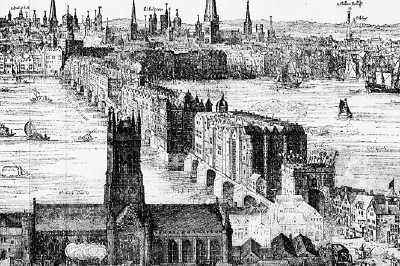
On the first page of the third chapter of Military Philosophers Nick refers to the nursery rhyme “London Bridge is Falling Down. ” Though most children are familiar with the first stanza, it is in fact twelve stanzas long and has a history shrouded by mystery and superstition. The bridge about which the poem revolves has been found to contain the bones of small children within its mortar to please the water spirits which the bridge disturbed during its construction. The history of the London Bridge is one of disaster and reconstruction which has influcenced the cyclical nature of the famous nursery rhyme. The original bridge was constructed out of wood by the Romans around 50 AD. Still in virtually the exact location as its initial location across the river Thames, the bridge has undergone many transformations over the last 2,000 years with a history of being destroyed and rebuilt. In 1091 a F4 Tornado tore through the bridge and was destroyed yet again in 1136 by a fire. In 1176 under the direction of King Henry II the bridge began its 33 year reconstruction. The bridge was finished in 1209 under King John who decided to build house and shops on the bridge, see artist’s etching bellow.


The northern gate of the bridge gained notoriety for its display of the heads of traitors. The greatest danger of this arrangement was of death by fire or drowning. These fears were realized in 1212 when fires broke out simultaneously on either side of the bridge, trapping nearly 3,000 people. Another fire in 1633 destroyed the northern third of the bridge but also prevented the bridge from being burned in The Great Fire of London in 1666. By 1722 the congestion on the bridge was so severe that the Lord Mayor proclaimed that all coaches going north must stay on the east side and all the coaches going south must stay on the west. This has been cited as one of the principle reasons that the British drive on the left side of the road. Finally , to finish off the 18th century, from 1758-62 the houses were removed from atop the bridge and two center arches bellow were replaced with one arch spanning the entire bridge. By the 19th century it had become clear that the bridge needed to be replaced. In 1799 a competition for new designs was held. John Rennie’s £2,000,000 design was built 100 feet upstream from the original bridge. His faulty design caused the bridge to sink an inch every eight years. The new London Bridge is pictured in its new location in 1890:

(Wikipedia)

By 1924 the east side of the bridge was three to four inches lower than the west. In April 1968, an American entrepreneur bought the bridge and transported it in pieces back to America. The bridge was reconstructed in Lake Havasu City, Arizona and rededicated it in 1971. During this time in London British contractors were working to build the modern day London Bridge which is in the same location as Rennie’s bridge. The bridge was completed in 1972 at a cost of £4 million. In 1984 the HMS Jupiter collided with the London Bridge causing significant damage to both the bridge and the ship. On Rememberance Day twenty years later, red lighting was added to the bridge to prevent collision by airplane or boat. The modern day bridge is pictured below.

(David Williams, 2005, Wikipedia)

The simple nursery rhyme, mimics the constant destruction and rebuilding of this famous bridge. From its original construction in 50 AD the bridge has transition from wood, to stone, to modern materials of steal and concrete. The poem first suggests to the reader to prevent the bridge from falling down, to build it with “wood and clay,” then “bricks and mortar,” next with “iron and steel,” and finally, “silver and gold.” Though the construction has not moved to the forth stage of silver and gold, the British have taken the advice of the rhyme to get a metaphorical watchman. Now that fires and drownings are problems of the past, modern treats of collision with ships and aircraft are prevented with red lighting lining the bridge. The small children playing the London Bridge hand game and signing the rhyme may not draw these parallels, but its historical correlation with the history of the bridge is obvious. After Nick flippantly refers to the London bridge he comments how “now death had undergone so man.” He must be aware of the symbolism of destruction and rebuilding that has permeated throughout The Military Philosophers and the whole of Nick’s life.

Sources:

http://www.rhymes.org.uk/london-bridge-is-falling-down.htm
http://nurseryrhymes.allinfoabout.com/London_Bridge.html
http://en.wikipedia.org/wiki/London_Bridge
http://www.associatedcontent.com/article/23982/history_of_london_bridge_from_the_fire.html?page=2&cat=16

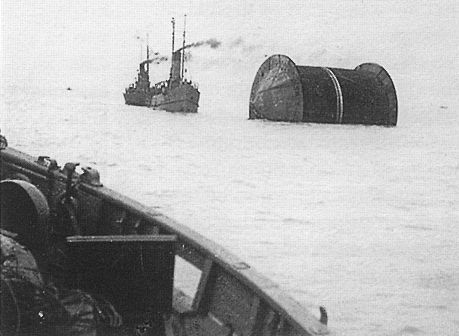
During Nick Jenkins’ and Finn’s duties of accompanying the military attachés to France, one of Finn’s concerns is that while at sea or on land, they will run into Pluto or the Pipe Line Under The Ocean. This pipeline did actually exist and it played an important role in the success of the Allied forces during the war, especially as they were preparing to storm the beaches of Normandy. Operation Pluto was conducted by British scientists, in cooperation with oil companies and armed forces during World War II. It would allow the flow of fuel between France and England via the English Channel, as the Allied forces needed an extraordinary amount of fuel to operate effectively throughout Europe. The idea was that Pluto would alleviate the dependence on oil tankers which were targeted by German submarines and were easily delayed by bad weather. These tankers were also needed in the Pacific as the Allied forces, mainly the United States, were fighting a war on two fronts.

Testing of the plans for the pipeline’s use began in June 1942 with the laying of pipe across the Firth of Clyde. The project was deemed ‘strategically important, tactically adventurous, and, from the industrial point of view, strenuous’. Pluto was originally brought into the plans for the initial Allied invasion of Europe, but there were no ships that were big enough or had the necessary equipment to lay down the piping. The first pipeline laid for use was on August 12, 1944 about a month and a half after the execution of Operation Overlord. Much of the construction of the pipelines connecting to Pluto was done at night to avoid detection by German aerial recon. The pump stations were also put in inconspicuous buildings such as cottages, garages, and even an ice-cream shop. This shows that the operation was indeed secretive so Finn’s maniacal concern that the military attachés would see the equipment is justified: “We had blundered on a kind of junction of Plutonic equipment. Finn must have instantaneously seen that too. He rushed towards the installation, as if unable to contain himself – perhaps no simulation – taking up his stand in such as place that it would have been doubtful manners to pass in front of him.” (TMP 158)

While none of the representatives from Allied countries seem to take notice of the equipment that Finn is so desperately trying to hide, it is understandable why he would want to shield it from their view. If it had been discovered the Axis of Evil could have attacked it and done serious damage to one of the most important technological innovations that led to the Allied victory. From the time Pluto became functional in August of 1944 to VE Day on May 7, 1945, over 172 million imperial gallons of fuel was pumped to Allied forces all over Europe, which was integral to the successful completion of the campaign and ending World War II.

Bibliography

Wikipedia, Operation Pluto. February 25, 2008, April 15, 2008.

Isle of Wight Council, Islander’s Stories, http://www.iwight.com/images/pic2.jpg 2008. April 15, 2008.

In the corporate world of America, Britain, and elsewhere the general consensus seems to be the higher up the more illustrious your job. During World War II, however, the order completely reversed. Due to the constant blitzes, V1s, and V2s living or working towards the top of a building meant great risk. In The Military Philosophers, by Anthony Powell, this is the case. With important and secret work below ground and meaningless tidbits near the top, the British army took these measures to protect themselves from serious blows. In this hierarchy, Nick seems to be right in the middle: above most, but also below many.

As Nick climbs the stairs to the higher levels, on which lives “the Civil branches and their subsidiaries, Finance, Internal Administration, Passive Air Defence, all diminishing in official prestige as the altitude steepened,” (38) he prepares for Blackhead. Blackhead, one of the most infamous characters in The Military Philosophers, deals with simple issues and is quite a nuisance to get through. Nick brings to his agenda the matter of “restrictions on straw for hospital palliasses” (38) in Scotland. This issue is completely irrelevant to the war being fought on continental Europe and is simply unnecessary to discuss. This, however, is not the only unrelated material that Blackhead deals with. Whether it is the Belgian Women’s Corps looking for a bicycle or the Norwegian military attaché seeking office furniture, it goes through Blackhead’s office (42). Being placed in “a rookery of lesser activities” (38) near the attic of Nick’s building, Blackhead’s work is relatively insignificant and far from any truly important business.

On the opposite side of the spectrum, in the basement, rather imperative and high security matters are discussed. As Nick replaces Pennistone, his senior officer, he sits in on a meeting to discuss the release of Polish officers from Russia. On his way there Nick describes his surroundings, saying that a marine, “showed [him] into a room in the bowels of earth…a brightly lit dungeon” (11-12). Sunny Farebrother makes similar comments: “Can’t tell whether it’s three o’clock in the morning, or three o’clock in the afternoon. No disturbance from time” (14). Nick and Farebrother are so far beneath ground that neither sun nor bomb penetrates into the basement, making it a safe place to conduct serious and important business. Once Widmerpool enters the room the men begin to discuss the matters at hand. Once the issue of the Poles has concluded, some men, including Nick, are required to leave with Widmerpool’s snide comments: “I have some highly secretive matters to deal with on the next agenda. I can’t begin on them with people like you hanging about the room” (16). Here Widmerpool illustrates the importance of the topics discussed in the basements of buildings.

With a second floor office, Nick is physically in between the two opposing ends. He is situated right in between Blackhead’s perch and Widmerpool’s dungeon. Working with the Poles and later the Belgians, Nick’s own agenda simply seems like it would be more important than Blackhead’s soap issues, but also less important than that of Widmerpool’s secretive affairs. By discussing the matter of straw with Blackhead and also conversing about the Poles with Widmerpool, Nick shows that he is the middle man. When dealing with the subject of bringing the Belgians to train in England Nick takes the information from Kucherman, the Belgian Military attaché, directly to Colonel Finn, Nick’s superior officer, and then to Blackhead. Again, Nick acts as the middle man in this issue.

Through her less than impressive portrayal in The Military Philosophers, one can only assume the worst of Pamela Flitton. As she gladly “[gave] men hell” with her seductive beauty ]and domineering persona, Pamela Flitton succeeds in her attempts to ruin the lives of countless men-old and young, powerful and pedestrian (74). However, one can only question her intentions and goals, as she continues to coax hopeless men into spiraling relationships. Her most obvious motives would be wealth, power, or quite possibly own insecurity-all of which seem logical. However, as Pamela Flitton seems to be ” just as happy deranging the modest home life of a middle-aged air-raid woman, as compromising the commission of a rich and handsome Guards,” none of the prior explanations accounts for Pamela’s motivation behind her overwhelmingly malicious actions (74). One possible explanation, however, lies in her troubled past, which consisted largely of her drunken father and instability within her family. Her father, Cosmo, a “heavy drinker and professional gambler,” who eventually abandoned his wife and daughter, must have given Pamela a false perception of men, especially as he was the only influential male figure in her life at the time (58). Due to the lack of a paternal figure, Pamela Flitton may have developed a twisted view of men, leading to a need for blind redemption and unjust revenge.

Pamela’s notorious relationships with countless men continue to unveil themselves throughout Nick’s narration in The Military Philosophers. Starting with the two RAF officers who “were court-martialed as a consequence of a fight about which was to drive her home after a party,” it becomes clear that Pamela simply must enter and exit relationships in a loud and tumultuous manner (73). Wooing men left and right, however, it is still quite unclear as to why Pamela feels the need to leave every man she encounters in distress.

While Pamela’s intimacies with men seem to be no more than heartless attempts to acquire power and wealth, Nick begins to realize that her intentions are not ones of ambition. As she was “scarcely interested in looks or money, rank or youth,” Pamela Flitton found it much more satisfying to cause “deep suffering” to all the men she encountered (74). Whether with Odo Stevens or Widmerpool, Pamela ceaselessly works to become the central figure in their lives, only to vanish, hurting her victims just as her father had done to her years ago. In the case of Odo Stevens, she reassures Stevens that `[she] meant more to [him] than anyone else” not because she cared that Stevens was babbling about the deceased Priscilla, but most likely because Pamela needed to be first in his heart in order to deepen his suffering once she left. Moreover, with Pamela’s hidden intentions in mind, her relationship with Widmerpool, which at first was unfathomable, begins to make more logical sense. Older and less experienced, Widmerpool would be an extremely naïve partner and, more importantly, one with “potentiality for deeper suffering”-the ideal relationship for Pamela (74).

Looking further into Pamela’s intentions for her inconsiderate actions, it becomes quite clear that her sole intention is not any of money, power, or fame. Instead, Pamela’s escapades seem to be related to her revenge for her father’s irresponsibility, which directly correlates to her vision of men. While her past does not and cannot serve as any form of justification of her actions, this explanation does, in fact, add another dimension to Pamela’s character, who originally seemed to be no more than a manipulative and promiscuous mistress.

There hasn’t been a prison invented yet that could hold me, although I was a little surprised at how quickly the Poles put me in the jug. They said I had, “gone a bit too far this time,” but I don’t see how it’s my fault that those prissy Poles can’t take a joke now and then. Maybe I should have stayed with the French; at least they kept booze around. Come to think of it, the French were pretty decent folks. Sometimes I wonder why I ever left them. Then I remember that whole mess with colonel, which I thought it was hilarious, but pretty well pissed him off. Either way, the damn Poles put me in a British detention barracks.
Prison isn’t so bad once you get used to it. Sure, they’re all different, and some are worse than others, but in general you get a meal or two a day, sometimes even three, and you hardly have to do anything at all. In military prisons they sometimes make you do these damn drills where you have to go out and march around for a bit, but even so it’s easier than being in the field and digging trenches all day. After a while, though, even a nice relaxing prison can get kind of boring, so I never stay in them very long.
The British place they stuck me in wasn’t so bad, but I could tell it was the kind of place that would have me twiddling my thumbs out of shear boredom in no time. So I decided I was going to leave. I wasn’t quite sure how at first, since the security was better than most places I’d been stuck in the past, but at least the British weren’t likely to just shoot you for the hell of it. I thought about trying a rather elaborate escape, which included a couple of disguises, but upon reflection I realized that even a four year old could have spotted the flaws in that plan. Keep it simple stupid, I had to remind myself. The more I thought about it, the more excited I got; it looked like I was in for a challenge. Then, something even better than I could have possibly imagined came up.
Two officers, Tweedledee and Tweedledum, walked right up to the front door of the barracks and asked for me. Tweedledee did all the talking while Tweedledum just sort of looked impatient. There was some arguing, but after a few minutes and much shuffling of papers, the two blokes were finally brought over to where I was. After looking at me for a moment, Tweedledee spoke.
“Szymanski, right?”
I told him that’s what some people call me. Tweedledee laughed and Tweedledum handed me a couple of papers. After trying to wade through all the military jargon, I ask Tweedledee what the hell was going on and he explained that the charges against me had been found to be false and were being dropped. The documents were clearly fraudulent, but some lieutenant colonel named Sonny Farebrother had signed the damn things anyways. I wasn’t going to complain.
“Come on, you’re out of here.”
It was the first, and so far the last, time I’ve ever left a prison the same way I came in, through the front door escorted by a couple of officers. Once we were in the car, Tweedledee started talking again.
“Name’s Odo Stevens. We’ve got a job for you and it looks like we might end up working in the same area for a bit.”
Then he rambled on for a while about something or another. The gist of it all was that the British wanted me to knock off someone or another rather important. Seems they figured I had the skills to handle the job and also the kind of reputation that would let them cut ties with me if necessary. They even offered me a commission. Things kept getting better and better.
The whole affair didn’t turn out quite the way it was supposed to, but I walked away in the end which is what matters. A couple of days after Odo picked me up at the prison I was shipped off on an airplane. Now, no one told me where I was going, they said it wasn’t important, so I took my time getting to the airport and stopped by the prison wearing my second lieutenant’s uniform. Then, when I finally got the airport, I asked again about where I was going. The captain in charge there said I was going home for all he knew, and then he told me to shut up and get on the airplane. The last thing they told me was to make contact with some guy named Peter Templer once I got to my destination.
Well, it took a while, but I eventually found Templer. I have no idea how he got himself involved in anything secret since he was definitely a bit old to be out in the field. I honestly didn’t like him much. He was kind of stuck up, and kept trying to get with every girl he saw. One time when we were at a bar together he told me that he used to be quite the ladies man, which was hard to believe after watching how he consistently made a fool of himself. Maybe he was just getting old. Another night, after having a bit too much to drink, Templer started talking about Pam. I didn’t like how he talked about her; he had nothing good to say. She was a real devil both in and out of bed, but nobody should talk about a woman the way Peter Templer talked about Pam. I think that’s one of the things I disliked most about him. He also seemed to enjoy gambling and was pretty good. He managed to take a lot of my money. Fortunately I found other ways to supplement my pay.
It was too bad that I had to report to Templer. It’s never a good thing to dislike your boss, especially when the other side is willing to pay quite nice sum of money for your services. I never really betrayed our mission, but selling little bits of information here and there gave me a comfortable amount of income. One night, Odo Stevens, who showed up as part of our mission for no good reason that I could see, almost found me out in a bar. But I managed to get him so roaring drunk that I don’t think he remembered anything from that night. Stevens just can’t hold his alcohol. Anyways, since our primary mission was to knock off the head of the local Gestapo, I thought it made sense to get a little friendly with them; gain some of their trust and all.
At any rate, we eventually got the whole operation set up and ready to go. Odo and I were the ones actually set to do the dirty work, but the way Templer talked about it you’d never know. We were just waiting a few more days for everything to fall into place when we got an order to abort the mission. Someone at the top had changed their mind. After the work we’d put in, it pissed us all off. Stevens got so thoroughly drunk that night that he couldn’t keep his damn mouth shut. He started complaining about our mission and said more than he should have. From what we’d been told, there were already plans to extract us, but after Stevens very public drunken rant it became obvious that those plans would have to be executed quickly if we were actually going to escape. Stevens somehow managed to get everything together and got out the next day. I was told to stay low and my extraction would come a few days later. Peter, on the other hand, wasn’t told anything about how he was getting out.
It seemed like quite an oversight to me. But I heard rumors from Cairo that some high ranking officer, Widmer something or another, had it out for Templer. Since there seemed to be no immediate plan to extract him, I could believe someone wanted Templer dead. So, I thought I’d do them a favor and maybe win some brownie points. Besides, I wanted to get some of my own back at Templer, and I even managed to weasel a bit of money out of my Gestapo contacts for betraying Peter. So the night before my extraction I found Templer in a bar and put him out of his misery. The next day everything went smoothly and I got out to Cairo. The best part is, I didn’t even have to go back to jail for any of that.

Throughout The Dance, we are constantly bombarded with old friends whom we (and Nick) haven’t seen in ages. While reunions are usually fun: — catching up on new events, remembering the good old days, etc. — Nick’s encounter with Peter Templer in the beginning of The Military Philosophers is not one of excited remembrance or mutual happiness in seeing an old friend. In fact, Templer seems to not even care that his good friend, Nick, from years ago, shows up unexpectedly at the same meeting. While twice Nick, expects that Templer himself. Instead, he is “indifferent” to the fact that Nick is even there. How can an old friend whom we (and Nick) think we know so well, turn around and become so different? Nick remembers a change in Templer even from the last time they met, at Stourwater. He says, “I had been struck by a hardness, even brutality of expression that had changed someone I had once known so well,” (15). What was once a fun-loving, laid-back man changes into something much colder and unnatural. Foreshadowed occurrences, usually involving women who were once passionate about him, end up changing Templer far more than he could ever have imagined.

When first encountering Templer, Nick takes his hostility and ignorance to a personal level. Nick, unusually put off by Templer’s reaction to seeing him, even says that he “began to regret suggesting” that they have a chat after the meeting (19). He describes in detail all the things about Templer that has changed, trying to justify why Templer could possibly be mad at him for. Nick said that Templer has lost weight and resembles more of his younger self, yet Nick says that, “His manner was so unforthcoming, so far from recognizing we were old friends who had not met for a long time,” (TMP, 19). They have been friends since Eaton, and so it doesn’t make sense to Nick that Templer would be so ignorant and unhappy at their meeting. The nosy questions that Nick proceeds to ask are so that he can justify that Templer’s coldness, and confirm that it is not himself that is at fault.

For the most part, Templer changes because of drastic events in his life. One of these is the confinement in an asylum of his ex-wife, Betty, whom we met at Sir Magnus Donners. While there was some indication that something was wrong with not only their marriage by Betty herself, such an extreme level of disorder is completely unexpected. While at Sir Magnus Donners, Betty became very upset when her husband willfully engages in actions typical of his then-personality while depicting the sin Lust with two other women. While this may have been an early indication of something not all-together perfect, her condition quickly withers. The movie depicts her as not only incapacitated, but almost brain dead. This has a profound affect on Templer, especially since she is his wife. Despite the fact that he seems to pay little attention or show care to her, he still once cared enough to marry her, and her mental problems did affect him.

Betty’s condition may have been drastic enough to drive him into the arms of another woman, Pamela Flitton. After Pamela is finished with the men that she sleeps with, she merely walks away, leaving them heartbroken or worse (case in point, Widermpool). This happened to Templer, and explains Templer’s lack of interest in women as well as his drastic personality change. Pamela is a woman who craves the power to control men. She works her magic on her conquests who have increasingly more power than the next. When she decides that Widmerpool is a far greater challenge than Templer, she leaves him. When Nick encounters Templer, he has a crave for power than is completely unlike him. Nick even says, “The thought of Widmerpool’s potential powers evidently excited him,” (20). Pamela changed him, and now he is doing anything he can to become more the man that he thinks that she wants. However, Templer brings up what he thinks is a lighter note and says that he is no longer dating. It is possible that this is because the last two women he has dated have left him heartbroken and damaged.

Clearly Pamela and Betty are the direct causes for Templer’s personality change. Even if these women hadn’t treated him the way they did (either intentionally or unintentionally), he would have changed quite a bit from what Nick was used to. Templer’s exposure to the war as well as the added responsibilities of being a ranked soldier are very stressful. This adds to his personality, and more than likely would have changed his priorities anyways. Pamela and Betty create radical situations that a normal person would not have to deal with, and they, more than responsibilities or war, changed Templer from the guy Nick knew so well to a power-seeking and dispassionate individual.

The previous two books of the “World War II Trilogy” of Anthony Powell’s A Dance to the Music of Time series, The Valley of Bones and The Soldier’s Art, have marked death and sadness for Nick Jenkins. We have seen Nick struggle to find friends in the Army and spend a considerable amount of time away from his wife. Meanwhile, we witness his friends and acquaintances drop like flies due to German bombs. If The Military Philosophers is any different, it is worse. Nick sees the dreaded Widmerpool gain more and more power and his two oldest friends die. This makes The Military Philosophers the most depressing of all the volumes in the series for the reader.

As I have stated in my previous two essays, The “World War II Trilogy” is a far cry from the earlier novels. A tragedy in Nick’s early life might involve a woman unknowingly playing with man’s heart. A tragedy in this latest trilogy involves the death of a character, and it’s usually someone we like. And, as we see our friends die, we also see the most hated characters climb the power ladder. As we first see in The Valley of Bones, Widmerpool has been gaining higher and higher rank in the British Army. By the end of The Military Philosophers, he is Colonel Widmerpool, and he finally admits what we’ve always known when he says to Nick, “I have come to the conclusion that I enjoy power.” (205) He continues his bad attitude towards Nick when he abruptly dismisses him from a meeting because he was not important enough: “‘Do go away Nicholas. I have some highly secret matters to deal with on the next agenda. I can’t begin on them with people like you hanging about the room.'” (19) Widmerpool seems to be unconscious of his attitude towards Nick when they see each other at a mutual party and Widmerpool proceeds to tell Nick all about his engagement to Pamela Flitton, the Devil Incarnate. During this scene in the film, Widmerpool refers to Nick as “one of [his] oldest and closest friends.” We see Nick’s frustration with Widmerpool continue to grow as he, as Pennistone puts it, “[passes] into a world beyond good and evil.” (197)

The Military Philosophers contains the biggest tragedy so far in the series; maybe not for Nick, but certainly for the reader. Stringham and Templer, Nick’s two oldest friends, die while in the line of duty. Stringham’s death is not much of a surprise; Stringham had been beaten down throughout the series, and it seemed inevitable that if he were sent somewhere, he would not come back. Templer’s death, however, comes completely out of nowhere. Nick had no idea Templer was working undercover, and his death comes as a shock to him and to us.

Stringham’s and Templer’s deaths now make Widmerpool Nick’s oldest acquaintance. For us, this is a travesty. It’s safe to say that however Nick feels about a character, we feel that way doubly. Although Nick parted ways with Stringham and Templer, it always brought smiles to our faces when they would reappear. They represented the start of our journey into A Dance to the Music of Time. However, with their death comes the harrowing realization that the dreaded Widmerpool is now our only link to the beginning. It seems fitting that he should be responsible for Stringham’s and Templer’s deaths.

Powell does give Widmerpool his comeuppance, however, when Widmerpool becomes engaged to Pamela Flitton. She is ostensibly the only character who stands up to Widmerpool. When they fight, they fight as equals. They only way Pamela seems alive is when she is angry: “She was in a sudden rage. Her usually dead white face now had some colour in it.” (210) Widmerpool, for some reason, is oblivious to her tendencies: “Widmerpool, not surprisingly, was apparently stupefied by this onslaught; myself scarcely so.” (211) However, never forget that Widmerpool is basically Pamela Flitton in male form: “His own rage made him able to stand up to her.” (212)

Anthony Powell’s The Military Philosophers is the saddest installment so far in the series, at least for the readers. The deaths of Stringham and Templer make Widmerpool, who has been becoming worse and worse as he quenches his thirst for power, our only link to the beginning of the novel. However, we may see Widmerpool return to his previous state as someone you can deal with once the war ends. At that point, there will no longer be a rank associated with his name and he will be married to Pamela Flitton, who will most definitely keep him in check. Nevertheless, we do see signs of Widmerpool returning to his old form when he says to Nick, “I fear the war has taken a sad toll of our friends.” (206) Spoken by anyone else, it would be the most heart-wrenching line of the novel. However, spoken by Widmerpool, it is taken as false grief. However, this still a chance that Widmerpool meant what he said, and we may look to a more agreeable Widmerpool in the future. Don’t count on it, though.

Jumping into A Dance to the Music of Time in book nine has been an adventure to say the least. After my struggle to look beyond the military lingo of the book and uncover the plot, I discovered the complexity and extent of this story. Familiarizing myself with the numerous characters and their relationships was a feat not easily accomplished. I often asked myself, “whose sister-in-law is whose mom is whose wife who divorced who really loved who?” With so much of my attention focused on these characters, I forgot about the man who created them. I have spent the last few weeks trying to get to know Nick and the constant flow of people that pass in and out of his life; now I would like to look into Powell’s life and hopefully gain a refreshing new perspective.

Powell was born in 1905 in England. His father was an officer in the Welch Regiment so Powell spent his early life moving with his father’s orders. Powell was sent to The New Beacon, a boarding school in Kent, around the age of 12. In 1919 Powell gained acceptance to Eton and enrolled in the fall. Though he claims that he easily formed relationships with people whom he liked, the reports from his housemaster noted that he grew reserved and moody over the years. Powell found pleasure in the visial arts and became a founder-member of the Eton Society of the Arts. He continued on to Balliol College, Oxford to read history at the age of seventeen.

At the age of 21, in December of 1925, Powell lost his virginity to Lulu, a girl he met on a trip to Paris of whom little details are known.

After finishing school, he was living in London and working as an apprentice at the publishers Duckworth and Company. Powell joined a Territorial Amry regiment in South London suburb. He published his first novel, Afternoon Men,in 1931by Duckworth’s and supervised its producti himself. His second novel, Venusberg, followed shortly after in 1932. The novels kept coming and Powell pubished Froma View to a Death, in 1934.

Powell met Lady Violet Pakenham in 1934 through her sisters and proposed to her that same year.

He eventually left Duckworth publishing and began writing for Warner Brothers Studio. The job required long hours, but paid well. With this hard earned money, Powell and his wife moved to Hollywood hoping to gain work, however he received no offers and returned to London in 1937.

With the threat of the war growing, Powell was accepted on the Army Officers Emergency reserve. The day war was declared, Lady Violet Powell received confirmation that she was pregnant again, after suffering two miscarriages. Powell was ordered to report for regimental duty in the rank of Second Lieutenant. Powell said that this “led no only into a new life, but entirely out of an old one, to which there was no return. Nothing was ever the same again.”

Powell took, time away from writing novels during the war. He was dedicated to the Army and focused his energy in excelling in his posts. Powell spent the years of the war travelling from division to division and finally in September of 1945 he began the three months’ demobilization leave that brought his military career to an end. Though he was not writing, this time certainly affected his later books.

I assume all my classmates already understood the extreme personal experience embedded in the plot of The Dance to the Music of Time, but prior to this research I was unaware of the similarities. Powell’s education, military experience, and relationships with women are reflected in The Dance to the Music of Time.

Source: http://en.wikipedia.org/wiki/Anthony_Powell

In Anthony Powell’s The Military Philosophers, Nick Jenkins works closely with the Polish government-in-exile, as well as the military men that are also a part of this government. After Poland was attacked and conquered by both the Soviet Union and Nazi Germany, many Poles fled the country, and wound up in Britain. Polish units on the ground, on the sea, in the air, and even in intelligence, helped the Allies towards an eventual victory against the Nazis.

The Polish Army, while the government was in exile, was incredibly active on both the Western and Eastern fronts. On the Western Front, Polish units were reorganized in France soon after Poland was overrun. This new Polish force numbered somewhere around 80,000, but when France surrendered, about 20,000 Poles, as well as their top commander and later prime minister of the Polish government-in-exile General Sikorski, escaped to Britain; where they formed another fighting force, this time under British control . A little after this happens, Nick starts to work as a liaison between them and the British. This group became known as the Polish I Corps, and was later joined by the Polish II Corps when the Soviet Union released many of the Polish citizens that they captured when they invaded. The Polish II Corps was used extensively in the European Theater and was essential to victories at Monte Cassino as well as the battles of Ancona and Bologna . These additional troops were extremely useful throughout the entire European Campaign, and were able to turn the tide of battle at a crucial time, helping the Allies towards victory.

The Polish Navy was a small but effective fighting force that was used in a variety of ways. Although the Polish naval forces were never very large, they made for effective convoy escorts, and sunk 12 ships during the course of the war . These convoy duties were one of the most important and hazardous naval missions of the war. Valuable war material had to be transported across the Atlantic Ocean from the United States to Britain, in large, slow, vulnerable merchant ships. They needed protection, and thus convoys were created to help escort ships across the ocean, which often concealed German submarines, which were otherwise capable of sinking them at any time.

The Polish Air Force was a force to be reckoned with during World War Two. The Polish Air Force, while based in Britain, controled the fighter squadron that had the most air-to-air victories during the Battle of Britain. This squadron, the 303 Fighter Squadron was responsible for 126 air-to-air kills. There are two reasons why it was Polish pilots that scored the most air-to-air victories. Firstly, many of the Polish pilots were veterans of two previous German invasions: the Polish and French invasions. The other reason is that the pre-war Polish Air Force emphasized training, which meant that the pilots were often better trained than their adversaries, which provided a decisive advantage .

Despite the fact that Poland had been mostly subjugated by both Germany and the Soviet Union, many Poles joined in the resistance movement, which was controlled by the government-in-exile. These resistance fighters did many things and helped the Allies in various ways. One of the most important things that the resistance provided to the Allies was intelligence. In fact, the Armia Krajowa (AK), the largest of the resistance groups in Poland and the official military arm of the Polish government-in-exile, was able to supply the British with pieces of a V-2 rocket that crashed, as well as plans for the pieces that were too big to transport back to London . In addition, the Polish Resistance was instrumental in the failed Warsaw Rebellion, when the AK tried to take over Warsaw long enough for the government-in-exile to come back and make peace .

The Polish government-in-exile, as well as the Polish military units, were a very important Ally during World War Two. In fact, up to the entry of the Soviet Union in 1941, the Poles were the third largest Ally in terms of manpower . Polish units served with distinction during World War Two, often helping to exploit vulnerabilities in battle, as well as providing valuable escorts for convoys, experienced pilots, and valuable intelligence. Thus, Nick Jenkin’s post of Polish liaison was, in fact, a fairly important one because he was dealing with one of the largest and most important of the Allies.

Sources Cited:

“Armia Karjowa”. Wikipedia. . April 14, 2008. April 15, 2008.

“II Corps (Polish)”. Wikipedia. . March 25, 2008. April 15, 2008.

“Polish Contribution to World War II” Wikipedia. . April 13, 2008. April 14, 2008.

In a work of such magnitude as A Dance to the Music of Time, death is a tragedy that inevitably must be faced. In the span of the twenty-odd years of Nick Jenkins’ life we have seen, it is almost certain that we should see how death enters his life, and how he reacts to it. The first death that we saw Nick deal with was that of his friend, Mr. Deacon, in A Buyer’s Market. When he dies, Nick seems relatively unaffected by his death, and he exits the dance as he entered: as an anecdote in Nick’s life. It is inevitable, however, that as the Dance advances onward, people closer to Nick will have to leave. As we wrap up the third quarter of Powell’s epic, particularly as the death toll of the Second World War begins to increase, more people whom Nick has met throughout his life, such as General Conyers, Molly Sleaford and Chips Lovell begin to pass away. Some of these deaths are relatively insignificant among the many of World War Two. However, two recent deaths of Nick’s childhood friends, Charles Stringham in A Soldier’s Art, and now Peter Templer in The Military Philosophers, have had a greater impact on Nick, and on us as the readers of Powell’s epic.

Stringham and Templer were the first friends that Nick introduced us to. When Nick was at Eton as a boy, Stringham and Templer lived in the same house as he and the three shared many experiences together such as the “Braddock alias Thorne” incident. Their friendship was not to last, however. After they left Eton, the three grew apart from one another, and in each book after the first, Nick only meets the two of them intermittently.

When Nick does see Stringham or Templer, their lives seem to be heading downhill. While Stringham has a failed marriage with Peggy Stepney and turns to a life of drink, Templer seems to be fairly stable in his relationship with his wife Mona until it is shattered when she runs off with J.G. Quiggin. Stringham is eventually cared for by his mother’s old secretary Tuffy Whedon, as Templer enters another unsuccessful marriage with his second wife Betty, who “went off her rocker.” (MP, 21) The last we see of Stringham is when he is working as a mess waiter in Nick’s division. The last we see of Templer is when he is about to be sent off on a secret mission, snubbed by Pamela Flitton.

The events surrounding the deaths of Stringham and Templer share some surprising similarities. Both of their deaths occurred rather inconspicuously. While Templer is left high and dry in Egypt, Stringham dies unknown in a prison camp after he is captured in the Japanese occupation of Singapore. Perhaps the most significant similarity between the two deaths is Widmerpool’s involvement. Just as we learn that it is Widmerpool who cut the English support from Templer in Egypt, we also learned in A Soldier’s Art that Stringham was put in the Mobile Laundry by Widmerpool, who knew beforehand that it was going to the Far East.

Curiously, the character of Pamela Flitton seems to appear on the occasion of both deaths. Mrs. Erdleigh says that Pamela “loves disaster and death.” (MP, 131) Certainly, there are two occasions in The Military Philosophers where she brings the news of death to Nick. In the first instance, she tells Nick that Stringham “was at Singapore.” (MP, 59) Later on, while Nick is at the Embassy party with Widmerpool, he finds out about Templer’s death, and about Widmerpool’s involvement, from Pamela. “[Widmerpool] persuaded them to leave Peter to die. The nicest man I ever knew. He just had him killed.” (MP, 211)

With Stringham and Templer gone, the only one left of Nick’s Eton acquaintances is Widmerpool. Yet from the fates of Stringham and Templer, perhaps we can infer something about Widmerpool’s future. Though he has seen a steady rise in power until now, it is doubtful that this will last. Both Stringham and Templer became slowly less content with themselves after their first failed marriages. Similarly, their lives began to worsen as well. Though Widmerpool was engaged in At Lady Molly’s, the marriage was called off, and Widmerpool has remained a bachelor up to this point. Now, however, Widmerpool is married, and to Pamela Flitton no less. Though she may not be the harbinger of Widmerpool’s death as she was for Stringham’s and Templer’s, it is certain that if Widmerpool’s life sees a downward turn, and it seems as though it might, she will be the one to tell Nick (certainly Widmerpool would be too prideful to tell Nick himself). Finally, just as Widmerpool was a catalyst in Stringham’s and Templer’s death, he will most certainly be a catalyst in his own downfall.

On March 5th, 1940 the Soviet Union authorized the mass killing of nearly 22,000 Polish citizens and soldiers. Those who died included an admiral, 14 generals, 24 colonels, 79 lieutenant colonels, 258 majors, 654 captains, 17 naval captains, 3,420 NCOs, seven chaplains, a prince, 43 officials, 85 privates, 131 refugees, 20 university professors, 300 physicians; several hundred lawyers, engineers, and teachers, more than 100 writers and journalists and around 200 pilots. The killings, both brutal and efficient, once discovered by the Germans in 1943 led to what could have been the loss of the second greatest allied force during World War II. Although the Soviet Union denied such allegations, and instead tried to place the blame on Germany, both England and the United States knew the truth. There was no easy solution to this problem. The Poles wanted justice; the Soviet Union wanted to be through with the matter and the rest of the Allies wanted to keep the peace. The question of what to do brought about the notion of consequentialism, and phrases such as “the end justifies the means” and “for the greater good.” The oversimplified question was this: should the massacre of 20,000 Poles be overlooked in order to stop the potential loss of millions. Stopping potential loss of course meant keeping Soviet support, for they were much more valuable than the Poles in that point of the war, both because of greater numbers and ability to flank the enemy.

Widmerpool, ever the unfeeling, uncaring realist, backs England and the United State’s decision to deal with the Soviet/Polish problem later. He follows the consequentialist reasoning that there are greater matters at hand and that such a relatively small issue should not cause a stir. “In any case, whatever materializes, even if it does transpire – which I sincerely trust it will not – that the Russians behaved in such a very regrettable manner, how can this country possibly raise official objection, in the interests of a few thousand Polish exiles, who, however worthy their cause, cannot properly handle their diplomatic relations, even with fellow Slavs. It must be confessed also that the Poles themselves are in a position to offer only a very modest contribution, when it comes to the question of manpower.” Although Widmerpool has been known to have some rather complicated points of view, most notably at the old boy’s dinner with his economic rant, there are few hidden messages in this dictation of his; a few thousand Poles are not as important as the millions Germany could kill if not stopped.

Personally I fall a few steps short of Widmerpool’s strong beliefs. It almost seems that he is trying to convince himself and those around him that Katyn is not an important issue and that the Soviets are most likely not even responsible. I believe in the prioritization of the importance of the various allies, but for different reasons. Katyn most definitely was a major military issue and both English and American intelligence had good reason to believe it was indeed Soviet doing. In the end, another great consequentialist quote, it would seem that the right choice was made in overlooking the not so pretty incident. It is a difficult argument to make that the Allies’ choice was either unethical or ethical. How does one define ethics during wartime? In my opinion the best option during the time would have been to carry out the war with Soviet support, as was done, and only if/after the war was won to raise the issue of Katyn. Pennistone has an excellent quote for this situation, for many seem to believe the government should act only with the purest of intention and the best morals. “A great illusion is that government is carried on by an infallible, incorruptible machine. Officials – all officials, of all governments – are just as capable of behaving in an irregular manner as anyone else. In fact they have the additional advantage of being able to sooth their conscience, if they happen to own one, by assuring themselves it’s all for the country’s good.”

Sources:

http://en.wikipedia.org/wiki/Katyn

Contact  secretary@anthonypowell.org | +44 (0)7544 681 093

Registered Office: 12 Hawthorn Way, Storrington, Pulborough, RH20 4NL, UK

Privacy & Cookie Policy   |   © Copyright: The Anthony Powell Society 2025. All rights reserved.
The Anthony Powell Society is UK registered charity 1096873 and regulated by the Charity Commission
Website by Beachshore