Anthony Powell’s The Acceptance World is not about the “acceptance world” as Templer describes it. Instead, it narrates Nick’s acceptance into a significant world, the world of love, as well as many other worlds, such as the world of art. Accurate prediction comprises a major theme of the novel; Nick’s acceptance into the world of love – acceptance by his first love, Jean – is predicted in two ways: through Mrs. Erdleigh’s intentional divination when she reads his tarot, and through Templer’s metynomic and unintentional description when he describes the “acceptance world” for Nick:
If you have goods you want to sell to a firm in Bolivia, you probably do not touch your money in an ordinary way until the stuff arrives there. Certain houses, therefore, are prepared to `accept’ the debt. They will advance you the money on the strength of your reputation. It is alright when the going is good, but sooner or later you are tempted to plunge. Then there is an alteration in the value of the Bolivian exchange, or a revolution, or perhaps the firm just goes bust – and you find yourself stung. That is, if you guess wrong. (45)
Though he intends to describe only the economic world, Templer’s portrayal relates two types of acceptance worlds: literally the financial world; and symbolically the world of love, represented by Nick’s relationship with Jean. This description links these two worlds and contributes to the theme of accurate prediction, because his precise description of the first world also acts as a symbolic description of the second. The theme of accurate prediction is conveyed in two ways throughout the novel: through the fulfillment of an intentional divination-Mrs. Erdleigh’s, and through the fulfillment of a metonymic description-Templer’s.
Mrs. Erdleigh reads the cards for Nick during their first encounter:
I expect he wants to hear about love… This is a much more important lady-medium hair, I should say-and I think you have run across her once or twice before, though not recently. But there seems to be another man interested, too. He might even be a husband. You don’t like him much. He is tallish, I should guess. Fair, possibly red hair. In business. Often goes abroad. (15)
This divination from the cards exemplifies the theme of accurate description in the novel. The “important lady” of whom she speaks is Jean, whose redheaded husband, Bob Duport, Nick despises, as he relates in chapter three of A Question of Upbringing. Nick’s relationship with Jean demonstrates the truth of her reading, which comprises the intentional divination aspect of the major theme.
Templer’s definition of the “acceptance world” acts doubly by both describing the world that Duport and Widmerpool are entering and by outlining the progression of Nick’s relationship with Jean. Nick “has goods that he wants to sell to a firm in Bolivia”, which she symbolizes, but does not touch his currency “in the ordinary way until the stuff arrives there” (45). He gives his love, the goods, to her but does not collect the profit of this until it arrives there, until she first recognizes his feelings in the cab, when: “I took Jean in my arms” (65). Templer’s description continues to outline their relationship: “then there is an alteration in the value of the Bolivian exchange, or a revolution, or perhaps the firm just goes bust-and you find yourself stung” (45). The alteration that occurs in their relationship is the imminent return of Bob Duport, which represents a possible revolution in the love affair. Though never directly stated, Nick and Jean’s relationship appears over at the end of the novel. She says, “Did Peter mention Bob is coming back…. And his prospects are not too bad…. That may make difficulties” (214). He then tells the reader, “things still had their enchantment” (214). The word “still” implies that the relationship is afloat but will end after the conclusion of the novel. Templer’s description of the “acceptance world” foretells the progression of their relationship and comprises the aspect of metonymic description in the major theme of accurate prediction.
On page 170, Nick discusses the aptness of Templer’s phrase:
Even as a technical definition, it seemed to suggest what we are all doing; not only in business, but in love [and] art… Sometimes the goods are delivered, even a small profit made; sometimes the goods are not delivered, and disaster follows; sometimes the goods are delivered, but the value of the currency is changed. Besides, in another sense, the whole world is the Acceptance World as one approaches thirty; at least some illusions are discarded.
This quote highlights the connection between Templer’s description and Nick’s coincident acceptance into the two worlds described; it describes and predicts Nick’s acceptance into the worlds of love and art. In Nick and Jean’s relationship “the goods are delivered, even a small profit made” for a while, but, with the advent of Duport’s return, “the goods are delivered, but the value of the currency is changed”(170). Nick’s acceptance into the world of art is his business relationship with the novelist St. John Clarke, which developed because of his employment in a firm involved with “the publication of art books” (8). In this relationship, “the goods [the contracted Art of Horace Isbister] are not delivered, and disaster follows” (170). This quote, like Templer’s definition, describes and predicts Nick’s acceptance into separate worlds and contributes to the novel’s major theme of accurate description.
Nick’s relationship with Jean fulfils Mrs. Erdleigh’s tarot predictions uttered during their first meeting, and it follows the course laid out by Templer when he describes the “acceptance world.” The fulfillment of these predictions, the development and progression of their relationship, comprises the major theme of accurate description in the novel.


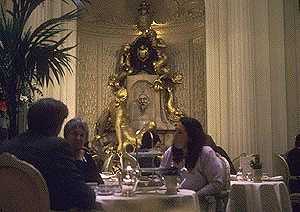 This is the Palm Court in the Ritz, London. Here Nick keeps his appointment with Mark Members. Beneath the gilt statue of the nymph are sitting a large party of South Americans. J.G. Quiggins turns up instead of Members, and then Jean Templer Duport turns up with her brother Peter and his wife Mona. Volumes later one of the South Americans will turn out possibly to have been Colonel Flores, who will become Jean’s second husband. Powell wrote in a letter to James Tucker, “The answer about whether Flores was one of the party in the Ritz… is that one simply does not know. They may have been just relations. Jenkins was going to ask him, if he had an opportunity, but that never arose. A definite linking did of course cross my mind, but I decided against being specific, as so much of life seems to be like that” (quoted in The Anthony Powell Society Newsletter, Autumn, 2001).
 The Acceptance World begins in London in 1931. Jenkins meets Uncle Giles for tea at the Ufford, where he is introduced to Mrs. Erdleigh. She “lays out the cards” for him, predicting a relationship with a woman in his future. Jenkins later discusses with Barnby his trouble getting the author St. John Clarke to write an introduction for his firm’s book on the painter Isbister.