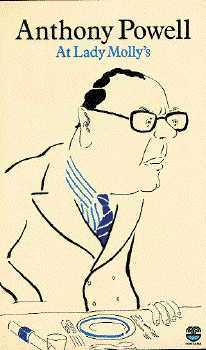
Samuel Pepys (1633-1703) was a famous diarist of the Restoration period in England. In At Lady Molly’s Powell creates a faux passage from Pepys’s Diary, describing a supposed visit to Dogdene, the fictional stately home of the Sleaford family (11). Then, much later in the book, a chance remark of Dogdene reminds Jenkins how much Widmerpool’s appearance is like Pepys’s:

I thought of Pepys, and the ‘great black maid’; and immediately Widmerpool’s resemblance to the existing portraits of the diarist became apparent. He had the same obdurate, put-upon, bad-tempered expression. Only a full-bottomed wig was required to complete the picture.” At Lady Molly’s, 195.

At Lady Molly’s begins in London around the New Year of 1934. Jenkins, now working as a script-writer, is invited to a party at Lady Molly Jeavons’s by his colleague, Chips Lovell. He recalls a childhood meeting with Mrs. Conyers, an old family friend and wife of General Conyers, and her sister, Mildred. At Lady Molly’s he encounters Mrs. Conyers and discovers that the party is being held for her sister Mildred, now Haycock, now in her 40’s, and her new fiance, Widmerpool.

Lunching at his club with Jenkins, Widmerpool asks advice about a premarital weekend with Mildred Haycock. Then Jenkins goes to tea with General and Mrs. Conyers, joined by Frederica Tolland Budd, all of whom ask about Widmerpool. Frederica gives him a lift, and they stop in to see Norah Tolland and Eleanor Walpole-Wilson. Finally, Jenkins goes to a movie with an unnamed date; on the way in, they encounter Quiggin.

Jenkins goes to visit Quiggin and Mona at their home, which turns out to be a guest cottage at Thrubworth, the Tollands’ estate. They all go to visit Erridge for dinner. There Erridge and Quiggin discuss the financing of a planned magazine. Isobel and Susan arrive, and we learn of Susan’s engagement to Roddy Cutts. Jenkins believes he will marry Isobel. The butler Smith’s alcoholism is discovered, and we begin to see Mona’s flirting with Erridge.

Lovell describes Jeavons to Jenkins before they go to Molly’s. There, Molly tells Nick that Widmerpool has jaundice, and Nick sees Mrs. Weedon, who is looking after Stringham. He leaves Molly’s with Jeavons, who takes him to a club run by Dicky Umfraville. Templer arrives with Widmerpool, Mildred Haycock, and Templer’s date, a woman named Betty. Max Pilgrim and Heather Hopkins perform. Jeavons reveals to Nick that during the war he spent a weekend with Mildred. Widmerpool goes home ill, but Mildred and Jeavons recognize each other and remain. At the end of the chapter, Nick states that he “too, should be married soon enough.”

Jenkins visits with Lady Katherine Warminster and discusses Erridge and Mona’s trip to China. Later, Lady Molly holds a party in honor of Jenkins’ engagement to Isobel. At the party, Jenkins talks to Members, as well as General Conyers. The General pulls Jenkins aside and eagerly tells him about Widmerpool’s inability to perform sexually with Mildred. Widmerpool arrives at the end, seemingly unaffected by the cancellation of his wedding.

These are the major characters in this volume. Although they are mostly organized by chapter, members the Tolland family (who appear passim throughout the volume) are listed first, approximately in order of their birth:

Alfred T., Lord Erridge, Earl of Warminster (called “Erry”) – eldest brother, in his thirties, an eccentric, left-leaning peer
Frederica T. Budd – distinguished, a Lady-in-Waiting
Norah T. – a lesbian, living with Eleanor Walpole-Wilson
George T. – was at school with Jenkins
Blanche T. – “dotty,” does good works
Susan T. – about 25 or 26, becomes engaged to Roddy Cutts
Robert T. – in business, “a bit of a mystery”
Isobel T. – “highbrow,” goes to nightclubs, becomes engaged to Jenkins

Hugo T. – at university, somehow unsatisfactory
Pricilla T. – not “out” yet, Chips Lovell’s interest

Chapter 1

Chips Lovell – scriptwriter, colleague and friend of Jenkins
General Aylmer Conyers – Jenkins’s family friend, eccentric, great military hero
Bertha (Blaides) Conyers – his wife
Mildred Blaides (later Haycock) – Bertha’s sister, a nurse, “rackety,” later engaged to Widmerpool
Lady Molly (Ardglass) Sleaford Jeavons – aunt of the Tolland children, giver of informal parties

Ted Jeavons – Molly’s present husband, mild-mannered, not aristocratic
Uncle Alfred Tolland – uncle of the Tolland children
Smith – Erridge’s dreadful butler, sometimes helps Lady Molly
Widmerpool – engaged to Mildred Haycock

Chapter 2

Eleanor Walpole-Wilson – old friend of Jenkins’, living with Norah Tolland
Heather Hopkins – neighbour of Eleanor and Norah, piano player

J. G. Quiggin – Marxist critic, a friend of Jenkins since university

Chapter 3

Mona – Templer’s ex-wife, presently living with Quiggin

Chapter 4

Tuffy Weedon – looking after Stringham
Mrs. Foxe – Stringham’s mother
Dicky Umfraville – nightclub owner, knew Stringham in Kenya

Max Pilgrim – a gay entertainer

Enjoyed the LM papers, also just read the Acceptance World ones for the first
time. I liked the political and economic ones–sometimes it’s good to take a
step back from the text and fill in the background, and the point about W’s
prescient Keynesianism is a needed one. Good work all around.

best
Nick

___ 0 ___

John … Three or four of us were discussing your class and their essays over lunch today at The Wallace Collection Lunch. A couple of people expressed surprise and admiration that you’re teaching ‘Dance’ at all, especially to late-teenagers, and that they were getting something from it. And those of us who have read any of the essays were all surprised and delighted at their quality.

Keith Marshall

Essays: 2001-2

Throughout the first four books of Powell’s Dance to the Music of Time, Nick Jenkins, the narrator, is seemingly surrounded by an all-encompassing conflict between a way of life characterized by well-defined and forceful “assertions of the will”, and another way of life characterized by a tendency towards circumlocution and inaction. Many important characters in Dance lean towards one such group or the other, and can thereby be divided into two opposing categories. These groups create a series of conflicting opposites throughout the book: the business world and the art world, interest in politics and political indifference, professional advancement and professional stagnation, romantic action and inaction. The friction these conflicts create sheds light on many of Powell’s important characters.

      Women play a key role in determining which characters belong to which group, creating significant contrast between Widmerpool and Jenkins. Widmerpool, through his “vigorous and instantaneous assertion[s] of the will” (ABM 69) seems to attempt to dominate the women with whom he is infatuated. This becomes especially apparent when Widmerpool chooses Mildred as a wife, and Mr. Conyers comments, “a man who marries Mildred must be a man with a will of his own.” (ALM 74) Jenkins on the other hand, seems content with taking a less dominant role in his relationships. It appears that he gets involved with Gypsy only because of her “lack of demur” (ABM 256), and surely didn’t take a truly dominant role in his relationship with Jean.

The professional lives of Powell’s characters also help us categorize them. Widmerpool, Sir Magnus, and General Conyers all have enjoyed professional success, whereas Mr. Deacon, Jenkins, Uncle Giles, and Bill Truscott have not. Powell explicitly designates both Conyers and Widmerpool as “men of the will” (ALM 74, ABM 239) and definitely implies something to the same effect with Sir Magnus. In all three of these cases, their will becomes most clearly manifested through professional endeavours. Jenkins though appears to feel estranged from this group, and does not actively peruse professional advancement in publishing (79) or in screenwriting.

Interestingly, Jenkins seems to distinguish between men who exert their will on others (people like Widmerpool and Quiggin), and those who seem to exert their will on themselves (Conyers). Throughout Dance, Jenkins repeatedly reflects negatively on people who exhibit this “forceful will” but, once he meets Conyers, begins to admire a second type of “introverted will.” Powell thus illustrates that the will, in itself, is neither good nor bad, but when used forcefully, it can create a Widmerpool.

At Lady Molly’s represents a new beginning beyond being the first novel of the second movement of the Dance – it describes Nick’s final push into the adult world. Nick completes his passage to manhood through what he describes as his first true “act of the will”: his marriage to Isobel Tolland. In addition, through the many new friends and acquaintances he makes in the book (more than in the three previous novels), he establishes for himself both a new, more mature social sphere, and a large group of familiar in-laws. It seems probable that Nick will continue to operate within this social sphere throughout the following few books of the Dance, rather than return to his associations with people like the Walpole-Wilsons, Milly Andriadis, and Sir Magnus Donners. Despite the passive, “introverted” nature that Nick shows in the first trilogy of the Dance, he manages to take a proactive leap forward into the world of marriage and adulthood in At Lady Molly’s.

Though we receive little concrete information about Nick’s life in the Dance, what we do see indicates that he is somewhat submissive to the wills of others, and shows no interest in advocating the importance of his own will. Indeed, Mrs. Erdleigh describes him as “half-way between dissipation and diffidence” in The Acceptance World (15). Because of this nature, it is all the more surprising that he abruptly marries Isobel Tolland. Not only is the marriage an “act of the will,” as he says, but an action that shows a strong willingness for both commitment and somewhat dramatic change in his life: a willingness for two things that we had little idea existed, in part due to his strange secrecy with his personal feelings, before he began mentioning the possibility of marriage. This secrecy persists, most notably, in his refusal to say anything of substance about his marriage or about Isobel. Nevertheless, marriage is a big step for him, marking the end of his days as a bachelor and hurtling him into the world of adult concerns that he was formerly – as a passive unmarried man with his few friends divided between two social classes – only half a part of.

By the end of the first movement of the Dance, Nick seems to have few, if any, good friends. His contact with old school-buddies Stringham and Templer is waning, and his relations with Members, Quiggin, and Widmerpool, though cordial, are not especially intimate. In addition, Nick’s acquaintances in general, since the death of Mr. Deacon, are nearly all of his own generation, with the exceptions of Mrs. Erdleigh and Uncle Giles, whom he sees only occasionally. At Lady Molly’s sees the introduction of a great number of relatively important and diverse characters, characters that will probably continue to associate with Nick, especially because most of them become his in-laws with his marriage to Isobel. In General Conyers and Jeavons Nick finds two older friends, quite different from someone like Templer, who may serve as role models of a sort. Also, unlike the characters of the previous novels, those of At Lady Molly’s are closely connected with one another, either through family ties, or through Lady Molly. The book in some sense revolves around Lady Molly, because even though she is in only two scenes, her parties and her reputation serve as a common ground for nearly all the characters of the book.

By the end of At Lady Molly’s, Nick finds himself in entirely different circumstances from those he was in at the end of The Acceptance World – he has taken the proactive step of getting married, and has established himself in a new social sphere and a new family. In addition, he has retained some relations with the more important of the acquaintances of his past. Nick seems to have gained a certain confidence and maturity in At Lady Molly’s, and by its end he has truly reached adulthood.

Erridge is caught in the middle in his struggle between his heritage and his political leanings. He has a very strong sense of being a member of the upper crust, yet he also wants to support the political views of the working man and laborer. Erridge tries to conceal his inner self, but is not always successful, as throughout the book At Lady Molly’s his actions and characteristics are compared to the old style aristocracy — a life he only half wants to distance himself from.

While referred to by many different names, the eldest of the Tolland siblings chooses to follow family traditon and remain known as Erridge. His choice of name reflects his inability to decide between the two worlds he is a part of, as he chooses the most neutral of his three titles. To conceal his association with the aristocracy, he chooses to remain known as Erridge, rather than using the more prestigious title of Earl of Warminster. While he rejects the more aristocratic of his titles, he also chooses the name “Erridge” over his given name of Alfred Tolland. To Lady Molly, that he has his own family and friends refer to him by his title always seemed “rather pompous” (28). While Erridge hopes to maintain this balance between two identities, Quiggin seems unwilling to let him. Throughout our first meeting with Erridge, Quiggin refers to him as Alf, choosing to use not only Erridge’s given name, but a contraction of it. This appears a deliberate attempt on Quiggins part to try and cover up the fact that while Alf purports to be a supporter of the Left, he still holds ties to the Aristocracy.

In our first meeting with Erridge his reluctance completely to embrace the lifestyle of the common man shows through in more than his choice of name. When discussing the struggle against fascism with Quiggin, Erridge states that he “doesn’t always think like the rest of [Quiggin’s compatriots]” (119). He then quickly moves conversation to the Marxist magazine they are planning, however once again refusing to take either side fully. During their first meeting, Jenkins also gets the impression that “whatever his political views, whatever the social changes, Erridge would remain in a comfortable position” (116).

Erridge’s inability to leave behind his heritage shows through even more once Jenkins visits Thrubworth, and has a chance to see Erridge in his own environment. Even about the most basic of issues, Erridge manages, consciously or not, to give off an air of high-class life. When debating whether any champagne was left in the cellar, Jenkins hears in his voice the “faint murmur of ancestral voices answering for the Government some awkward question raised by the Opposition” (141). The tour of Thrubworth reveals even more about the mansion’s owner. When Isobel comments that “Dukes are much more cunning than Earls,” Erridge, an Earl himself, takes offense and Jenkins becomes “conscious of the bones of an old world pomposity displayed beneath the skin of advanced political thought” (150). A little later, Jenkins notices within Erridge the “guilty enjoyment” of showing off his house (151). As Much as he may try and hide it, Thrubworth and the title that comes with it excite Erridge.

The characters, specifically the Tolland family, are left to speculate as to why Erridge has abandoned his title of Lord Warminster. Nick, however, seems to have hit it directly on the mark: guilt. Erridge wants to embrace his heritage, but he also feels guilty for being wealthy. In order to appease his guilt, Erridge not only gives generously to those who ask for it (153), but he also tries to conceal his aristocratic leanings. By remaining neutral in the battle between his conscience and his desires, he puts himself in a position of safety and security, even if it becomes obvious that he is not entirely committed to either side.

Jenkins’s more reserved, detached personality, as described by Ms. Erdleigh in The Acceptance World, permits him to develop some unique perspectives on relationships prior to his entering into marriage . He can view his impending nuptials almost from a third-person perspective. Jenkins emotionally removes himself in such a way that allows him to see the marital relationship from a more individual perspective versus a more awestruck, enmeshed perspective, of anticipated marital bliss. This characteristic of being able to emotionally remove himself is evident in his speech at the close of chapter four. He says, “I passed through the empty streets, thinking that I too, should be married soon, a change that presented itself in terms of action rather than reflection, the mood in which even the most prudent often marry: a crisis of delight and anxiety, excitement and oppression .” (ALM, 202) In Jenkins’s approach-avoidance perspective of marriage, he views it as an action one takes in life, like an unwanted oppressive stage of development, that will culminate in some joyful states of being.

He demonstrates in this speech that he has contrasting views on the state of one’s mind prior to marriage. These result from his observing the different marriages of his friends. He goes through his life remaining detached, simply watching those around him, contemplating their actions, and only afterwards becoming a participant himself. He learns the positives from the Jeavons’ marriage and the negatives from Widmerpool’s impending one. This discrepancy causes Jenkins to have contrasting feelings towards marriage of both highs and lows. Jenkins cannot understand what Mrs. Haycock sees in Widmerpool and why she would want to marry him. He says, “I record these speculations not for their subtlety, but to emphasize the difficulty in understanding, even remotely, why people behave the way they do.” (ALM, 67) With this remark Jenkins recognizes that people’s actions are often difficult to figure out, especially surrounding love.

Jenkins’s observations of his friends’ marriages are crucial as he sculpts his own perceptions on marriage. Jeavons, whom Jenkins has grown attached to, and Widmerpool, his longtime acquaintance, have entered or are in the process of entering into marriages though the course of this book. Both of the men are asserting their will and marrying up, into the aristocracy. Jenkins will also marry up into the aristocracy, following the example set by his friends. He views their marriages as trial-runs for his own. He is learning from the mistakes made by both Jeavons and Widmerpool. General Conyers says that Widmerpool makes the mistake of delaying. He states, “If he wanted to marry her, he ought to have got down to matter and done it. No good delaying in things of that sort.” As Jenkins observes the actions of others, he makes assumptions about marriage as a whole. Jenkins says that those entering marriage often feel “a crisis of delight and anxiety, excitement and oppression.” Jenkins is correct in describing marriage with these two contrasting views. The state of mind of one who is about to enter into the life-long bond of marriage is full of turmoil and contrasting thoughts. The emotions are difficult to describe and therefore Jenkins is unable to find one word to convey the feelings he is experiencing. Jenkins finds delight in the Jeavons’s marriage, with the comment that “the strongest protest she (Molly) ever seemed to make was: ‘Oh Teddy, dear do you ever catch hold of the right end of the stick?”(ALM, 159) and anxiety in Widmerpool’s marriage with his remark, “I should not wish to appear backward in display of affection”(ALM, 60). Jenkins also describes marriage as a “form of action, of violence almost: an assertion of the will.” He is correct in this sense as well because marriage is a violent action in terms of the emotional roller coaster that one experiences. He has observed these two different marital situations and learned from both, creating a more well rounded view of the highs and lows of marriage.

Jenkins’s proclivity to observe relationships from an undemonstrative perspective, removed from current circumstances, works to his advantage as he prepares himself for marriage. His unique personality and approach to life and relationships informs and readies him for marriage in a way that is well beyond his years. Under the present circumstances, with Jenkins entering into marriage and many around him doing the same, his reserved nature and tendency to observe are a helpful tool in preparing him for marriage. The fact that he observes and doesn’t jump in immediately, allows him to gain knowledge. This reserved nature that is his strength in leading up to marriage could become his greatest weakness if he doesn’t open up once he enters into marriage.

Throughout the first movement, Widmerpool is portrayed as a “nerd,” an outcast from society. Nick relates specific incidents such as the banana and the sugar incidents, which heighten this impression of him. However, in the fourth book, Widmerpool’s status is lifted to one of admiration, even respect. Nick describes him as “energetic, able, successful” (44), things that he never was in the past. His will and determination have always shown through, but these qualities have only tainted his reputation further – by portraying him as a person who tries hard but does not succeed. Now however, these qualities have brought him success, so much so that the characters that used to make fun of him now admire him.

We notice the difference in Nick’s opinion of Widmerpool on page 43 when he says, (after comparing him to a rubber fish) “There was something a little frightening about him.” Widmerpool used to be the object of ridicule and therefore unintimidating but Jenkins’ description of him informs us that he is a changed man. His comparison of Widmerpool to an artificial object suggests that something about him was amiss; that he isn’t the usual awkward figure he used to be. Widmerpool has just walked into the room surrounded by an aura of confidence, a picture that Nick would probably have deemed impossible in his earlier Eton days.

“He was always prepared to embark on a lengthy cross-examination…. This process seemed somehow to gratify his own egotism” (52). Earlier, it seemed that Widmerpool was trying hard to please everybody. After the banana incident, instead of being angry, he had an almost “slavish” expression and did not retaliate at all. Here however, it seems he is not interested in anyone but himself. He has moved from caring about what other people think of him, to being obsessed by his success only. He was egoistical and cared greatly about wealth and being around people of a higher financial class, as shown on page 108: “Widmerpool would genuinely possess no opinion as to whether the view from the cottage window was good or bad …. He would be concerned only with the matter of who owned the land.”

There are various times in the fourth novel that Nick compares other characters to Widmerpool. Surprisingly, in contrast to before, these comparisons do not hurt our opinions of the characters; rather, they make a favorable impression. When comparing him to Quiggin (108), Jenkins calls Widmerpool “a man of the will”, which suggests that Widmerpool has an admirable amount of determination and potential. This again is in contrast of our earlier impressions of him in that although he was determined, he hardly ever succeeded. In Jenkins’ comparison of Erridge and Widmerpool, he says that Widmerpool does “not care for eating and drinking” (132). This tells us that even though Widmerpool is exposed to luxuries, he does not take advantage of them. This is an admirable quality that again adds to our changed impression of him.

“Another, far less expected party came in …, and Widmerpool had helped Bob Duport to get a job” (84). This is the incident that proves that Widmerpool’s Eton peers have a changed opinion of him. Peter Templer was the one that used to ridicule him but now he “no longer regarded Widmerpool with derision.” Templer has a newfound respect for him because of the job that he obtains for Duport. Widmerpool is now a successful businessman with presitigious business connections such as Magnus Donners. Unexpectedly, he is the one who gets Bill Truscott, the man predicted to be very successful, sacked from Donners-Brebner. This just proves the extent of Widmerpool’s accomplishments.

Widmerpool, first portrayed as a loser, is now the most successful of the Eton group. He has moved from being ridiculed, to being admired, and even respected. Although he still has a lot to learn when it comes to associating with members of the female sex, his success with his career provides us with more hope for his future relationships.

General Conyers opens and closes At Lady Molly’s. He isn’t like most characters in The Dance. While he possesses some of the traits common to them, he is much more unusual than most.

Conyers is an eccentric. One favorite theory is, “that poodles, owing to their keen natural intelligence, could profitably be trained as gun dogs,” (4, ALM). The thought of poodles as gun dogs is ridiculous. Poodles are paraded around with fancy haircuts,wearing bows. This idea of Conyers is totally off the wall. Conyers also plays the `cello. Even though he lacks any real skill, he practices daily. He is so bad that when Nick is visiting Conyers and Conyers is playing “Ave Maria” (a well known song at that time) Nick hardly recognizes it. Most people would give up if they were that bad, but since Conyers is eccentric, he doesn’t care and continues on playing.

Uncle Giles doesn’t think much about Conyers. Giles believes that Conyers’s success is due to the fact that Conyers was, “not entirely friendless in high places … Conyers always knew the right people,” (1, ALM). The fact is Conyers was a hero. He led a successful charge during the Boer War. His bravery got him where he is; the reason he has done well is due to that quality, even if Giles believes otherwise.

Conyers is strategic in what he says. He chooses to tell Nick about the story of Widmerpool and Mildred’s breakup. Conyers is psychoanalyzing Widmerpool and he wants to know more information about him so that he can confirm his own beliefs. He realizes that Nick, Widmerpool’s old schoolmate, will be useful to him in getting the information he wants.

Conyers spends a lot of time thinking, developing his ideas fully. When the Conyers question Nick about Widmerpool, the general thinks about everything Nick says. He psychoanalyzes Widmerpool and his conclusions are correct. Conyers believes that Widmerpool is, “Keen on a thing for a moment, but never satisfied. Wants to get onto something else,” (230, ALM). This can be seen in Widmerpool’s job experience. He is always trying to work his way up to a bigger and better job. Whenever he gets a new job, he immediately works on getting a new, better one.

Conyers is a character with many unusual qualities. His presence in At Lady Molly’s adds a lot to the story. Powell’s use of Conyers keeps the reader interested in the story as it progresses.

The title of Anthony Powell’s At Lady Molly’s highlights the theme of two conjoining worlds in the novel. The “Lady” in Lady Molly’s name represents one world, the aristocratic world, because it evokes a sense of formality; Dictionary.com lists these definitions for lady: “1. A well-mannered and considerate woman with high standards of proper behavior… 6. Chiefly British. A general feminine title of nobility and other rank.” This definition contrasts with the definition of the second half of her name: “A pet or colloquial name for Mary.” This half represents the bourgeois world, because of its informal nature. Powell assigns these two worlds symbolic genders; female characters like Isobel and Mildred Haycock embody the aristocratic world, while male characters like Nick and Widmerpool embody the bourgeois world. The pairs originate and exist in the worlds they represent, and in At Lady Molly’s these pairs join. By intermarrying these two metaphorically engendered worlds, Powell creates a metaphoric kiss between the aristocratic and bourgeois worlds in At Lady Molly’s, where the two worlds unite.

Powell equates the aristocratic world with women in two characters: Mildred Haycock, and Isabel. Mrs. Weedon describes Mrs. Haycock, formerly “the honorable Mildred Blaides”, as “not badly off” (176, 166). She is an aristocrat, the daughter of Lord Vowchurch. This position compares with Isabel, who is one of the ten Tolland children, children of The Earl of Warminster. Both girls descend from aristocratic families, and both are considerably well off: “[Mildred Haycock] is very extravagant”(166). These two characters constitute one of the worlds that join in At Lady Molly’s, and, because they are both females, their gender represents their natal world, the aristocratic world.

Powell equates the causal and bourgeois world with men in two characters: Widmerpool and Nick. Widmerpool’s father sold liquid manure, and Widmerpool himself strives to gain status and power; a willful effort to advance socially motivates his marriage to Mrs. Haycock. Nick associates in the same world as Widmerpool, although he exists in the bohemian rather than the financial or political part. These characters, and their male gender, represent the middle-class world, because they derive from and exist in it.

These two engendered worlds meet in At Lady Molly’s; symbolically, they kiss in this novel because they lovingly unite in marriage. Powell constructs the linkage between the two worlds in the title through the contrasting connotations of the words “Lady” and “Molly”, because that linkage happens at Lady Molly’s house, which “was a hinterland where none of the ordinary rules seemed to apply and persons of every sort could encounter” (155). Aristocrats such as Molly and Stringham associate with bourgeois such as Max Pilgrim and Mrs. Weedon.

Throughout the Dance thus far, up to At Lady Molly’s the reader sees a number of scenes of Widmerpool being embarrassed and making a fool of himself. However, at each occasion, he handles the incident coolly and is more composed each time. The true question is whether Widmerpool is learning how to deal with these embarrassments or whether he is just developing a tough hide.

Looking at all of Widmerpool’s major embarrassments, we first have the incident where a banana thrown by Budd explodes all over Widmerpool’s face in the beginning of the first book, A Question of Upbringing. Widmerpool’s reaction is not severe nor is he actually embarrassed. His reaction is, oddly, almost glad. Charles says that, “an absolutely slavish look came to Widmerpool’s face,” and that Widmerpool’s response, “I don’t mind … It doesn’t matter in the least,” (AQOU, 11) brought a deathly silence to the entire room. This is definitely not the effect that Widmerpool had most likely been hoping for.

Widmerpool’s reaction to the second incident is not nearly as understanding. Having dinner, Widmerpool is particularly unhappy at the fact that he has lost the chance to dance with Barbara, and in response to Widmerpool’s bad mood, Barbara pretends to pour sugar on him because he is acting sour and “needs some sweetening.” However, this little joke backfires as the lid of the sugar castor falls off and all the sugar inside pours all over Widmerpool’s head, leaving him looking like he has turned “white with shock.” Wordlessly, Widmerpool merely shakes the sugar off of himself and removes his glasses, wiping them at the same time.

The third embarrassing moment occurs with at the dinner party with the old boys. Here Widmerpool makes an uninvited speech and makes a fool of himself when he continues making his speech even after many people tell him to sit down and shut up. This speech is cut short when Le Bas has a stroke but strangely, the scene doesn’t embarrass Widmerpool at all.

The latest embarrassment to Widmerpool involves his engagement to Mildred Haycock, a woman described as someone who has “been around,” indicating that she has slept with many men. This may be a key point in the break up of Widmerpool’s engagement to Mildred. Although it isn’t exactly stated explicitly in the text, one can gather that the reason Mildred broke off her engagement to Widmerpool is because Widmerpool either could not perform in bed at all or just not very well. General Conyers relates that Mildred claimed that Widmerpool “wasn’t going to be any use as a husband.” With Mildred’s reputation, one must wonder whether this is an evaluation of Widmerpool’s sexual ability or of his true merits as a husband. However, instead of actually looking embarrassed, Widmerpool actually looks happy with the result. But General Conyers tells Jenkins that Widmerpool had in fact stormed all over Dogdene, packing up his belongings, making several phone calls, and leaving the house in quite a huff.

While all these incidents support the notion that Widmerpool is in fact developing a thick skin, impervious to most insults, he still is not without his vulnerable spots, or rather, a soft underbelly that is open to attack. Widmerpool seems to have developed a pattern of taking the embarrassment very well when it is dished out by a man, but when it comes to women, he can’t seem to deal with it very well. This is most likely a result of a sexual infirmity that has been developing throughout his life. He doesn’t seem to be comfortable around women sexually and this obviously bothers him greatly. Widmerpool tries not to let this appear to be so obvious but his attempts fail miserably. For instance, after the meeting with Gypsy Jones and paying for his abortion, Widmerpool begs Jenkins at Stourwater not to tell anyone, and even when it is mentioned years later; he is still touchy about the subject as he was when it first occurred. Also, when Barbara pours the sugar all over him, Widmerpool’s later reaction is more extreme, with his proclamation that he will not see Barbara again and that her actions were cruel. Indeed, Widmerpool takes embarrassment more to heart when it comes from or is a result of a woman.

In short, while Widmerpool has indeed come a long way with his ability to deal with the periodic embarrassments that pop up, he still has his soft spots. I can’t really ever see Widmerpool ever being as comfortable as he would like to be around the opposite sex. There is actually a scene in the story so far that may suggest that Widmerpool is actually a homosexual. The phallic banana, possibly a representation of a penis, bursting all over Widmerpool’s face, with Widmerpool’s response of a smile and then wiping the mess off his face is obviously suggestive. However this remains the only instance where the possibility of homosexuality arises. Widmerpool, I fear, will never have the ability to thicken his skin when it comes to ladies, leaving the reader to wonder what he will do later in the story.

Essays: 2007-8

The Peerage is a system of titles and rank in the United Kingdom conferred by the Sovereign. If one is neither royalty nor peer, then one is considered to be a commoner. Peers make up the Lords Temporal (as opposed to the Lords Spiritual, consisting of officials of the Church of England) of the House of Lords, one of two branches of Parliament. The Peerage system differs from others in Europe because instead of ennobling entire families, the Sovereign bestows rank only on individuals. In Anthony Powell’s At Lady Molly’s, a number of Peers are mentioned, including Erridge, also known as Lord Warminster, Lady Molly, and Lord Sleaford. However, Powell eschews any description of how the mechanics of the Peerage work.

The Peerage was created after William of Normandy conquered England. To control the country efficiently, William split the land into numerous manors and appointed various people to watch over them. Initially, those holding many manors were termed “greater barons” and those holding fewer manors were called “lesser barons.” When the King summoned these barons, the greater barons were summoned by the Sovereign, and the lesser barons by the sheriffs. Eventually, the King stopped summoning the lesser barons altogether, and the greater barons turned into the House of Lords.

It wasn’t until the 15th century that all the current titles were created. In descending order, the Peerage ranks are Duke, Marquess, Earl, Viscount, and Baron. One’s title is in either the form Rank + Name of Title or Rank + of + Name of Title. Viscounts and Barons almost always use the former, while Dukes always use the latter. Marquesses and Earls whose titles are based on the names of places use of, and those whose titles are based on surnames do not. However, when being addressed directly, any peer or peeress (except for Dukes and Duchesses) is called Lord Name or Lady Name.

Members of the Peerage once enjoyed extensive privileges before the 20th century, but only three of those survived into the 20th century to which the various members of the Peerage in At Lady Molly’s would be privy: the right to be tried by fellow peers in the Lord High Steward’s Court and in the House of Lords (abolished 1948), the right to personally access the Sovereign (obsolete), and the right to be exempt from civil arrest. This last privilege has been used only twice since 1945.

There are two ways in which one can become a member of the Peerage. One way is to become a hereditary peer either by appointment by the Sovereign or by inheritance. When the holder of a title dies, the title will stay within the family as long as there are direct descendants of the initial peer. If there are no surviving heirs, the title may be passed on through a letter patent, a letter issued by a government granting office, right, monopoly, status, or title, to another person. A writ of summons, a document sent by the monarch demanding the attendance of the recipient at Parliament, used to be issued to people to give them hereditary titles, but that method is now long obsolete. The other way to become a member of the Peerage is to be named a life peer, whose titles cannot be inherited. Life peerages are created under letters patent. A small group of twelve life peers created under the Appellate Jurisdiction Act of 1876 perform the judicial functions of the House of Lords, and in fact their role is directly comparable to that of the United States Supreme Court.

The House of Lords and House of Commons are alike in that members of the houses may become member of a political party. However, unlike the House of Commons, there are a number of members of the House of Lords who are not members of political parties. These people are called Crossbenchers. Also, no party has a majority in the House of Lords and no one gets paid a salary for their work. The House of Lords can reject laws, but can only delay them for one year, unlike the House of Commons, which can reject laws completely. In addition, the House of Lords is significantly constrained in terms of legislation regarding taxation and finance.

This novel was written for an audience for which the Peerage was and still is an important part of daily life, so it is easy to understand why Powell does not go into much depth describing its mechanics. However, the system can prove confounding when trying to understand it for the first time. Powell’s casual references to the Peerage are a reflection of the aristocratic world Powell has created.

Bibliography
Hereditary Peer”.
History of the Peerage”.
House of Lords”.
Letter Patent”.
Order of British Peerage”.
Parliament: What Parliament does”.
Peerage”.
Odrowaz-Sypniewska, Margaret. “Royalty and the Peerage”.

Four books into Dance, Nick finally comes face to face with that fascinating institution known as marriage. By the end of At Lady Molly’s Nick has settled down with Lady Isobel Tolland, but is he ready for the commitment? How does his marriage stack up with others encountered thus far, and will he be able to learn from his friends’ failures and successes? If marriage was a simple matter of the heart than perhaps things would be easy for Nick, but in British society marriage is a potent mixture of love, money, class, social standing, and sex.

When people become married, they accept the responsibility of supporting their new family. In the most basic sense this means financially. Marriages in this book have been started and terminated because of the spouses’ financial situations. Women like Bijou Ardglass and Mona Templer have a tendency to burn holes in their husbands’ pockets. Even Widmerpool’s fiancé has a taste for fine things, he “life on the Riviera had no doubt left its mark” (46). Shallow materialistic marriages have not faired well so far in A Dance. Nick does not have a high tolerance for shallow, unintelligent people, and over the course of the story Nick’s taste in women has become more refined. He has gotten past the Barbara Goring’s of the world. Chip describes Isobel as being “a bit of a highbrow when she isn’t going to night clubs” (19). Hopefully her intellect will be able to see Nick’s benefits if he cannot provide the money necessary for a night club lifestyle. Fortunately, money should not be a big hurdle for the young couple due to the Tollands peerage and Nick’s steady contract work with the Quota in place.

Lady Isobel is connected to the aristocracy through her brother Lord Warminster, while Nick comes from a much lower military background. This class difference could possibly create friction in the marriage, but two of the most successful marriages witnessed thus far have also been cross-class. The Conyers are an example of a military man getting married to a woman of the court. Mr. Conyers shifted successfully from military life to that of a courtier, and the Conyers’ marriage shows no signs of unhappiness. Even more impressive is the marriage of Ted Jeavons and Lady Molly. Molly’s first husband was Lord Sleaford, but after she was widowed she settled for a young soldier and car polisher named Jeavons. Class-wise this was a big step down from Lady Molly’s Dogdene days. Ted earns “not a cent. I think he feels pretty ill most of the time. He often looks like death itself. Besides, he is quite unemployable” (18). While at Umfraville’s club, Jeavons reveals that when he first came to London he “didn’t know a soul there. Not a single cat” (175). Obviously Molly’s marriage was not motivated by social or economic advancement, yet she has not kept the marriage from allowing her to “get some fun out of life” by throwing her many parties (18). Nick and Isobel should not have difficulty adjusting to the class difference, and Nick is already familiar to many of the Tolland’s, including the radical Lord Warminster, fellow Old Boy Uncle Alfred, and the lesbian Norah.

Another area of marriage that has presented itself as a problem for Nick’s contemporaries has been sex. Widmerpool in particular seems to be struggling. It is debatable that he has ever had a sexual experience, and his failed attempts at love seem to suggest that if he does have any sexual experience it is rather limited. Widmerpool’s engagement falls apart when he and his fiancé visit Dogdene. Widmerpool attempts to have sex with his fiancé and after an altercation they wind up breaking off the engagement that same night and Widmerpool hastily flees for London. Although the details are never revealed, it is easy quite possible that Widmerpool suffers from impotency, and is not able to satisfy the experienced Mrs. Haycock. Once again the Jeavon’s marriage demonstrates its vitality; they prove that even dull sex life cannot sink a marriage. Jeavons is described as one “one of those men…who are at the same time peculiarly attractive to some women” (179). Despite being a man with a history of intriguing sexual adventures he admits that Molly is “not a great one for bed” (179). Despite their difference in sexual aptitude Molly and Jeavons continue their relationship, albeit with Jeavons occasionally mixing in a pub crawl that ends with a tart. Nick has already had his own lustful adventures with Gypsy Jones and Jean Templer, so he need not worry about Widmerpool’s problem. If Isobel is not a “great one for bed” it seems likely that Nick is more of a romantic and will learn to live with it rather than destroy the relationship.

The most important trait that Nick and Isobel’s relationship possesses is that it is founded on love. When Nick first encounters Isobel, the reader is given the deepest insight into Nick’s personal feelings than anywhere else in the novel. “Would it be too explicit, too exaggerated, to say that when I set eyes on Isobel Tolland, I knew at once that I should marry her? Something like that is the truth; certainly nearer the truth than merely to record those vague, inchoate sentiments of interest which I was so immediately conscious. It was as if I had known her for many years already; enjoyed happiness with her and suffered sadness. I was conscious of that, as of another life, nostalgically remembered” (136). It is cliché and incorrect to state that true love conquers all and can save any marriage, but it is most certainly the best foundation for a successful marriage. Marriages that are based off of lust, money, and social status continually collapse in this novel when faced with minor problems. Templer’s marriage dissolves due to Mona’s boredom. Stringham’s is affected by his alcoholism. Widmerpool’s engagement crumples under physical intimacy. Yet the Jeavon’s marriage seems to be raised up as the golden standard; Ted and Molly have weathered tight economic times, Ted’s bouts of heavy drinking and his occasional extramarital affairs, and Molly’s cravings for social interaction. And what lies at the core of their union? As Ted sublimely puts it, “Molly and I are very fond of each other” (179).

The successful marriages have two things in common in A Dance: they are based off of love, and the spouses are flexible. The successful spouses adjust to each others needs, and forgive each others mistakes. Nick’s marriage certainly possesses the first trait, and his passive personality seems to suggest flexibility. Since Powell lived a happily married life, it seems likely that Nick’s marriage will follow the same trajectory, but it will be interesting to see how his marriage guides and influences his life. As long as Nick doesn’t follow Widmerpool’s marital advice he should be fine.

In cosmology, antimatter is defined as matter composed of antiparticles that, upon colliding with a matching particle of normal matter, annihilate and convert the mass of both particles into energy. In Anthony Powell’s Dance to the Music of Time a similar reaction might be expected in a collision between Uncle Giles and General Conyers. Conyers is worldly and unpredictable while Uncle Giles remains bitter and unchanging. Just as an antiproton is the opposite of a proton and a positron is the opposite of an electron so General Conyers is the opposite of Uncle Giles.

The first description of General Conyers in the opening pages of At Lady Molly’s highlights many of the differences between him and Uncle Giles. Nick describes General Conyers as “a man of the world always `abreast of the times,'” with a “taste for being in fashion and giving his opinion on every subject”(1) – a reputation “held against him by…Uncle Giles”(1). Already a clear distinction is apparent between the two characters: Conyers a “man of the world” and Giles “no friend of up-to-date thought, and on principal suspicious of worldly success”(1). Contrary to Uncle Giles, Conyers “always knew the right people”(1). He was “fond of dressing himself up to the nines”(1) and was known to “chase the women a bit”(3) during the war. He had a successful military career reaching the rank of “brigadier-general”(3) and was “expected to go much further”(3) before he “married a woman nearly twenty years younger than himself”(3). Although he wasn’t very good, “he had always loved playing the `cello”(4) and occupied much of his time “experimenting with a favorite theory that poodles, owning to their keen natural intelligence, could profitably be trained as gun dogs”(4). Married life didn’t slow him down and he maintained a “rather social life”(4).

The first descriptions of Uncle Giles are quite contrary to those of General Conyers. Uncle Giles is described as “neat, and still slightly military in appearance”(16), in spite of the fact that he “had not help a commission for at least twenty years”(16). Contrary to General Conyers’, Uncle Giles has a lack luster military career and “Capitan was probably a more or less honorary rank”(16). He didn’t particularly enjoy his time in the military and in fact it was one of his “chief complaints that he had been `put’ into the army”(64) a position “for which he possessed neither Mrs. Foxe’s romantic admiration or her hard-headed grasp of military realities”(64). His departure from the Army was a dishonorable affair and while there was never a court-martial “the necessity for [him] to turn in his papers was unquestioned”(65). While General Conyers “always knew the right people”(1), Uncle Giles suffered from what he called a “lack of influence”(66). Influence was an attribute “which he invested, to a greater or lesser degree, every human being on earth except himself”(66). When he did seem to know people they often turned out to be “undesirable friends”(65). While both Conyers and Giles chase women, Conyers is the only one who seems to have had success. One of the most evident differences between the two characters is Conyers ability to change unexpectedly while Uncle Giles remains fixed, a constant to which Nick can draw comparisons. After meeting his soon-to-be wife, General Conyers promptly, and “much to the surprise of his friends- married a woman nearly twenty years younger than himself; sending in his papers about eighteen months later”(3). This was a rather unexpected change which nevertheless General Conyers accepted without missing a beat. Uncle Giles on the other hand, seems incapable of making such a radical change and seems doomed to forever squabble over his share of the trust.

Antimatter, while admittedly strange, does serve a purpose. When it collides with its counter part it creates energy, energy that is used to fuel production. So if General Conyers is the foil to Uncle Giles, then what is his purpose? It seems that the consistency of Uncle Giles has allowed him to become a meter-stick, a tool to be used by Nick in the measurement of others. General Conyers’ role is a little less clear. At the end of the fourth book he provides useful information regarding the break up of Widmerpool and Mildred, information we might not have encountered otherwise. However, whether he will take a larger role in Nick’s life in the subsequent novels remains to be seen.

Citation

Seeds, Michael A. Horizons Exploring the Universe. 8th ed. Brooks/Cole, 2004.


Love, the perception of being in love, and relationships play a special and important role in each of the novels we have read in A Dance to the Music of Time. Powell does not reveal a lot about Nick Jenkin’s character and we find it difficult to learn about Nick because he himself divulges little of his personal life. We do not hear about his working environment, we never meet his parents, he says little about his studies at school, but as Nick grows older, we do learn more about his different love interests. As he matures so does his idea of the meaning of love graduating from his brief infatuation with Barbara Goring building to his engagement with Isobel Tolland. His relationships are the only window we have as a reader into the Nick’s personal life. Nick’s maturation and mood coincide with the increased seriousness of relationships throughout the novels.

Barbara Goring is the first woman who Nick has feelings for, but throughout A Buyer’s Market, he gradually becomes less and less interested in her. This comes at a time when Nick is young and excited and does not know what he is looking for in life. He is keen on attending parties which function as prime social environments for those seeking the companionship of the opposite gender. At the beginning of this novel Nick’s feelings for Barbara can be summarized by him saying: “When I said good-bye [to Barbara] at the gates I experienced a sense of unaccountable loss…” (18 BM) continuing later with “…dances seemed pointless unless Barbara was present” (24 BM). He is jumpy and does not know what he is getting himself into. As an immature young adult he finds himself lost in the world of grown up ideas. His feelings completely dissipate for Barbara when she dumps an entire castor of sugar over Widmerpool’s head, leading Nick to conclude he “had made an egregious mistake in falling in love with Barbara” (73 BM). Some time later when he is at a party at Stourwater, he further shows he has finished with his juvenile love for Barbara by repeating that he “was … conscious suddenly that being on love with Barbara … now seemed a rather amateurish affair” (192 BM).

Nick does not show any signs of being interested in another woman until his unexpected sexual encounter with Gypsy Jones. This “relationship” comes at a time of frustration in Nick’s life and one of general somberness in the book. Jenkins has just attended a series of parties with his mind set on closing on Barbara only to come to the realization that this pursuit has been fruitless. He finds himself leaving the last party in disgust after Barbara’s infamously childish display of “sweetening” Widmerpool. He then unexpectedly runs into Mr. Deacon and Gypsy on his way home. This meeting sparks a relationship with Mr. Deacon, one that ends tragically when Mr. Deacon dies during a drunken accident. This sorrow adds to Nick’s frustration with life and culminates in having sex with Gypsy. The darkness of these times leads Nick to act outside of his normally reserved interactions with women.

Jean Templer comes into Nick’s life during a time when he is beginning to settle down. We find him attending fewer parties and the one where he meets Jean at again is entirely upper class. It is apparent that at this time in life Nick is doing better for himself. Nick has a brighter outlook on life is willing to be involved in a more established, adult relationship with a woman. He notes that Jean “seemed to express none of the qualities I had liked in Barbara” (191 BM). This signifies that he is mature enough to step back and analyze his curiosity with Barbara and notice the things about her that in the end made him detest her so much. At the end of A Buyer’s Market Nick reveals one of the few gems of his social life to us saying “Certain stages of experience might be compared to a game of Russian billiards, played (as I used to play with Jean, when the time came) on those small green tables…” (274 BM). This is a very optimistic quote and it tells the reader that Nick has been able to capitalize on the buyer’s market by finding Jean Templer. In the books to come Nick and Jean have a love affair while Jean and her husband Bob Duport are separated. Though this primarily sexual relationship is still immature, it is a still progress in Nick’s series of relationships.

Isobel Tolland is the last of Nick’s love interests we meet and the last one Nick will need. Nick is older and he is beginning to realize that his window to procure a spouse is closing. The manner in which Nick introduces Isobel is remarkable: “Would it be too explicit, too exaggerated, to say to say that when I set eyes on Isobel Tolland, I knew at once that I should marry her?” (136 ALM) He goes on to open his mind a little in what is the first case of Nick exhibiting any introspection whatsoever:

“…what about the fact that only a short time before I had been desperately in love with Jean Duport; was still, indeed, not sure that I had been wholly cured?…Were the delights and agonies of all that to be tied up with ribbon, so to speak, and thrown into a drawer to be forgotten? What about the girls with whom I seemed to stand night in cinema queues? What, indeed?” (136 ALM)

This shows us that he is profoundly more mature because he is truly trying to understand what this relationship with Isobel will bring. He is ready to finally let go of everything else he has experienced in his past relationships for it is unlike what he has experienced with Isobel even in the first moments of meeting her. Nick’s transformation from a young man whose immaturity and mood kept him from having a serious relationship into a smarter more astute man shows us there will be many more changes to come. Hopefully this development will allow us to learn more about Nick’s character as he continues to develop and evolve.

Widmerpool is a unique character who can be described as a “recurrent factor” (page 29 book #2) that crops up in the novels many times. We watch him evolve from a college student to an engaged man. Despite his apparent increase in level of maturity, as A Dance To The Music of Time progresses, Widmerpool’s insecurities never seem to completely disappear and some of the first impressions he made in his time at Eton never seem to be erased.

We are first introduced to Widmerpool in A Question of Upbringing as “wearing a sweater once white and a cap at least a size too small, hobbling unevenly, though with determination, on the flat heels of spiked running shoes. (3)” We get the initial idea that he has a slightly awkward way about him and has not completely matured yet. He did not fit in with the boys at school and “most of the time he was alone; even when he walked with other boys he seemed in some way separate from them. (4)” Along with his lack of social skills, he also lacked athletic talent. Jenkins noted that “so far as I know he never reached even the semi-finals of the events for which he used to enter. (4)” He was always the odd one out and easily made fun of. For example, when Stringham, Templer, and Jenkins run into him on the day of the `Braddock alias Thorne’ incident, “(they) walked behind him for a time, with Stringham imitating the way Widmerpool put his feet to the ground. (37)” Overall, his experience at Eton could be described by the following quote: “He had no colours, and, although far from being a dunce, there was nothing notable about his work. (4)” Widmerpool tried to keep to his own business, but always managed to stick out or somehow happen to get a banana thrown in his face.

Jenkins encounters Widmerpool later in A Question of Upbringing at La Grenadiere in France. At this point, the `legend’ of Widmerpool has been passed on through time. “So much as five or six years later (after Eton) (some) still occasionally hear an obtrusive or inappropriate garment referred to as `a Widmerpool.'” Jenkins’ first impression of this old schoolmate at La Grenadiere was that “he tidied himself up a little since leaving school, though there was still a kind of exotic drabness about his appearance that seemed to mark him out from the rest of mankind. (118)” Once again, there was this unidentifiable characteristic about Widmerpool that made him stand out. Although he had become an “accepted, if not specially popular, figure and was no longer looked upon as an oddity (as he had been at school), (127), he still had “an air of uneasiness (118)” about him. He was still easily embarrassed at mention of Akworth scandal and easily upset about the “Braddock alias Thorne” affair. Widmerpool clearly matured in his years after Eton, but still possessed many insecurities which stayed with him through all the books we have read so far.

In A Buyer’s Market, Jenkins reunites with Widmerpool at the Walpole-Wilson’s dinner party. Jenkins’ first mentions him as examining Lavery’s portrait of Lady Walpole-Wilson with “the air of one trying to fill in the seconds before introductions begin to take place, rather than on account of deep interest in art. (28)” This description suggests that he is still socially awkward, just as in A Question of Upbringing, and unsure of how to handle himself in some situations. His `air of uneasiness’ is also shown when Jenkins casually says that their paths have probably never crossed before because they must be asked to different parties. Widmerpool “went red in the face, and made one of those awkward jerks of the body which Stringham used to imitate so deftly. (31)” This seems to be an overreaction to a small, insignificant comment. Throughout the night, and as they moved onto the dance at the Huntercombes’, Widmerpool involves himself maturely in conversations, but still manages to fulfill the role of the one who girls, namely Barbara, manage to blow off dances with. He also finds himself once again in an awkward situation- this time with Barbara pouring sugar on his head as “a literal application of her theory that he `needed sweetening’. (70)”

Also in A Buyer’s Market, Jenkins admits that he has never been able to picture Jenkins “as an adult” and that he imagines him “forever floundering towards the tape in races never won. (30) The image Widmerpool created for himself in school will probably always stick in other character’s minds.

In The Acceptance World, a major event was the Old Boy Dinner for members of Les Bas’ house. Some may argue that at this point in his life, Widmerpool had completely transformed and was now a confident working man for the Donners-Brebner company. However, Jenkins mentions, “yet Widmerpool had never entirely overcome his innate oddness; one might almost say, his monstrosity.(178)” Once again, there was an unidentifiable characteristic about him that just stood out. At this dinner, it was also shown that he would forever carry with him the impressions he created at Eton. “However successful Widmerpool might have become in his own eyes, he was not yet important in the eyes of the present.. Remembered only because he had once worn the wrong kind of overcoat. (191)” Many of Widmerpool’s insecurities many come from the fact that people only remember these odd things about him.

In the fourth book, At Lady Molly’s, Widmerpool was introduced as the fiancé to Mildred Haycock. Jenkins described him as “scarlet in the face, grinning agitatedly through the thick lenses of his spectacles… he advanced into the room like a huge fish swimming in a hitherto unexplored and unexpectedly exciting aquarium. (43)” This suggests he is feeling a little uncomfortable and nervous about this meeting with Mildred’s family, which is understandable. However, he seemed to have many other worries about marriage as well. “There seemed more here than the traditionally highly-strung state of a man who has only lately proposed and been accepted. (56)” Although this may largely be due to the fact that Mildred’s financial affairs are in an “appalling mess,” his insecurities may be contributing to his uneasiness about marriage. He has never married before and was not always been successful in his interactions with girls. He was also worried about “the question of what name should cover the identity of Mrs. Haycock and himself when first appearing as husband and wife. (61)” Widmerpool seemed to unnecessarily make small issues into larger issues.

Throughout the four books we have read, Widmerpool pops up in many different places. Although he matures throughout the years, he proves to be sufficiently awkward in many situations. The image he created for himself at Eton also continues to pop up. In At Lady Molly’s, Miss Weedon mentions that she was “familiar with Stringham’s mimicracy of Widmerpool”(from Eton). (166) In this same book, Jenkins notes that Widmerpool`s “reappearance throughout his life helped to prove, somehow rather consolingly, that life continued its mysterious, patterned way. (44 #4)” Similarly, Widmerpool’s personality somewhat stays the same in a “patterned way” as he keeps proving to still possess the insecurities of the young university student inside of him.

In the first four books of A Dance to the Music of Time, certain parts of Nick’s life are absent. Most notably we do not meet members of Nick’s family. Yet, throughout the books, we meet a whole host of father figures, men that are older than Nick, whom he befriends, and perhaps even looks up to. In The Acceptance World, for example, we met Ted Jeavons and General Conyers, but in previous books, we have also met similar characters, most notably Uncle Giles and Edgar Deacon. If we focus on these three examples, Nick seems to grow much closer to these father figures than with his contemporaries, and they impart to Nick, and us, lessons, and views of Nick himself.

Ted Jeavons is the newest of these old men that Nick has met. Most people, upon meeting him for the first time are given a strange impression of him. Mark Members, for example, is described as watching him “with absolute horror.” (LM, 224) Compared to Lady Molly’s last husband, he is a relative nobody. He engages in habits such as his occasional pub crawl, or activities such as bringing a tart home, which are looked down upon by others. But Nick finds Jeavons strangely intriguing, and he is interested in exploring the “mysterious avenues” of his life. (LM, 157) His life does show some interesting similarities to Nick’s. For example, he is a common man, with an acceptable, but by no means grand, living, who has married into a noble family. Just as Nick seems to find himself bumping into people from his past, so too does Jeavons bump into past acquaintances like Mildred Haycock. Also, while Jeavons does attend Lady Molly’s parties, he seems to stay in the background of them, in a manner similar to Nick’s in A Buyer’s Market. We might perhaps consider Jeavons a glimpse into Nick’s future, and a lesson to Nick about how he might live his life later on.

General Conyers is the other father figure introduced to us in At Lady Molly’s, and he is quite different from Jeavons. He has lived a successful life, and is, perhaps in a word, cool. He is well up to date in material like psychoanalysis and Virginia Woolf’s Orlando, to the point at which he can keep a conversation with Nick. In fact, after his discussion about the breakup of Widmerpool’s engagement, we see a bit of Nick in Conyers’ psychoanalysis. “You are an introvert of course…Introverted intuitive type, do you think?” (LM, 235-236) General Conyers also, like Jeavons, gives us a look into Nick’s future. Up to this point, Powell has given us examples of many marriages that have failed. Stringham, Templer, Quiggin, and Widmerpool, are all left in the wakes of failed marriages, and it seems that, as Nick moves into married life, he has no positive example to draw on (as we have not heard about his own parents’ marriage). In Conyers, however, Nick has a positive example of strong, lasting marriages. The Conyers family is living quite happily, despite the great difference in their ages.

We met Edgar Deacon earlier in the series, in A Buyer’s Market. He, like General Conyers, is a figure from Nick’s past. The two are even introduced in similar fashion: their introductions make up the few flashbacks that we see in Powell’s novel. While Conyers is married though, Deacon is acknowledged as being queer (in both senses of the word), and seems to get himself into trouble, such as the scene he causes at Milly Andriadis’ party. Nick, however, holds the man quite dear in his heart, attending both his birthday party and his funeral.

The most ubiquitous of Nick’s father figures by far is Uncle Giles, who we have seen in every book so far. Uncle Giles is perhaps less of a positive example than Nick’s other father figures. He is looked down upon by the other members of the family, and is seen perhaps as somewhat of a nuisance for his constant attempts at “squeezing out a few pounds more than his agreed portion” from the family trust. (QU, 22) He is, however, the only true member of Nick’s family that we have seen with any frequency in the books, and Nick is quite close to him. Even though they usually only talk about the trust, Nick is “glad to have remembered Uncle Giles” during rough times, such as when Stringham cuts the dinner with him for other commitments. (QU, 229)

While less noticeable than Mr. Deacon, Uncle Giles, and General Conyers and Ted Jeavons, Nick has met several other older men that have made an impression on him, such as Sunny Farebrother, Le Bas, and Alfred Tolland. Many of these men share uncanny resemblances, which indicate their shared role in Nick’s life. The scene in which Jeavons tries to convince Nick to buy an “atomiser,” for example, mirrors the scene in which Sunny Farebrother tries to convince Jimmy Stripling to buy a collar turner. Furthermore, these men, along with the previous four, have shared one quality: while seen much differently by other people, Nick has his own impressions of them, and those impressions are generally positive. He cannot understand, for example, why the Templers treat such an agreeable person as Sunny Farebrother with “so little consideration.” (QU, 79)

Four books have shown us a lot about Nick’s life, and we have seen many forces that have changed him. We have not been introduced to Nick’s father, but indeed, we have met many of his father figures. These father figures each define a part of Nick in their own way. In many ways, he is closer to these men than to his other friends, like Stringham, Templer, and Widmerpool. We will undoubtedly meet more of them as Nick’s life continues.

The fourth instalment in Anthony Powell’s Dance to the Music of Time, At Lady Molly’s. takes us in a direction we have never been in before, with the engagement of Nick and Isobel Tolland. Somewhat surprisingly, this is the event least talked about in the whole book, with only the rare line here or there. Nick has never been one to analyze himself, at least not to our knowledge, and now that Isobel has become much more than a friend, he perhaps is simply not willing to give us his insight on the matter. It is simply unexpected that we do not hear in great detail of everything Isobel related, seeing as he has talked for chapters about previous women. The only retrievable notion of Nick’s feelings is buried in one of Powell’s signature beginning of chapters, a confusing monologue of reflection.

I can almost count the number of times Isobel is mentioned on one hand, and there are only two occasions of real importance, Nick’s declaration of love and desire for marriage, and his short speech on fate. The latter proves to be the most interesting. “A background of other events largely obscured the steps leading up to my engagement to Isobel Tolland. Of this crisis in my life, I remember chiefly a sense of tremendous inevitability, a feeling that fate was settling its own problems, and too much reflection would be out of place. Marriage, as I have said, is a form of action, of violence almost: an assertion of the will” The word that jumps out at me most in that quote is `crisis.’ Crisis is simply a stage in a sequence of events at which the trend of all future events is determined, essentially a turning point. Nick’s engagement very literally is a turning point in his life. Crisis, though, usually contains negative connotations. One thinks of destruction, death, and damage, not of engagements. Following this peculiar word, Nick states, “I remember chiefly a sense of tremendous inevitability.” Death is inevitable, taxes are inevitable, war is inevitable, poverty is inevitable, and hunger is inevitable. Engagements are not inevitable. They might be fate, they might be destiny or they might be providence, but they are certainly not inevitable. Nick’s use of that word implies that he feels trapped, sucked into something he cannot control or understand. He next says, “Fate was settling its own problems.” Seeing as he considers fate to be settling his engagement, problems and engagement are, intentionally or not, synonyms. “Marriage, as I have said, is a form of action, of violence almost.” Since when are `violence’ and `marriage’ used in conjuncture? Honeymoons? Yes, those can be violent, divorce can be violent, but marriage? And finally, “an assertion of the will.” Assertion, noun: a positive statement or declaration, often without support or reason. I truly hope that one day when I get married, I feel support and at least some reason behind my decision. Without support or reason I might as well just pick up a phone book, pick a name at random, and decide to marry that person.

With Powell’s massive vocabulary it is hard to believe that the words highlighted were unintentional or consequences. Instead, they show that subconsciously, Nick is not ready for this engagement and marriage. Starting as a mere whim “would it be too explicit, too exaggerated, to say that when I set eyes on Isobel Tolland, I knew at once that I should marry her?” Nick’s desire for Isobel has finally come full circle. In less than one hundred pages, he moves from wanting to have, and when he finally confronts himself about it, the words he chooses illustrate how worried and unprepared he really is. Exclaiming that fate is behind everything is only a means for him to feel better about his decision. We rarely are able to see into Nick’s heart and understand his emotions; this passage is as close as he will come to tell us how scared he is.

Contact  secretary@anthonypowell.org | +44 (0)7544 681 093

Registered Office: 12 Hawthorn Way, Storrington, Pulborough, RH20 4NL, UK

Privacy & Cookie Policy   |   © Copyright: The Anthony Powell Society 2025. All rights reserved.
The Anthony Powell Society is UK registered charity 1096873 and regulated by the Charity Commission
Website by Beachshore