

Conference 2005
Anthony Powell Centenary Conference
Friday 2 and Saturday 3 December 2005
The Wallace Collection, London


Hertford House (left) home of the Wallace Collection and Jeremy Warren, the Wallace’s Assistant Director.
The Society owe Jeremy and all the trustees and staff of the Wallace a huge debt of gratitude for hosting the Centenary Conference, for their Powell Exhibition Dancing to the Music of Time and for all their other associated events.
Conference Report
by Tony Robinson
As delegates arrived at the forecourt of Hertford House in Manchester Square, London on that bright morning of December 2nd, they might have been forgiven for feeling that their destination was not the Society’s Conference, hosted by the Wallace Collection, but Proust’s late 19th-century Paris.
The house was built in 1776 for the Duke of Manchester but the steep roof and the porte cochere with which the architect Thomas Ambler refaced it gives it the appearance of an hotel de ville.
So writes Mark Fisher in his guide to Britain’s Best Museums and Galleries.
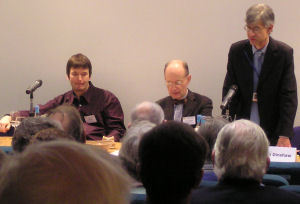
with Ian Rankin and Society Chairman Patric Dickinson
While the Conference itself started that morning in the building’s more prosaic Lecture Theatre, down a steepish stone double staircase which also gave onto the Centenary Exhibition rooms, and for many ended two days later with the two guided walks in the streets of Mayfair or Bloomsbury, my own Conference timeline had seemed to have stretched over a longer period. As just one member of the Conference Organising Committee, I had been privileged to have been invited to the opening of the exhibition Dancing to the Music of Time a month earlier, at the beginning of November. The first person I met was Queen Marie-Antoinette. This bizarre event occurred on the aforementioned stone staircase at the Wallace. I did not follow her, as bidden, to her apartment on the first floor, where she was illustrating the Wallace’s other exhibition – Fit for a Queen but enjoyed instead the lavish, indeed glittering, champagne reception, where some Society members found ourselves in the company of a good number of Afternoon Men (and Women).
And just as “my Conference” had so started in early November, it continued through December and only really ended with the splendid AP centenary birthday party on December 21st hosted by our Chairman, Patric Dickinson, at the College of Arms. The champagne was equally good and copious, the conversation, so aided, witty. We all hoped we would be able to gather again in the aura of AP in another hundred years time and were eventually escorted out of the College precincts onto Queen Victoria Street, lit by the lamps of which AP apparently so disapproved, by Richmond Herald.
In due course, the published Conference proceedings will comprehensively reflect all that happened during the two core days on December 2nd and 3rd. There is no way that I can attempt to encapsulate the consistently high quality and excellence of all the contributors (and the responses they elicited) other than to observe that, as an enthusiast rather than an academic, I was never less than 100% engaged and disappointed only when, as always, we ran out of time at the end of Saturday afternoon. I shall highlight just three talks for brief personal comment while wishing I could cover all the others.
It was difficult to have to choose between the parallel sessions but I do not regret my decision to opt for the session at which Colin Donald led with “Awfully chic to be killed”. Any analysis of what it is that makes people laugh or at least feel they are experiencing something uniquely comical has to be very brave; Colin succeeded splendidly in describing how
a deliberate dissonance in register between subject matter and language used to describe it … is the central source of Powell’s most distinctive and entertaining effects.
I found this talk quite riveting.
The atmosphere of the highly overcrowded side room in which we massed for session 7A to hear Michael Barber talk about AP’s friendship with Malcolm Muggeridge is also memorable. While not all of this would be new, it was related to a compelling fresh narrative drive and authority. Such was the lack of seating, that next to me, Hilary Spurling had no option but to crouch on the floor during the whole of this session. She too appeared to be listening very intently to AP’s unofficial biographer.
On the previous day, in our opening session, Ian Rankin had reflected on the way in which certain (but not all, especially crime) authors cause their characters to age and change their outlooks as time passes, citing the process employed in Dance by AP as a key influence on his own development of Inspector Rebus. He also observed, in passing, that school reunions are intimations of mortality. That note of pessimism is unlikely to infect our next re-union Conference if the quality, vigour and sheer enterprise displayed in 2005 are anything to go by. Perhaps the Garden God will be keeping a kindly eye on us.
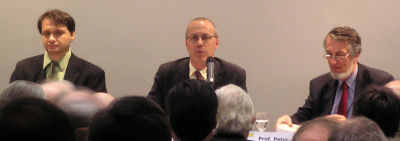
opening the conference with Ian Rankin
and Society Chairman Patric Dickinson
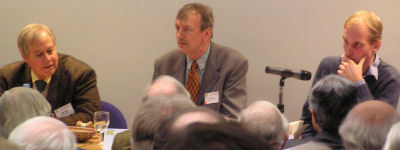
leading a discussion with John Gould (left)
and Ivan Wise
Keynote Speakers
-

Ian Rankin who opened
the conference -
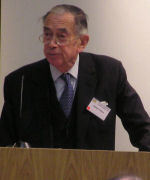
Anthony Hobson -
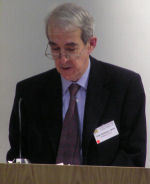
John Saumarez-Smith -
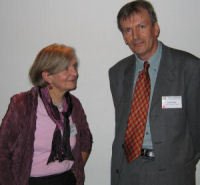
Hilary Spurling
(chatting to John Potter)
Other Speakers
-
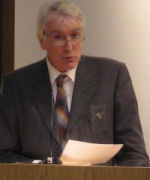
Dr John Roe -
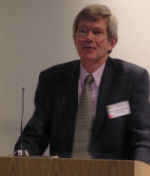
Prof. Patrick Parrinder -

Colin Donald -

Patric Dickinson
(seen here closing
the conference) -
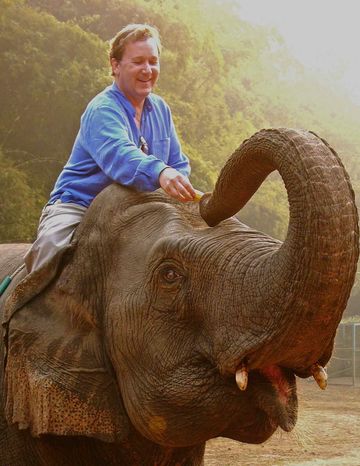
Julian Allason entertaining
the crowd at the end of day 1
What The Delegates Said...
Thank you for a wonderful experience … illuminating, stimulating and fun … the best planned and implemented academic conference I have ever attended
A triumphant event … exceptionally good in every way
Congratulations … for such a stimulating and well-organised celebration
Brilliantly organised and full of new insights into a writer I thought I knew well
Memorable in every way: outstanding speakers … notable scholarship worn easily
I congratulate you … on organising a truly excellent conference … the longer it went on the better it seemed to get
What a centenary year … the Centenary Newsletter was very special … the conference was outstanding
All worked with clockwork precision, every detail had been thought out, the location was perfect, and the papers were not only interesting and stimulating but extremely well chosen and contrasted
An excellent session … extremely informative and highly entertaining
I greatly enjoyed the congress and felt privileged to have been allowed to give a paper
You should be knighted … for making the AP centennial such a creative, tasteful sequence of events
Thank you for a most wonderful experience … which has given me food for thought for months and years to come
I am absolutely delighted I attended
-
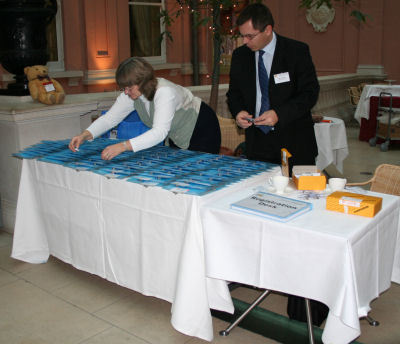
Sue and Chris getting ready for the influx of
delegates on Friday morning -
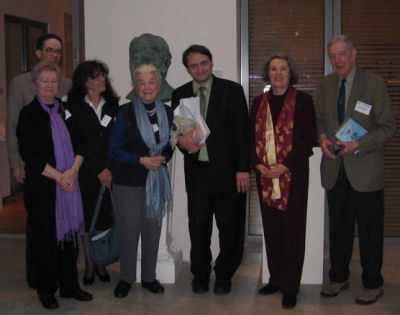
Members of the Society’s NE USE Group
pose outside the exhibition with
William Pye’s bust of Powell
Conference Proceedings
The conference proceedings are being prepared for publication and we hope they will be available before the end of 2006. Further details when available from the Hon. Secretary.
-

Heraldic Crests -
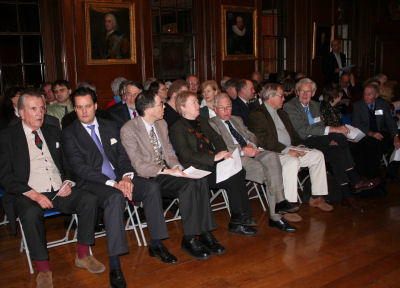
Portraits of heralds make an atmospheric
backdrop to delight the eager audience for
the reading of Powell’s play
The Garden God at the College of Arms
Conference Programme
|
Thursday 1 December Pre-Conference |
|
1830 for 1900 Buffet Reception Venue: Imperial College Rector’s House, 170 Queen’s Gate, London, SW7 |
|
Friday 2 December Conference Day 1 – Powell’s Works |
|
| 0900 Registration & Coffee | |
|
0945 Session 1 Welcome Keynote: Reflections on Dance; Ian Rankin
|
|
| Short Break | |
|
1035 Session 2A Paper: Too, Too Bogus: the London Social Scene in the Early Novels of Powell and Waugh; Lisa Colletta, Babson College, Boston, USA Paper: A Reassessment of Powell’s Early Novels; David Hallett, Memorial University of Newfoundland |
1035 Session 2B Paper: Awfully chic to be killed: Linguistic Register and the Comic Art of Dance; Colin Donald, The Scotsman Paper: Homage and Critique: Anthony Powell’s use of Kipling in Dance; Harry Ricketts, Victoria University of Wellington, New Zealand |
| Short Break | |
|
1135 Session 3 Paper: Knowing and Unknowing: Proustian Moments in Powell’s Dance; John Roe, University of York Paper: A Guest at the Arthurian table: Dance and Chivalric Romance; Patrick Parrinder, University of Reading |
|
| 1230 Lunch | |
|
1400 Session 4 Paper: Last to Join the Dance: The Curious Case of Gibson Delavacquerie; Nicholas Birns, New School University, New York Paper: Powell, Priapus and Petronius; Peter Wiseman, Emeritus Professor of Roman History, University of Exeter |
|
| Coffee Break | |
|
1525 Session 5 Interlude: Riding out with Umfraville – a true Story; Julian Allason, Vice-President, Anthony Powell Society Paper: Two Dance Characters File Complaints Against Anthony Powell; Edwin Bock, Emeritus Professor of Political Science, Syracuse University |
|
| 1630 Close | |
|
1930 Play Anthony Powell, The Garden God (a rehearsed reading) Venue: The College of Arms, Queen Victoria Street, London, EC4 |
|
|
Saturday 3 December Conference Day 2 – Powell’s Milieu |
|
| 0900 Registration & Coffee | |
|
0945 Session 6 Keynote: Anthony Powell and Cyril Connolly; Anthony Hobson
|
|
| Short Break | |
|
1035 Session 7A Paper: Powell’s Friendship with Malcolm Muggeridge; Michael Barber Paper: Anthony Powell and Jocelyn Brooke: A Literary Friendship; Jonathan Hunt |
1035 Session 7B Paper: Powell’s Depiction of Change in Upper Class London Society During World War II; Julie Jackson, University of Derby Paper: A Social History of Britain in Twelve Chapters; Christine Berberich, University of Derby |
| Short Break | |
|
1135 Session 8 Paper: Musicians for the Dance: Constant Lambert and Hugh Moreland; John Gould, Philips Academy, Andover, USA Paper: The War: Powell and Orwell; Ivan Wise, The Shaw Society |
|
| 1230 Lunch | |
|
1400 Session 9 Keynote: Anthony Powell, Bibliophile; John Saumarez Smith, G Heywood Hill Ltd Paper: Anthony Powell and His Book Illustrators; Jeremy Warren, Assistant Director, The Wallace Collection |
|
| Coffee Break | |
|
1525 Session 10 Paper: What’s in a Name? Anthony Powell’s Genealogical Interests and the Nomenclature of Dance; Patric Dickinson, College of Arms, London Keynote: Painting Time: An Illustrated Talk on the Pictorial Power of Powell’s Imagination & the Creative Origins of ‘his Dance’; Hilary Spurling |
|
| 1630 Close | |
|
Sunday 4 December Post-Conference |
|
1000 Guided Walks of Powell’s London Walk 1: Anthony Powell and Nick Jenkins in Bloomsbury and Fitzrovia Walk 2: Nick Jenkins’s Odyssey on the Night of the Three Parties |
|
1230 Informal Sunday Lunch Fitzroy Tavern, Charlotte Street, London, W1 (near the end of Walk 1) The Audley, Mount Street, London, W1 (near the end of Walk 2) |
-
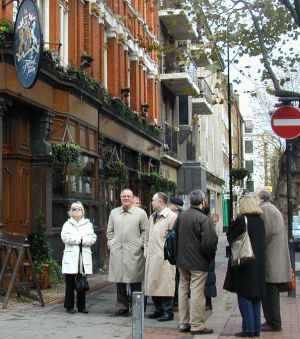
Waiting for Sunday Lunch at the
Fitzroy Tavern at the end of Walk 1 -
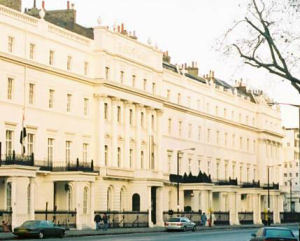
North side of Belgrave Square,
near the start of Walk 2 -

Berkeley Square -

Stephen Holden (red scarf)
who led Walk 2 expounding
on the architechural details -
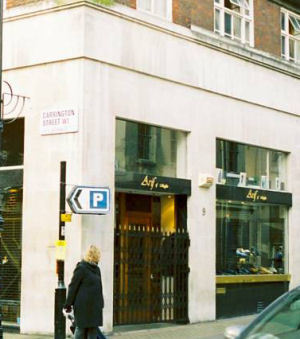
The site of Powell’s first
London lodgings at
9 Shepherd Market -
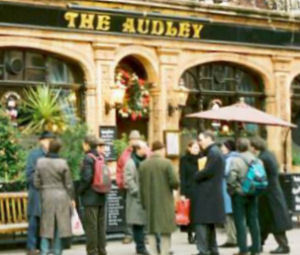
The end of Walk 2: waiting
for lunch at The Audley
Photographs by Keith Marshall, Noreen Marshall, John Potter, Christine Berberich, Jeanne Reed, David Hallett


Website by Beachshore