In Anthony Powell’s second Dance book, A Buyer’s Market, Nick Jenkins witnesses the development of his friend Charles Stringham from the boy he was in the first book, A Question of Upbringing, to the young man Stringham becomes as they make their way into adulthood. After many years without seeing each other, Nick is surprised to hear his old companion referred to as “one of Peggy’s pompous friends” (BM, 44), never having before associated Stringham with pomposity, an ostentatious display of dignity or importance. Nick feels “uncertain whether, in fact, Anne Stepney had not used the term ‘pompous’ in the usual, and not some specialized sense” (BM, 102). In some ways, Stringham has maintained his usual manner of behavior, though at times his motives are a mystery. However, Nick continues to disagree with a drastic change in Stringham.
In their years at Eton, Nick knew Stringham as “an excellent mimic” (QU, 9), usually copying the awkward stride of Widmerpool, and the friend who drew faces on the notice-board as if to “protest against the voice of authority” (QU, 8). One of Nick’s strongest memories of Stringham was the Braddock alias Thorne incident. To Nick’s surprise, Stringham had called the police on their housemaster, Le Bas, reporting of his whereabouts as if he was an escaped convict. Initially, Stringham seemed excited at the commotion which he had caused; however afterwards he showed no signs of pleasure in the prank, saying, “I am afraid it was all in rather doubtful taste. In some ways I regret having been concerned in it. One is such a creature of impulse,” thus indicating his return to his state of indifference as his “cheeks lost the flush they had taken on during the excitement” (QU, 49, 50). Such a turnaround in behavior was most likely due to Stringham’s noted “fits of melancholy’ (QU, 9).
However, during their years in university, Stringham unexpectedly bailed on dinner plans with Nick for a party with the Bridgnorths. He said to Nick, “The fact is I am cutting your date … I’ve been asked to a rather good party at short notice” (QU, 226). His abrupt nature of doing things reflects poorly on his consideration for others and leaves Nick taken aback and annoyed. When Nick was ditched for dinner, he begins to recognize that “considerable changes had indeed been taking place” (QU, 227) in Stringham.
Nick and Stringham had not seen each other for many years after the dinner incident. When Nick chances upon him in a café, it is his chance to reacquaint with Stringham and see who he has become. Stringham’s impulsiveness has certainly followed him into adulthood, indicating straight off his affair with an older woman, Mrs. Andriadis since his “name is rather intimately linked with hers at the moment” (BM, 94). This relationship turns out to be short lived since Stringham leaves the party after an argument, insisting that he must go out, saying “I am at the moment looking into my soul to examine the interesting question of where exactly I do want to go” (BM, 145). Nick deduces that “Their connexion, on his part at least, seemed no more than a whim” (BM, 160) and perhaps Stringham had simply been suffering some sort of restlessness, though Stringham never supplies details about his relationships.
Similar to the boy Nick used to know, Stringham still find pleasure through various pranks or remarks. At the Stourwater party, Stringham instigates trouble by inquiring, “Would it be an occasion for the dungeons?” (BM, 199), knowing Sir Magnus Donners would lead an adventurous tour of the castle. Nick, realizing this inside joke, says, “It stuck me, at this moment, that such occasions, the enjoyment of secret laughter, remained for him the peak of pleasure, for he looked suddenly happier” (BM, 202). Though Stringham has retained some of his humorous nature, his comments are often ill-received. After stating he wants to go to a place of vice, Mrs. Andriadis mumbles, “Do tell him not to be such an ass” (BM, 146). Similarly at Stourwater, “Mrs. Wentworth seemed not greatly amused by [his] facetiousness” (BM, 190).
Despite these moments of witty remarks and opportunities for jokes, his depressive and reticent states are more prevalent. For instance, Stringham conveys “vagueness in speaking of his own employment” (BM, 132) and considers himself “still to be seen passing from time to time through the Donners-Brebner Building. It might be hard to establish my precise status there” (BM, 104). His comments convey a lack of interest in his career, similar to the way he shows a false yet “elaborate friendliness” (BM, 102) when in conversation with Nick. During his argument with Mrs. Andriadis, Stringham complains, “The fact is I am much too boring to stay at a party. That is exactly how I feel myself… I cast a gloom over the merry scene. ‘Who is that corpse at the feast?’ people ask, and the reply is ‘Poor old Stringham'” (BM, 144).
What puzzles Nick most about Stringham is his engagement to Peggy Stepney. He says, “I found it impossible to guess whether he was getting married because he was in love, because he hoped by taking this step to find a more settled life, or because he as curious to experiment with a new set of circumstances” (BM, 197). The motives for such a decision are questionable since it could possibly be yet another impulsive act between the “fits of melancholy” or as he dryly puts it “It comes to us sooner of later” (BM, 212). The interactions between the two hardly ever seem warm and affectionate, including a moment when Stringham “had placed his own hand over hers, upon which she had jerked her fingers away, almost angrily… His first movement had been mad, so it had appeared, almost automatically, not even very specifically as a mark of affection” (BM 198). Whatever the circumstances may be, Nick cannot determine what could “possibly be equated with that state of mind [‘turning over a new leaf’]” (BM, 213).
Stringham’s personality apparently still contains some wit and impulsiveness but is accompanied by states depression and unconcern. His actions in most cases are indifferent of the feelings of others, still, having known Stringham during his adolescence accustoms Nick to Stringham’s sense of humor and persona, though not entirely. In the midst of the book, Powell introduces the idea that the “persons we see most are not necessarily those we know best” (BM, 193). Inversely, if we are so close to persons, we may not see them for who they really are. If Nick is friends with Stringham, he would fail to see the faults that others condemn him for. For the time being, Nick is simply assuming that “the detachment [Stringham] had always seemed to possess was now more marked than ever before” (BM, 102) or perhaps Stringham is just having another case of the doldrums. On the other hand, Nick has seen first hand that “there could be no doubt that he possessed a personal remoteness, a kind of preoccupation with his own affairs, that gave at least some prima facie excuse for using the epithet [pompous]” (BM, 102). On rare occasions is Stringham actually pompous by definition, but as he develops into a negative character, Nick and others may find it hard to call Stringham a “good friend.”


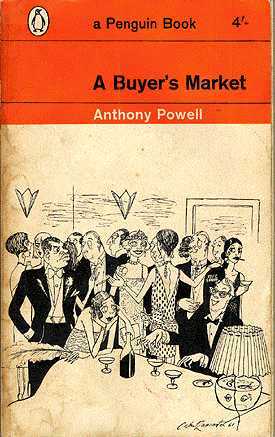
 jumps to London in 1928 at the Walpole-Wilsons’, where Jenkins is attending a dinner party with his love interest, Barbara Goring. After dinner they go to the Huntercombe’s dance, where Barbara, in a joke gone awry, pours sugar over Widmerpool’s head. Jenkins and Widmerpool leave the dance soon afterwards, and meet Deacon and Gypsy Jones in the street. They encounter Stringham, who invites them all to another party.
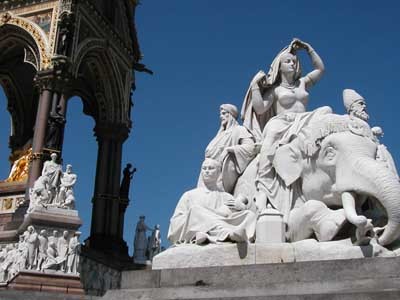 “We ascended the steps of the Albert Memorial…. [Eleanor Walpole-Wilson’s remark] caused Barbara to burst out laughing. This happened on the way down the steps at the south-east corner, approaching the statues symbolising Asia, where, beside the kneeling elephant, the Bedouin for ever rests on his haunches in hopeless contemplation of Kensington Gardens’ trees and thickets, the blackened sockets of his eyes ranging endlessly over the rich foliage of these oases of the mirage.” A Buyer’s Market, 23.