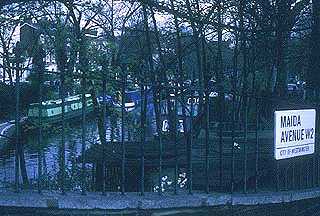
This is Little Venice and Regent’s Canal near Maida Vale in London. In here one night, Pamela Flitton Widmerpool, in a fit of high dudgeon, threw the only copy of the manuscript Profiles in String, by X. Trapnel.

“Then an extraordinary thing happened. Trapnel was still standing by the edge of the water holding the dripping sheet of foolscap. Now he crushed it into his hand, and threw the ball of paper back into the Canal. He lifted the swordstick behind his head, and, putting all his force into the throw, cast it as far as this would carry, high into the air. The stick turned and descended, death’s head first. A mystic arm should certainly have risen from the dark waters of the mere to receive it.” Books Do Furnish a Room, 223.

–0–


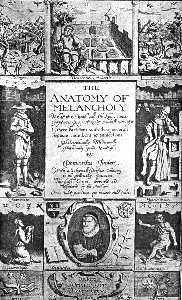
Title page from Robert Burton’s Anatomy of Melancholy.

“The title page showed not only Burton’s own portrait in ruff and skull cap, but also figures illustrative of his theme; love-madness; hypochondriasis; religious melancholy. The emblems of jealousy and solitude were there twoo, together with those soverign cures for melancholy and madness, borage and hellegore. Burton had long been a favourite of mine. A study of him would be a change from writing novels. The book was to be called Borage and Hellebore.” Books Do Furnish a Room, 2-3.

Books Do Furnish a Room begins at the “University” (Oxford) in 1945. After the War, Jenkins begins researching a book on Robert Burton and The Anatomy of Melancholy. He meets with Short and Sillery, whose attractive secretary, Ada Leintwardine, is preparing his journals for publication. He learns that Erridge has died, and he must return home for the funeral. On the train to London he runs into “Books” Bagshaw, who informs him about the magazine Fission and its publishers, Quiggins and Craggs.

The whole Tolland family including the Jenkinses attend Erridge’s funeral. As the service is beginning, Widmerpool, Gypsy Jones Craggs, Craggs, Quiggin, Uncle Alfred Tolland, and Pamela enter. Pamela feels sick and disrupts the service as she leaves. Afterwards, at Erridge’s living quarters at Thrubworth, the family and visitors discuss Erridge’s affairs. Leaving, Pamela vomits in a large oriental vase. Dicky Umfraville hints that he may be Pamela’s father.

Jenkins goes to a party at the Flores’, where he realizes Jean has money. Rosie Manasch reveals that she has been funding Fission. Widmerpool arrives and hears Jenkins plans to meet X. Trapnel. The next week they do so, with Bagshaw, and and discuss many literary ideas. Jenkins runs into Moreland. Odo Stevens sees Pamela, who looks right through him. Trapnel meets the Widmerpools. He is disinterested in Pamela, but manages to borrow a pound from her husband.

At a pub Trapnel confesses to Jenkins his love for Pamela. Jenkins has dinner with Roddy Cutts; they meet Widmerpool and accompany him to his flat, where Short, who lives downstairs, tells them Pamela has left, perhaps with Trapnel. Trapnel, living with Pamela, writes a parody of Widmerpool for Fission. Later, while Nick is visiting Trapnel and Pamela at their squalid flat, Widmerpool appears and confronts them.

Jenkins returns to “School” (Eton) to make arrangements for his son to attend school there. Then, a flashback describes the collapse of Fission and the falling out between Pamela and Trapnel. As Bagshaw and Jenkins console Trapnel and take him home from a pub, they find the manuscript ofProfiles in String (flung by Pamela) in the river. Crushed, Trapnel hurls his walking stick into the river. Back at School, Jenkins meets Le Bas, who does not remember him, and then Widmerpool, who is vacationing with Pamela (who has returned to him). The book ends with a description of newly published novels, which includes one of Jenkins’s.

The cover depicts X. Trapnel, drawn by Marc Boxer.

These are the major characters in this volume, organized by chapter.

Chapter 1

Sillery – an elderly don at the “University” (Oxford)
Leonard Short – a university contemporary of Jenkins, now living near Widmerpool
Ada Leintwardine – Sillery’s secretary, also associated with Quiggin & Craggs publishing
“Books (Do Furnish a Room)” Bagshaw- proposed editor for Fission

Chapter 2

Tolland family – link to complete list of family members
Alfred Tolland – uncle of Tollands
Kenneth Widmerpool – now a member of Parliament, involved with Fission
Pamela Flitton Widemerpool – his dangerous and awful wife
Gypsy Jones – one-time lover of Widmerpool, communist
Howard Craggs – publisher, married to Gypsy
Quiggin – old acquaintance of Jenkins, now writing for Fission
Mona – Peter Templer’s ex-wife, went to China with Erridge
Dickie Umfraville – Frederica Tolland’s husband, refuses to attend funeral
Roddy Cutts – Susan Tolland’s once-wandering husband, now brought to heel

Chapter 3

X. Trapnel (Francis Xavier) – a well-regarded but perennially poor writer
Rosie Manasch – a friend from Jenkins’s dancing days, supporter of Fission
Odo Stevens – acquaintance of Jenkins from War
Col. Flores – South American military/governmental figure
Jean Templer Duport Flores – his wife, Jenkin’s old heart-throb

Chapter 4

Roddy Cutts – Jenkins’s brother-in-law, a Tory MP

Chapter 5

LeBas – Jenkins’s old housemaster when he attended “School”

Essays: 2001-2

sually in a book when a chapter is focused on a funeral that chapter tends to be sad. Chapter two in Powell’s Books Do Furnish a Room is set around Erridge’s funeral. This doesn’t discourage Powell from throwing humor into this chapter. In fact this chapter is one of the most humorist chapters found in The Dance. Powell fills this chapter with humor keeping the reader laughing all the way through Erridge’s funeral.

Widmerpool’s party draws a lot of attention as it enters the church for Erridge’s funeral. Powell uses Widmerpool and his group to add humor to what would ordinarily be a sad event. Widmerpool is shown as the leader of this group as they find their seats. He “shot out the hand of a policeman directing traffic, to indicate where each was to sit of the group apparently under his command” (47). The image of Widmerpool acting as a policeman is easy for a reader of Dance to see, especially after his behaviour in the military. If Widmerpool were indeed a policeman, his uniform would no doubt be too small just as his military one was. Pamela tests Widmerpool’s power when she doesn’t act exactly as he wishes, but he lets it pass.

Powell lightens up this chapter with Pamela’s sickness. She feels faint during the service and decides to leave the reception afterwards early. While Nick escorts her to her car, she turns green and Nick knows that she is going to vomit. Nick asks her if she wants to go back, “to the bathroom,” but it is too late. Pamela looks around the room and sees, “two tall oriental vessels … standing five foot high…. [then] Pamela came to a decision. Moving rapidly forward… she turned away and leant forward. All was over in a matter of seconds.” (82) Pamela vomits in one of the antique oriental vessels.

Widmerpool, Alfred Tolland, Quiggin, Craggs, and Gypsy arrive right after Pamela’s illness. Widmerpool admires the antique that has just been vomited into. Powell uses this scene for a few reasons. He wants to imply that Pamela might be pregnant and that is why she is vomiting. He makes Widmerpool seem stupid for liking the antique that was just defaced. Finally this scene adds humor to the chapter.

Powell describes the process of cleaning the antique vessel in one humorous paragraph. The action is undertaken by Nick, Jeavons, Hugo, “with shrewd advice from Roddy Cutts,” (86). The reader is given a description of the four-man team struggling with this large object that was never made to be cleansed anyway. Nick says, “The job took quite a long time. More than once the vase was nearly broken. We returned to the sitting-room with a good deal of relief that the business was at an end,” (86, BDFR). Powell uses this scene purely for comedic purposes. The image of Nick, Jeavons, and Hugo juggling this large vessel in a bathroom makes the reader laugh out loud.

Chapter Two of BDFR is a great example of the humor that Powell uses throughout Dance. Even though the book is centered on a funeral, it is one of the funniest chapters to be found in the sequence. Its ending puts the lid on the humor with Dickie Umfraville revealing one of the funniest names for an alcoholic cocktail: “Death Comes for the Archbishop” (92).

Throughout Books Do Furnish a Room, X. Trapnel plays a multitude of different roles. He is able to do so successfully, to whatever degree his life can be considered a success, because he is certain of his one true role in life: that of a poor writer. After falling in love with Pamela however, Trapnel loses sight of his place in the world, and where he once had dozens of roles to play he is left with none at all.

When we first meet Trapnel, we are most struck by his passion for books and literary discussion. Nick describes how “this business of being a ‘writer’ — that is the status, moral and actual, of a writer — was a matter on which [Trapnel] was inordinately keen” (111). Furthermore, Trapnel is described as having “a passionate interest in writing” and a “taste for discussing it” (114), and he certainly demonstrates his keen interest in literary affairs by his lengthy discussion with Books on the subject of Naturalism (214-217). Trapnel, while sometimes confusing and seemingly incomprehensible, is quite clear on his love of books.

Another facet of Trapnel’s personality that becomes apparent as Nick comes to know him better is his tendency to always play a role with the utmost persistence. “The essential point was that Trapnel always played a part; not necessarily the same part, but a part of some kind.” “Where he differed from the crowd was in so doggedly sticking to the role — or roles — he had chosen to assume” (143). Nick goes on to list the many different roles in which Trapnel has portrayed himself:

a writer, a dandy, a lover, a comrade, an eccentric, a sage, a virtuoso, a good chap, a man of honour, a hard case, a spendthrift, an opportunist, a raisonneur; to be very rich, to be very poor, to possess a thousand mistresses, to win the heart of one love to whom he was ever faithful, to be on the best of terms with all men, to avenge savagely the lightest affront, to live to a hundred full of years and honour, to die young and unknown but recognized the following day as the most neglected genius of his age

– most notably the desire to play a rich man one day and a poor man the next (145). Yet the role of being poor, according to Nick, is “the only aim Trapnel achieved with unqualified mastery” (145). Above all his other roles, Trapnel succeeds at consistently being poor.

After Trapnel falls in love, however, his life is completely changed. “One of the consequences of [Pamela’s] presence” states Nick, “was to displace Trapnel’s tendency to play a part during the first few minutes of any meeting” (192). Later on in the same visit, after Widmerpool arrives, Trapnel is described as having “lost command of his role as actor” (201). Somehow the very presence of Pamela completely destroys his ability to play any role at all. Without even any overt attack against Trapnel she has managed to corrode one of his most defining characteristics.

The most serious attack on Trapnel’s role playing ability, however, comes when Pamela attacks, both verbally and physically, his manuscript. Even just by criticizing and belittling his writing, Pam is able to send Trapnel into “a bit of a state” as Books calls it (213), more accurately described by Nick as “in a bad way,” a “man weighed down by sorrow and fear” (217-218). Trapnel’s condition upon discovering the objects floating in the water to be the pages of Profiles in String goes from bad to worse. His first action is to “abruptly stop playing the part” he had been playing that night (222). As we slowly come to realize, that will probably be the last role he will ever play. When he explains to Nick and Books about Pamela’s sex habits, he even further demonstrates the extent to which he has been deprived of his roles. “Irony, melodrama, narcissism, fantasy, all his accustomed tendency to play a role had been this time completely eliminated” (225). With his works lost and his role as a writer destroyed by Pam, Trapnel will never again play the roles he once did.

Before Mrs. Pamela Widmerpool came into his life, Trapnel was secure in his position. He was a writer, a poor one at that, who could stray from the beaten path because he always knew where his own path led. Pam, through her malicious and alluring attractive powers, forces upon Trapnel a new life, completely vanquishing his former self. When she destroys Profiles in String, the last remnant of his previous, happy life, he is left a broken shell of a man, perhaps having “taken a knock from which he [would] never recover” (240). Our final thoughts of Trapnel, of him “just about” hanging on, recall once again the empty shell that he is at the end of the book. Pamela, in casting Profiles into the river, might as well have sent Trapnel — and his deaths-head sword-stick — into the same murky waters.

Books Do Furnish A Room is the first book of the fourth and final movement of the Dance, and as such marks the beginning of the end – Nick’s descent into old age. But as the book takes us through another phase of Nick’s life, and ever closer to the end of the Dance, it also provides a link, through the novel’s literary theme, to the very beginning of the sequence. Ultimately, we are reminded of where Nick started and how far he has come – both in the dance of time and the literary world – and are left with an undeniable feeling of nostalgia as he nears the finish line.

Books Do Furnish A Room gives us our first real look into the literary world that Nick has supposedly been a part of for many years. Though emphasis is not (unsurprisingly) placed on Nick’s personal involvement with the magazine, Fission highlights the interaction of the literati of the Dance and serves as a focal point for the plot of the novel. Indeed, almost all of the characters of Books Do Furnish A Room are affiliated with the literary scene in some way. The predominance of this literary theme provides hitherto lacking insight into Nick’s life, mainly into his profession, and what his personal experience as a writer is like.

At the beginning of Books Do Furnish A Room Nick returns to Oxford to conduct research for his book on Burton and enjoys a reunion with his former don, Sillery, and classmate, Short. Later, at the very end of the book, Nick travels to Eton to make arrangements for his son to go to school. At Eton he encounters his old housemaster Le Bas, who does not remember him, in addition to a student (Akworth) asking Le Bas for help. Both of these returns to educational institutions bring back memories of Nick as a student in A Question of Upbringing, and highlight his literary origins. Nick received the education and influences that led him to be a writer at these two schools, and also made his first literary connections, Quiggin and Members, at Oxford. In addition, these returns awaken a deep feeling of nostalgia for the reader and doubtless for Nick too, as we all recall that both Stringham and Templer, his old Eton buddies, are no longer with us.

Books Do Furnish A Room highlights the literary themes of the Dance, and gives us a glimpse into the professional world that Nick is a part of. In addition, two returns to places from Nick’s past – at the very beginning and end of the book – frame Books Do Furnish A Room both in terms of the literary world and the winding down of the Dance by providing the reader with a reminder of Nick’s origins. And yet, even as we see that Nick has come a long way and is beginning the final phase of his life, we are reminded that an older generation (Le Bas and Sillery) still exists, and that a new one (Nick’s son and young Akworth) is emerging.

Widmerpool lacks a sense of self-esteem in many of his interactions with people he is attracted to in A Dance to the Music of Time. He is taken advantage of by these people, and his reactions to these unfortunate circumstances seem extremely odd. His behavior is described as “slavish” on more than one occasion. At the beginning of the novel, the reader feels pity for Widmerpool. Gradually, after certain incidents in which he is made to look like a fool and then fails to stand up for himself properly, the reader feels less sympathy for Widmerpool and more agitation at the fact that he cannot defend himself appropriately against people he is attracted to. Widmerpool, however, makes progress with time. He gains strength as a person and, in certain situations regarding his business and military affairs, becomes downright intimidating. Still, he seldom appears confident and remains unsuccessful in his social interactions. Late in the series, at one specific incident, the reader becomes impressed by how Widmerpool stands up for himself in front of the one person whom he is truly attracted to.

Beginning with a scene in A Question of Upbringing, Widmerpool’s lack of self-esteem is very evident. Stringham describes a time when he and Templer watch an overripe banana SPLAT right in Widmerpool’s face. Budd, who is captain of the popular “Eleven,” aimed this banana elsewhere, but didn’t quite hit his target. Rather than getting angry, or upset, Widmerpool calmly removes his spectacles and begins to clean them off. Budd approaches him to apologize; a gesture that leaves Widmerpool very satisfied. He is “obviously astonished to hear himself addressed by name, and so politely, by no less a person than the captain of the Eleven” (11). This is when the infamous “slavish look” first appears on Widmerpool’s face. This scene is interesting because Widmerpool’s reaction to having a banana thrown in his face is not exactly a typical one. Most people would be upset or angry, in response to this; masochistically, Widmerpool seems to take pleasure in a seemingly humiliating situation. He does not make a humble exit, but remains where he is and smiles at his encounter with Budd. It is possible that his bewildering reaction is a result of having feelings or an attraction to Budd.

Behavior such as this begins to form Widmerpool’s character. In A Buyer’s Market, the desirable Barbara Goring creates another situation similar to Budd’s. After Barbara has refused Widmerpool’s pleas to dance with her throughout the evening, he begins to become irritated by her treatment of him. Barbara decides that she is going to take a seat next to Pardoe, where Widmerpool knows she will sit for the rest of the evening, but he tries to take a stand. As she rises to make her way over there, he grabs her wrist, quite forcefully. “Why are you so sour tonight? You need some sweetening,” says Barbara (71). Just then, she grabs a sugar castor and empties the entirety of its contents out on Widmerpool’s head. The slavish look returns. Nick comments that this “was a hard situation for anyone to carry off with dignity and good temper” (71). Widmerpool stands up, shakes himself off, and once again, begins to wipe his spectacles of the mess, “smiling slightly, almost apologetically, to himself” (72). This situation is similar to Budd’s because he displays “almost the identically explicit satisfaction derived from grovelling before someone he admired” (72). The difference between this situation and the one with Budd is that Widmerpool leaves shortly after the incident. Nick remarks that “when Widmerpool pushed his way between the chairs, disappearing a minute later through the doors of the supper-room, he seemed to the world at large, perhaps correctly, to be merely a man in a towering rage” (72). Widmerpool tries to salvage any shred of dignity that he can in this situation by walking away; this response contrasts to his response to the banana incident. Although he is not very successful in maintaining his dignity in the situation with Barbara, Widmerpool demonstrates the progress he has made from his embarrassing moment with Budd.

A third situation in which the reader questions Wimderpool’s odd reactions to embarrassment occurs in At Lady Molly’s. Although we do not see this situation firsthand, General Conyers paints a pretty picture of it. He tells of a time when they are gathered at Dogdene together. The well-traveled Mildred Haycock is to be Widmerpool’s wife although she is not acting very nice to him when they arrive there. The weekend of Mildred acting “crisp” to Widmerpool ends in chaos. Conyers comes down for breakfast on Sunday morning and sees Widmerpool, looking very disgruntled, as he is about to depart. He hears the story of what occurred between the two only after Widmerpool leaves. “Widmerpool had been in her room the night before. Things hadn’t gone at all well. Made up her mind he wasn’t going to be of any use as a husband”(231). Widmerpool is rejected. He leaves before anyone is really awake, possibly in an attempt to avoid being publicly embarrassed by Mildred, who is known for tendency to be outspoken. In this particular scene, Widmerpool is quite clearly embarrassed and does not show signs of enjoying any aspect of Mildred’s treatment of him. The ever-so-characteristic slavish look does not appear on his face this time. He takes a stand for himself by leaving. This is definitely a step in the right direction for Widmerpool.

In a scene in the tenth book, Books Do Furnish a Room, Widmerpool makes the ultimate progression from his adolescent masochism. His decision to go to X. Trapnel’s apartment and personally address his wandering but beautiful wife Pamela and Trapnel is questionable, at first. The reader, who does not want to see Widmerpool humiliated once again, is apprehensive about this. Fortunately, he is not. It is a relief to see Widmerpool defend himself. He arrives at Trapnel’s apartment, and is greeted by Nick. He strides into the sordid room, and makes his point very clear; Trapnel has crossed Widmerpool in three significant ways, and he is not going to stand for embarrassment this time, no matter how much he loves Pamela. Widmerpool takes his stand, but as he is doing so, Trapnel raises his sword. Widmerpool, to his credit, remains calm and says, “No dramatics, please” (203). This is a truly great moment for Widmerpool. He simply refuses to be humiliated.

Widmerpool’s self-esteem has matured since the beginning of the sequence. He has progressed from being someone who accepts being taken advantage of by people who he is, in any way, attracted to with a smile, to a person who is able to remain dignified in a most horrifying situation. It is refreshing to see Widmerpool acting more self-confident than he has in previous times. He has made significant progress from the beginning chapters of A Dance to the Music of Time, and although Widmerpool is not always the most favorable character in the novel, the reader feels glad that he has made progress in his social interactions.

In Books Do Furnish A Room Pamela Widmerpool’s character reveals itself to be a much more dangerous one that before. In The Military Philosophers she shocks us with the way she treats men: she physically toys with them, destroys their self-esteem, and then throws them away. Now she moves up to a whole new level. In this book, X Trapnel is her victim and she decides not to play with his sexuality, but his career. She somehow manages to pick on that one aspect of the men’s lives that is most important to them. X Trapnel does not care for sex at all; rather, he is obsessed with his writing. Her earlier sexual conquests, however – Peter Templer, Odo Stevens and Bob Duport – were all sexually confident, and she succeeded in destroying the confidence of every one of them.

Duport says on page 190 (TMP), “I only stuffed her once, against a shed in the back parts of Cairo airport, but even then I could see she might drive you round the bend”. Sex is all Pamela got involved in; she was not emotionally attached to any of the men she had these escapades with. Bob Duport had obviously been a one time thing, but in the case of Peter Templer, she had managed to “drive him around the bend” by convincing him of his sexual incompetence. She mistreats Odo Stevens too. First she slaps him in front of Jenkins and Mrs. Erdleigh, and as if this isn’t enough to embarrass him, goes on to say “You don’t think I’m going to take orders from a heel like you, do you? … You’re pathetic as a lover. No good at all. You ought to see a doctor” (135, TMP). Stevens is angry and calls her “a little bitch”. Nevertheless, Pamela once again gets away with her nastiness.

Her experiences with these three men show her to be a mildless witch, with probably little intellectual sensibility, or rather, none at all. Unfortunately, she is worse. In Books Do Furnish A Room we become aware that she does have knowledge through which she wields power over X. Trapnel. First, he falls so madly in love with her that he cannot even mention her name to Jenkins: he has to write it on a slip of paper.The next thing we hear, she has moved in with him, in spite of being married to Widmerpool. When Jenkins visits them in their shabby apartment we hear “the first aesthetic judgement [Jenkins] has ever heard her make” (196) – “I’m not satisfied with X.’s book.” But that in itself is a mild statement coming from Pamela. We are not disappointed however. She reverts to her predictable awfulness: “I’d rather you burnt it than publish it as it stands. In fact, you’re not going to” (135). Trapnel’s reaction shows that he is under her control, and his career goes downhill from there.

“At the same time, he could easily have moved onto stronger stuff. Pamela might have encouraged that course; living with her almost necessitated it” (203). This statement by Jenkins convinces us of her dreadfulness because he is rarely explicit in his description of people. Pamela proves him right when she throws all of X. Trapnel’s manuscript into the canal; he has no copies. In destroying Profiles in String, she destroys his career, and him, too.

“As the gas flared up again, its hiss for some inexplicable reason suggested an explanation of why Pamela had married Widmerpool. She had done it, so to speak, in order to run away with Trapnel” (192). She returns to Widmerpool though, and it remains a mystery as to why she married him in the first place. Her intentions cannot be good, and this is obvious from her behavior. “Giving men hell is what Miss Flitton likes,”says Duport (74, TMP). “I know the sort. Met plenty of them.” Will Widmerpool be spared?

Essays: 2007-8

The end of World War II brings about many changes to our favorite characters. Some of these changes are back to relative normalcy, but others are nothing short of wholesale transformations in the case of Jean (formerly Templer, formerly Duport) Flores. She emerges after the celebration of the termination of the war when Colonel Flores gives Nick a ride to Whitehall. Initially Nick does not even recognize her, rather he is shocked at how similar Colonel Flores’ daughter looks like Jean. Upon realization Nick observes: “Jean had altered her whole style.” (233 MP) Both she and her daughter Polly exhibit a look Nick has never seen before and he feels: “their elegance appalled one” (232 MP) These are just preliminary changes that he notices in their his encounter with Jean as he has the opportunity to attend a party at the Flores’ apartment where he sees much more of her.

For a period of Nick’s life prior to the Second Great War, he would have found himself at a loss without the company of Jean. Life was unthinkable without her. However, the conclusion of The Military Philosophers confirms that: “Jean and I were no longer the persons we then had been.” (236 MP) Nick is asked to drinks by Colonel and Madame Flores and it is here that Nick really gets an idea of how she has changed. Jean spent all those years running around three-timing Jimmy Brent, Bob Duport and Nick himself. She found herself unwilling to settle into one lifestyle as she was seeking riches and none of those men, individually or collectively could give her what she was looking for. Now she has settled down with Colonel Flores because he can provide her with this standard of living. Upon entering the drawing room in their apartment Nick sees a “profusion of flowers” (95 BDF) along with “the abundance and variety of drink on offer” (95 BDF). This gives Nick a complete sense of closure to his past relationship with Jean. He knows he could not have offered Jean the riches Colonel Flores could and therefore never would have been able to make her happy had they continued their relationship.

Jean’s newfound access to wealth has shifted her image from “a well-turned-out schoolgirl” to “an enchantress on the cover of a fashion magazine.” (96 BDF) She has adopted this attitude as well. She is a more powerful and opinionated woman than she was before the war. When she and Nick engage in conversation about the goings on of Colonel Flores she is very inclusive referring to the government’s placement of the Colonel as their placement: “`Carlos has been given a military area in the Northern Province… We are both pleased really. It shows the new Government is being sensible.” (98 BDF) She also easily passes judgment on her previous lovers. Talking about Bob Duport she casually offers that “He’s rather a weak man in some ways.” (98 BDF) Her connection to power has turned her into a confident woman who has no problem sharing her view. The Jean we meet is neither the Jean Templer nor the Jean Duport we knew in earlier novels. She is Jean Flores and if she can so easily criticize Jimmy Brent for being “very fat” one wonders what she might say to Jimmy or Bob if she were talking about Nick.

In Books Do Furnish A Room Nick Jenkins runs into Colonel Flores and his wife, the former Jean Templer, at a party at their house. The Flores’ home in London is overflowing with flowers, ironic because of the meaning of their last name, along with alcohol. Both of these superfluities were particularly hard to obtain in post-war England. The decadence at this party is an overt reference to the wealth in the hands of this South American couple. Nick’s comments about the Flores’s dress, especially that of Jean’s, gives an accurate timeline at which to set the party in The Dance and reinforces their unbridled wealth. Hilary Spurling, the author of Invitation to the Dance, and Anthony Powell agreed that this party had taken place in the spring of 1946. This may be true due to other details in the book but based on the release of Dior’s New Look, the party would have to have taken place in the spring of 1947 instead.

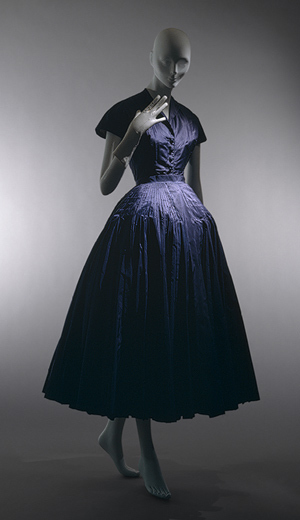
Upon setting his eyes on Jean, Nick notices that she looked “rather superb in what was called `The New Look.'” This look that Nick has picked up on is from the 1947 spring/summer collection by Christian Dior. This is first collection released by Dior, which founded its haute couture fashion house the year previous (Met). “Featuring rounded shoulders, a cinched waist, and very full skirt, the New Look celebrated ultra-femininity and opulence in women’s fashion. After years of military and civilian uniforms, sartorial restrictions and shortages, Dior offered not merely a new look but a new outlook” (Met). Jean’s appearance embodied this swift transition into an era of luxury. A dress that Jean would have worn at such an event can be seen below:

(The Metropolitan Museum of Art)

This sapphire blue dinner dress entitled “Chérie” from the 1947 spring-summer collection is made of a changeant silk taffeta. This dress exemplifies the New Look in its “sloped shoulder, raised bust line, narrowed waist, and a monumental volume of skirt falling away from a padded hipline to below the calf” (Christian Dior). Something as lavish as this, as it does now, would cost an obscene about of money. Nick believes that Jean becoming “so fashionable had to be attributed, one supposed, to her husband” (BDFR 95). A husband in such high society with equally high a pay roll would be needed to support fashions such as these.

Nick marvels at Jean’s stark transition, “in the old days much of her charm — so it had seemed — had been to look like a well-turned-out school girl, rather than an enchantress on the cover of a fashion magazine.” Nick now noticed that she had a very slight foreign intonation in her speech which complemented her new “haute couture” look. The ease at which Jean has transitioned into her role as Madame Flores is not surprising in the least. Upon arrival at the party it becomes apparent to Nick that, “money was after all what Jean really liked. In fact Duport, even apart from his other failings, had not really been rich enough. It looked as if that problem were now resolved, Jean was married to a rich man” (BDFR 95).

This wealthy new addition to Jean’s life is Colonel Carlos Flores; to Nick, the epitome of romanticism and prosperity. “Flores did posses the distinct look of Rudolph Valentino” (BDFR 96). Valentino was a silent film star who was known as a sex and fashion idol (Rudolph Valentino). The portrait below shows the poised and distinguished actor that Nick associates Colonel Flores with.

(World Almanac)

“Handsome, spruce and genial, the Colonel’s English was almost more fluent than his wife’s, at least in the sense fainly old-world tinge” (BDFR 96). The same romanticized, larger-than life perception is brought out in his description of the Colonel as with Valentino. Their high society demeanor sets them distinctively on a higher plane than Nick.

The fashion adorned by Mr. and Mrs. Colonel Flores boasts their high society profile and money that pays for it. Spurling identifies the Flores’ party as happening in “early spring of 1946.” The time at which Christian Dior released his New Look on to the fashion scene helps point out a possible mistake in the timeline of the The Dance — one that Powell agreed to. Nick’s seemingly passive descriptions gives us new insight into the lives of high society London.

Sources:

The Rudolph Valentino Homepage.

The World Almanac.

The Metropolitan Museum of Art.

Christian Dior. Martin, Richard and Harold Koda. The Metropolitan Museum of Art: New York, 1997.

Invitation to the Dance, Hilary Spurling, Little Brown & Co, Boston, 1977, 326.

In Books Do Furnish a Room, Pam continues to use her attractive figure and abrasive personality to bring men down. After marrying Widmerpool, she proceeds to leave him for X. Trapnel, a writer very much unlike Widmerpool. Trapnel’s interactions with her are disparate from his interactions with any other girl that Nick has seen him with and he is not the usual type of character that she troubles. He does not have any apparent weaknesses for Pam to take advantage of; he is emotionally stable, independent, and not overly concerned with his public reputation or money or the physical aspects of a relationship. He is cool and collected and would be hard pressed to lose his temper, yet Pam still finds a way to destroy him.

Trapnel’s life is mostly in the dark to Nick and his peers; he rarely tells anyone where he’s living and sometimes sends representatives to the publishing firm to pick up books to review and to drop off his writings. Sometimes the most that people know of his whereabouts is that he may be in a bar somewhere, though which one is harder to determine. Trapnel’s only lasting attachments are those to debt collectors, whom he avoids as much as possible. Trapnel is not entirely a loner; he does have girlfriends who are more than one-night stands such as Tessa, but he does not seem to get very close to them emotionally. He may even have a girlfriend because that’s part of one of the many characters that he so determinedly adapted. “The essential point was that Trapnel always played a part; not necessarily the same part, but a part of some kind. […] Where he differed from the crowd was in so doggedly sticking to the role – or roles – he had chosen to assume (BDFR, 143).” If a girlfriend was a necessary accessory, he could have one. Trapnel’s girls come and go without meaning too much to him. He’s not pleased to see them go, but they’re replaceable. Love would not be a fitting emotion for many of the personas that he adopts.

Trapnel’s first impression of Pam is an unusually negative one. He is not immediately entranced by her beauty and does not find her attractive until a second encounter: “Girls like that are not in my line. I don’t care how smashing they look. I need a decent set of manners (BDFR, 137);” he next sees her yelling at some man over the telephone, which quickly changes to a siren persona, “utterly different from what she’d been at the party. [I felt] both randy and sentimentally in love with her (163).” At that point, he was attracted by her strong personality and thought himself to be entirely in love with her. His initial disappearance with her is not unexpected on either of their behalves, but after many days go by with no word from him or his representatives about writing for Quiggin & Craggs, it starts to seem a little strange. Trapnel gave up his usual existence for her; he is in hiding, but not from merely debt collectors. She has become his existence. He has become dependant on her like a drug. While with her, he only reviews one book before giving up on that work seemingly out of apathy, and seems to become nothing outside of this relationship with, or maybe addiction to, her. She abuses him and criticizes him; she does not care for him when he is sick until she thinks someone else’s help is absolutely necessary; she doesn’t give him any mental or physical pleasure: “She goes rigid like a corpse. Every grind’s a nightmare. It’s all the time, and always the same (BDFR, 225);” she does not support him in any way. Before his relationship with Pam, Trapnel drank socially and took pills on occasion, but she takes the place of a destructive and highly addictive drug. Even after she leaves, he can’t support himself without a continual use of pills. With Pam, Trapnel loses control over himself enough to cease trying to play his many roles and allows himself to slip into a dependence that he cannot escape. His only reprieve is when she leaves him. Her finale before leaving only makes Trapnel’s collapse more spectacular. Yet Trapnel maintains his calm stance and only shows how devastated he is by casting his swordstick into the river, a dramatic action within a mysterious and powerful persona that, though he is crushed, he still assumes. “He lifted the swordstick behind his head, and, putting all his force into the throw, cast it as far as this would carry, high into the air. The stick turned and descended, death’s head first. A mystic arm should certainly have risen from the dark waters of the mere to receive it (BDFR, 223).” Even this persona seems a little destroyed when, instead of plummeting dramatically into the depths of the waters, “Trapnel’s Excalibur struck the flood a long way from the bank, disappeared for a moment, surfaced, and began to float downstream (BDFR, 223),” like a dead stick or piece of trash.

Trapnel is not the type of character to do things half-heartedly, so when he falls for Pam, he falls completely. He is also not the type of character to admit to and back down from a mistake, so his devotion to her becomes as entire as she demands it. Pam becomes a dangerous and destructive addiction, affecting his life to a greater extent than any addictive drug could have.

Throughout Dance, Powell focuses on different aspects of art. He has mentioned everything from paintings to tapestries to photography. However, Nick has yet to analysis literature. It may be because Powell is an author and a writer himself, or it may be that he does not want to take a hard look at his own profession. However, in Books Do Furnish a Room, Nick, Oddo Stevens, and X. Trapnel are all writing books and Powell overcomes whatever burden seemed to have burdened him, to talk extensively about literature, writing, and books themselves. Several times throughout the novel Nick mentions certain historical books. Because literature is Nick’s, and Powell’s, profession, as well as the fact that Powell has focused the entire book on literature, these books must have very profound connections to not only the characters in the book, but Nick and Powell themselves as well. One of these novels stood out to me as a little bit more important than the others. During Erridge’s funeral, Nick is reminded of a specific book, The Brother’s Karamazov, and one character imperticular: Father Zossima.

The story itself is of a murder. A man is murdered by his sons so that they could inherit his fortune. However, that story line takes more of an undercurrent as morals, faith, reason, and free will come into play. The character Nick mentions, Father Zossima, is an Elder in the town monastery. The second book in the series allows the reader to get to know Zossima, including his prophetic and healing abilities. However, the more relevant part of the story is Zossima’s death, because Nick associates the quote from The Brothers’ Karamazov at Erridge’s funeral. Before Father Zossima dies, he weaves a story of an insubordinate youth. From his experiences, he comes up with this philosophy: people must forgive others by acknowledging their own sins and guilt before others, and no sin is isolated, everyone is responsible for their neighbor’s sins.

Erridge’s death was accompanied with shock and awe. Nick says, “The trembling of prayers raised a faint echo throughout the dank air of the church, on which the congregation’s breath floated out like steam. Such moments never lost their intensity,” (BDFR, 53). While Erridge lived an eccentric lifestyle, he was not without his problems (leaving the Spanish war because he wasn’t wanted). And he was not without his entire “village” showing up: the whole Tolland family, Widmerpool , Pamela, Gypsy Jones, Craggs, Alfred Tolland, and Quiggan. These people are full of sins and malice towards one another. Maybe Powell’s association with Father Zossima’s philosophy was a hint to showing that Nick knows what his acquaintances are capable of, and the fact that they are at the funeral for the money, rather than the memory of Erridge. Nick’s own preference of keeping his life personal would also explain this quote and relate to the philosophy, as Nick doesn’t want to share his sins with his neighbors, in and of the same way that he would not hurt his friends.

Moreover, once Zossima dies, his body begins to decay. For centuries, the people of the village in which he lived believed that spiritual bodies did not decompose. The entire town was astounded when Zossima’s body began to decay almost immediately. They were shocked and devastated. This called into question the actual sanctity of Zossima’s life and soul.

Nick remarks, “One thought of Father Zossima in The Brother’s Karamazov. Reference to bodily corruption was a natural reaction from `Whom none should advise, thou has persuaded,” (BDFR, 53). The quote that Nick states is from Sir Walter Raleigh’s History of the World. He begins the phrase, “O eloquent, just, and mighty death!” Death is clearly something that is not avoidable or can be negotiated out of, and Nick makes this sad point using Raleigh’s words.

Erridge’s death was untimely and unforeseen, and Nick acknowledges this through references in literature. Despite Nick’s vast and emotional statements, Powell seems to want to leave the description of Erridge’s death to others. He does this by using references from novels familiar with the times, also profound in their own way. While we may have gone through thousands of pages with Nick’s strong, silent personality, he really bares it all in Erridge’s funeral scene, however subtly it may be. The reader gets a chance to see Nick’s true feelings and personality in a scene that is so very prominent to the Tolland family.

Sources:

http://en.wikipedia.org/wiki/The_Brothers_Karamazov

http://www.bibliomania.com/0/0/235/1030/frameset.html

http://www.luminarium.org/renlit/raleghfarewell.htm

http://www.sparknotes.com/lit/brothersk/

The beginning of Anthony Powell’s Books Do Furnish a Room marks the first time in three books in which we see Nick out of war time. Hitler has been defeated and Japan had been obliterated. However, a time of rejoicing for England is a time of depression for Nick. His melancholy is apparent from the first sentence: “Reverting to the university at forty, one immediately recaptured all the crushing melancholy of the undergraduate condition.” (1) As Nick writes his biography of Robert Burton, his depression at the beginning of the novel can be attributed to the combined effect of his irresolution, his presence at Oxford, and his loss during wartime.

According to Nick, “War left, on the one hand, a passionate desire to tackle a lot of work: on the other, never to do any work again… Irresolution appealed to [Robert Burton] as one of the myriad forms of Melancholy.” (2) After the war, Nick had nothing to do. His military job abruptly ended and he was forced to adjust to civilian life after six years as a soldier. Even for a non-combatant soldier, it is a difficult transition. “Only a week before, the peak of a French general’s khaki képi … had by conditioned reflex jerked my right hand from its overcoat pocket in preparation for a no longer consonant salute….” (1) We can see how it could be especially hard for Nick to revert to his old lifestyle because he did not really have a specific job to which to return. After six years of uninterrupted work, it is easy to understand why Nick would want either to do nothing at all, or to work only at what he loves to do. Nick obviously wants to get back into writing, but writing is the sort of job that is easy to neglect if one procrastinates. Nick’s irresolution to work or not is part of the cause of his depression at the beginning of Books Do Furnish a Room.

At the beginning of the novel, we learn that Nick is revisiting Oxford University to do research for his biography of Robert Burton, and his presence at the University is another major cause for his depression. Powell promotes the image of Nick almost suffocating in the scholarly air, and Nick reminds himself what it was like to be an undergraduate student, not having any fun. “As the train drew up at the platform, before the local climate had time to impair health, academic contacts disturb the spirit, a more imminent gloom was re-established, its sinewy grip in a flash making one young again. Depressive symptoms, menacing in all haunts of youth, were in any case easily aroused at this period….” (1) As students, we are familiar with the academic pressure about which Nick is talking.

Nick’s depression can lastly be attributed to the loss of his friends during World War II. Although Nick says, “The odd thing was how distant the recent past had also become…” (1), he still acknowledges that “shades from those days still walked abroad.” (1) During the war, he lost his uncle, his two oldest friends, his sister-in-law, his brother-in-law, and many, many more. The three World War II novels were the darkest of any of the books in the A Dance to the Music of Time series so far, and Nick, with nothing else to occupy his mind, is feeling this sorrow now. With the loss of so many people who were so close to him, the only people left are people neither Nick nor we particularly care for, such as Widmerpool, Pamela, Sillery, and Odo Stevens. Losing his friends has left a void in his life that will be very difficult to fill.

Nick’s depression at the beginning of Books Do Furnish a Room affects us because it is so human and understandable. While we haven’t all lost friends in war, we do know what it is like to have too much work to do, or worse, to have none at all. We understand how total and abrupt change can create a longing for our previous life. Nick’s depression forces us to look more deeply into Nick’s character, and pray he finds solace somewhere.

We are drawing near to the close of Dance, and still, characters new and old enter and return to catch our attention. J.G. Quiggin has been absent for several books. Howard Craggs and Gypsy Jones haven’t had a major role in any book since their introduction in the second, and Sillery and Le Bas similarly haven’t been involved since the beginning. All of these characters return Books do Furnish a Room to create an interesting dynamic, but ultimately, the new characters, most notably X. Trapnel, through his escapades with Pamela Widmerpool, define the book. One of the new characters we meet however, seems to largely take a background role in the story: Ada Leintwardine. We only truly see her three times: providing information to Sillery, working for Fission, and married to J.G. Quiggin. Yet even in the few times we see her, she shows us that she is a very different character from the previous women that Nick Jenkins has met in his life.

Several other women who make themselves seen and heard in Books do Furnish a Room offer us interesting comparisons with Ada. The first obvious comparison is with her “friend”, Pamela Widmerpool. We met Pamela in the last book and we saw her engagement to Widmerpool. Whatever expectations we had of her changing after becoming married have not been met. She is as she was before, still ensnaring men, like the hapless X. Trapnel, and bringing them down. Ada, in contrast with Pamela’s promiscuousness, is relatively uninvolved in romantic or sexual affairs. Though she catches the attention of men like Quiggin, and, in Bagshaw’s words, “provides an oasis of much needed good looks in the office,” (BR, 115) we do not hear much about Ada’s interactions with men outside the workplace. She even seems a little naïve, when, for example, she is completely surprised by the relationship between Trapnel and Pamela, despite being the one who introduced the the two to each other. “It can’t really be Trapnel.” (BR, 185)

Another woman who we can compare Ada to is Quiggin’s past wife, Mona. We have not seen her in several books, and she appears only briefly in Books do Furnish a Room, though seemingly as a foil for the other women, Ada and Pamela. In the previous books when we knew her, she was flighty and very prone to mood changes. She left Peter Templer for J.G. Quiggin on a whim, and then, just as quickly, left him for Erridge. Though she used to have a job as a model, she seems to have left that long in the past. Now when we see her, she seems to have her head completely up in the clouds, as she drones on and on about meaningless things. “I thought I must say hello, Nick, though it’s been years since we met…I just thought it was my duty to come, even in this daunting weather.” (BR, 55-56) Ada is a much more serious, down-to-earth character than Mona. She spends a great deal of energy driving the Fission magazine. When she becomes emotional about anything, it seems on every occasion to be related to the magazine, like Trapnel’s parody of Widmerpool’s writing.

A third important female character we meet in Books do Furnish a Room is Gypsy, Howard Craggs’ wife. We met her in the second book in the series, and as Nick very well knows, she is quite promiscuous, though in a different way from Pamela. Like Ada, she is also involved in the production of the Fission magazine. However, her similarity to Ada effectively stops there. While Ada is capable, and spearheads the production of the magazine, as well as the other efforts at Quiggin & Craggs, Gypsy is ineffective, even losing the original copy of Odo Stevens’ Sad Majors.

We have yet to see if Ada Leintwardine will become a recurring character in the last two books of A Dance to the Music of Time. Certainly, as Quiggin’s wife, if he returns, she probably will as well. Whether or not she does, however, she has served a distinct role as a woman quite unlike the others in the story. Neither promiscuous like Pamela nor shallow like Mona, Ada Leintwardine represents, historically, the new role of women in post-World War II Britain and the United States. She is independent, headstrong, educated, has a commanding position in the workplace, and makes effective use of it: she is the driving force behind the Fission magazine, and a driving force in Books do Furnish a Room.

Another similarity between Trapnel and Maclaren-Ross is their lack of stability and tendency to be somewhat nomadic. In Dance, when Nick asks for Trapnel’s telephone number, he responds by saying, “people can’t very well reach me. I’m always moving about. I hate staying in the same place for long. It has a damaging effect on work. I’ll ring you up or send a note. I rather enjoy the old-fashioned method of missive by hand of bearer.(113)” In Maclaren-Ross’s life, he moved many times both as a child and as an adult, from London to France to Oxford, even finding himself homeless at one point. He stayed in boarding houses when he had cash and Euston Station at Russell Square when he didn’t.

The personal lives of Trapnel and Maclaren-Ross also share many striking resemblances. Nick noted that he “did not know much about Trapnel’s girls, beyond his own talk about them, which indicated a fair amount of experience. Some `big’ love affair of his had gone wrong not long before our first meeting.(137)” Not long after this, Trapnel is introduced to Pamela Widmerpool and was “struck by her appearance.(184)” He later stated, “I’m mad about her. I’d do anything to see her again. (163)” Similarly, in August 1954, Maclaren-Ross had a “traumatic split from his girlfriend and moved to Oxford from London. On a visit to London, he met George Orwell’s widow, Sonia, and became obsessed. Then, just as Trapnel is involved in an affair with Pamela, Maclaren-Ross began an affair with Diana Bromley.

Overall, many small details in X Trapnel’s and Julian Maclaren-Ross’s lives emphasize the similarities between the two. The biographer of Maclaren-Ross, Paul Willets, describes him as “the mediocre caretaker of his own immense talents.” In Books Do Furnish a Room, Trapnel is described as wanting to be
“a writer, a dandy, a lover, a comrade, an eccentric, a spendthrift, an opportunist, a prisoner; to be very rich, to be very poor, to possess a thousand mistresses, to win the heart of one love to whom he was ever faithful, to be on the best of terms with all men, to avenge savagely the lightest affront, to live to a hundred full of years and honour, to die young and unknown but recognized the following day as the most neglected genius of the age.(144)”

These two descriptions seem to be similar, both portraying Maclaren-Ross and Trapnel and talented writers, but not exactly sure of what they want to do with their talent, as neither of them lived an ideal lifestyle. From their “financial embarrassments” to relationship problems, to having the same walking stick, it becomes very clear that Powell modeled Trapnel after Julian Maclaraen-Ross.

Bibliography:

  1. Allason, Julian and Keith Marshall. “Models for Characters in Anthony Powell’s `A Dance to the Music of Time'”. 
  2. The Julian Maclaren-Ross Website.
  3. Power, Chris. “A brief survey of the short story: part six.

In Books Do Furnish a Room we often find Widmerpool at the center of the actions or gossip. His name weasels its way into Nick’s conversation with Sillery, as they discuss his “political fortunes” and marriage to Pamela. (p.13) He then appears at Erridge’s funeral and at the publishing company. Later it is Widmerpool’s tumultuous marriage to Pamela that places him directly into the spotlight. However, with each situation we see a different part of Widmerpool’s personality.

When Nick visits with Sillery and Short, Widmerpool’s illustrious career is the subject of discussion. In past sections of A Dance to the Music of Time, Powell has displayed Widmerpool’s lust for power. This scene provides us with insight into how others view Widmerpool’s rise to the top. Short mentions a humorous incident when Widmerpool refuses to part with his briefcase when at a social function, insinuating that Widmerpool takes his work a little too seriously. (p.13) This point gets further emphasized as the book continues and nearly every conversation we have with Widmerpool is somehow related to business. X. Trapnel even writes a parody on Widmerpool’s writings on politics and the economy.

Yet, neither Sillery nor Short can say anything bad about Widmerpool’s career and his dedication to it, which prompts the conversation to shift to his wife Pamela, who is always a controversial subject. Pamela is Widmerpool’s buffer. The characters in A Dance to the Music of Time love to gossip about her and her appalling behavior only adds to the discussion. With attention focused on Pamela and her relationship to Widmerpool, no one directly scrutinizes Widmerpool himself.

In fact this may be partly why Widmerpool handles Pamela’s affair with X. Trapnel so well. While it obviously upsets him to some degree he never as Nick states, “makes a scene.” (p.195) Even during the confrontation with Pamela and Trapnel Widmerpool manages to keep his cool, despite Pamela’s lack of reaction and Trapnel’s rude demand that Widmerpool remove his hat from atop Tranpel’s manuscript, which given the situation is completely out of line. (p.199)

Widmerpool is the character that as a reader you love to hate. However, the manner in which he handled Pamela’s affair says a lot about his character. He did not get violent or begin shouting, and he had the courage to confront Trapnel about the situation in an extremely civil and rational way. Nick brushes on this when he describes Widmerpool’s reaction to finding him in Trapel’s home. Nick observes, “The fact that Trapnel had run away with Widmerpool’s wife had nothing to do with the business relationship between trapnel and myself. To disregard it was almost something to approve.” (p.199) Widmerpool acted dignified in a situation where many have failed to do so, providing evidence about how he has come so far in the world of politics, when many people do not like him.

Granted Widmerpool still has no problem throwing his weight around, as is evident at Erridge’s funeral, when he literally and figuratively leads his party into the church and seats them. Nick describes Widmerpool’s actions as those of a “policeman directing traffic” and that the only one to question his authority was naturally Pamela. (p.47) Despite the fact that Widmerpool’s purpose for attending the funeral is not to mourn, as he never knew Erridge, but business, his companions, including one of Tolland’s relatives, followed his lead.

I have only been able to observe Widmerpool for two segments of the Dance series, and have had difficulty matching the animosity toward his character that those who have known him since his days at Eden. To me Widmerpool is a power hungry and business-obsessed individual, lacking some basic social skills. I feel his dealings with Pamela show that he may have some redeeming qualities.

In the tenth installment of The Dance, Books Do Furnish a Room, Sillery reappears. His long absence from Nick’s life ends as Nick revisits Oxford to research Robert Burton and The Anatomy of Melancholy. While this encounter between the two brings back to Nick educational memories, I recalled the manipulative ways in which Sillery tried to influence Stringham in the first novel of the series, A Question of Upbringing. How much has Sillery actually changed? Has he connected to power? For all of the time between Nick’s schooling and 1948, Sillery has barely altered his ways: still manipulative and always changing.

Holding tea-parties while Nick is at school, Sillery surrounds himself with brilliant and capable talent so that he can network for the future. People like Quiggin, Bill Truscott, and Stringham all are considered to have a bright future by Sillery and thus invited to his parties. Sillery however treats each boy differently by assuming special characteristics in order to manipulate the situation. When dealing with Bill Truscott, who was bound for the position of Prime Minister at an early age, “he would behave like an affectionate aunt” (208, QU). In the meeting between Nick, Stringham, Miss Weedon, and Sillery, Sillery displays very similar behavior to that of becoming like Truscott’s aunt. Over the course of the discussion, which is about Stringham leaving the University early to take the position of secretary of Sir Magnus Donners, Sillery changes his attitude multiple times to adapt to the situation. At first Sillery is very aggressive as he tries to control the conversation, but as Miss Weedon retaliates by keeping the dialogue on her terms, Sillery quickly becomes reserved, noting that he had lost this battle. As Stringham’s parents arrive, however, Miss Weedon’s efforts are undermined and Sillery again goes on the offensive, acting flirtatiously toward Buster Foxe. Sillery succumbs, “himself to flattery, and perhaps [allows] Buster to hear the names of some of the more impressive specimens in his collection,” (219). Sillery’s tactics prove effective as Buster is convinced shortly that Stringham is to take the position at Donners-Brebner. By changing his attitude for Buster, Sillery manipulates him and the conversation.

When Nick, doing research, encounters Sillery at Oxford for the second time, Sillery acts very much in the same way. As the three men there, Nick, Short, and Sillery discuss Widmerpool’s affairs, it seems as if the three know equally about Widmerpool. However as that dialogue continues, Sillery’s manner changes suddenly to revert the conversation back to his control: “He began to rub his hands together, a habit that usually indicated the launching of one of his anti-personnel weapons, some explosive item of information likely to be brought out with damaging effect to whoever had just put forth some given view” (14, BDFR). Bringing up Pamela Flitton takes Short off his guard, and allows Sillery to brag about his information regarding her and also his new associate, Ada Leintwardine. Miss Leintwardine is handling Sillery’s secret diaries, typing them and also aiding in the publishing process. When the diaries are revealed Short is awestruck, exclaiming, “You’ve met everbody, Sillers. They’ll be read as the most notable chronicles of our time” (20, BDFR). After this comment, Sillery transforms into some sort of evil villain: “He screwed up his eyes, laughed a great deal, blew out his moustache” (20-21, BDFR). Knowing that his diaries have the ability to ruin the people he has connected to, Sillery turns into a monster.

Whether he is an affectionate aunt or evil villain, Sillery changes his character to manipulate situations. It is this transformation that keeps the younger and older Sillery similar. At first expecting some senile old man, as Sillery confuses Nick with many others, Nick is somewhat pleased that one of his old acquaintances remains constant after the war. With so many of Nick’s friends passing over the course of the last three novels, he enjoys his rock bun with Sillery.

A Dance to the Music of Time was written by a British author about British characters. It is therefore important for an American reader to keep in mind how the society in which Nick Jenkins and his friends live differs from American society at that same time period. One way in which life was surprisingly different for the two countries during and after World War II was rationing. Americans, who only really experienced gasoline rationing, often forget that rationing in Britain was far more serious and did not end until well after the war. Since the rationing of materials like food stuffs and clothing had a large impact on life in Britain during and after World War II, it is important to know what the rationing was and how it worked in order to better understand the sort of life that Nick Jenkins and his acquaintances are living.

Before the outbreak of World War II, Britain imported millions of tons of food, but due to the success of German U-boats Britain had trouble importing much needed goods. In addition, British farmers, miners, and manufacturers, turned their attention to the war effort. In order to best make use of its somewhat limited resources, and to make sure that those resources were fairly distributed, the British government decided to introduce a system of rationing. Food rationing began on January 8th, 1940 with bacon, ham, butter, and sugar. Later, in March 1940 all meat was rationed and in July tea and margarine were also rationed. In 1941 jam, milk, cheese and eggs went on ration, and in 1942 rice, dried fruit, and biscuits became rationed. A typical week’s worth of rations during World War II looked something like: 4 oz. of bacon, 3 pints of milk, 2 oz. butter, 2 oz. of margarine, 2 oz. fat or lard, 2 oz. of tea, 1 egg, 2 oz. jam, 3 oz. sugar, 2 oz. of cheese, and 2 oz. of sweets. The size of rations for various items changed throughout the war and while most rations were decreased some rations, like cheese, were actually increased.

Although, restaurants were not restricted by rationing, they still had rules they were required to follow. No meal could cost more than five shillings and meat and fish could not be served in the same meal. The first restriction was put into place to keep restaurants from only being available to the rich. Despite that restriction, there was a lot of resentment that the wealthy could eat out frequently, and thus did not feel the affects of rationing as much as those with less money. Most poor families, however, were still able to supplement their weekly rations by eating at work or school cafeterias.

Clothing, as well as food, became rationed on June 1st, 1941. Initially every person was given 66 points per year to spend on clothing with various items of clothing costing different amounts. A person’s annual ration was cut to 48 points in 1942 and then to 36 points in 1943. The rations were not very generous since, for instance, a raincoat or overcoat cost 16 points, a blazer 13, and a pair of pants 8 points. The rationing of cloth and clothing had a large affect on fashion since fabric had to be spared. Short trousers, rather than full length pants, became normal for young boys and unnecessary frills and lace disappeared from clothing. Certain items of clothing such as coveralls and other work clothes were not rationed. Second hand clothing was also not rationed so long as it was sold under a maximum price determined by the item’s ration-point value.

Rationing did not stop in the United Kingdom until well after the end of World War II. The first item to stop being rationed was bread, which had not even started to be rationed until 1946 and came off rationing in July 1948. Jam came off rationing as well in 1948, tea in 1952, sweets, eggs, cream, and sugar in 1953, and butter, cheese, margarine, fats, meats, and bacon in 1954. Clothing rationing ended in 1949. Even after World War II, rationing was a part of British life.

Nick Jenkins and most of the characters in A Dance to the Music of Time are quite wealthy, and so they likely do not feel the same kinds of affects that less well-to-do British citizens felt. Even so, Nick, when leaving the army at the end of The Military Philosophers, takes advantage of his “points gained by age, length of service… and so on” (MP 242) to get himself a set of everything “except the underclothes” (MP 244). Given the state of rationing at the time, Nick would have been foolish to turn down a chance at new clothes. When it comes to food, most of the characters are able to eat out often and their biggest complaint tends to be a lack of available alcohol. While alcohol was never rationed, it became so scarce that not even money could guaranty a supply. However, even the wealthiest characters in The Dance casually mutter complaints here and there about rationing.

Finally, X-Trapnel is an example of a character whose actions must be considered in light of the rationing that was happening in London. A reader should remember that petrol (gasoline) rationing was also taking place, and thus Trapnel’s refusal to take public transit and use of taxis is even more wasteful and expensive than it might be in other circumstances. Also, when Nick first meets X-Trapnel, he takes particular notice of his great coat, shoes, and suit. The great coat turns out to be an old RAF great coat bought from Bagshaw. Underneath Trapnel wears a tropical suit which Nick notes him wearing many times throughout the book. Nick also mentions Trapnel’s shoes and says that he wore them, “until their rubber soles, worn to the thinness of paper, had became all but detached.” Trapnel’s clothing does reflect his personality, but since Nick gives the reader a first impression of X-Trapnel by describing his clothing, an American reader should at the same time keep in mind that Trapnel’s choice in clothing and choice to wear his clothes to shreds also reflects a necessity dictated by the rationing that was still taking place.

Sources:

http://www.worldwar2exraf.co.uk/Online%20Museum/Museum%20Docs/foodration.html

http://en.wikipedia.org/wiki/Rationing_in_the_United_Kingdom_during_and_after_World_War_II

http://www.woodlands-junior.kent.sch.uk/Homework/war/rationing.htm

http://www.history.ac.uk/ihr/Focus/War/londonRation.html

Introduced by Nick as “a menace still to be learnt,” X Trapnel immediately strikes the reader as an eccentric and multifaceted character (112). Known for the multiple roles he plays in Books Do Furnish a Room – a “comrade, lover, writer, and sage” to name a few – X Trapnel has always managed to act a certain part. Despite the ephemeral nature of his roles, Trapnel seems to maintain a certain self-awareness of his part in his own life as well as in society, providing an almost paradoxical sense of stability; that was until he met Pamela Widmerpool. After falling foolishly in love with the newly wed Pamela Widmerpool, X Trapnel suddenly loses his grasp and understanding of his own role, which undoubtedly leads to his downward spiral in A Dance to the Music of Time.

When first introduced to X Trapnel, his passion for writing and reading literature becomes emphatically evident. With a “taste for discussing [literature]” and a “passionate interest in writing,” Trapnel clearly defines himself as a writer, having already published his novel Camel Ride to the Tomb (114). While his character can be complex and overwhelming at times, prior to his involvement with Pamela, Trapnel’s role as an author and a literary critic cannot be question. Furthermore, after his encounter with Trapnel and Bagshaw at a pub, Nick takes particular notice of the various roles he assumes. Nick mentions that “Trapnel always acted a part; not necessarily the same part, but a part of some kind…doggedly sticking to the role-or roles-he had chosen to assume” (144). Jenkins further clarifies Trapnel’s unique personality by describing just a few of his many roles, which “no brief definition” could describe:

“Trapnel wanted, among other things to be a writer, a dandy, a lover, a comrade, an eccentric, a sage, a virtuoso, a good chap, a man of honour, a hard case, a spendthrift, an opportunist…to be very rich, to be very poor, to possess a thousand mistresses, to win the heart of one love to whom he was ever faithful…” (144)

Despite his lack of ability to understand “what on Earth the [his role] was originally intended to denote,” X Trapnel had nonetheless always chosen his own roles, indicating that he was in control of the “part he played” (144). Now having chosen amongst being ” very rich, very poor, [or] the most neglected genius of the age,” X, for the most part, seems to control his own life – as he clearly dictates its direction (145).

However, after falling madly in love with the infamous Pamela Widmerpool, Trapnel seems to lose his own sense of self-awareness – the key component which maintains his stability. In fact, Nick notes that “one of the greatest consequences of [Pamela’s] presence was to displace [his] tendency to play a part…” (192). Pamela’s mere presence offsets the very nature of X Trapnel’s character. Due to his relationship with Pamela, it becomes clear that Trapnel no longer has the same control he once had to choose his own roles – thus losing command of the one consistent aspect of his life.

Even after changing the very nature of X Trapnel’s role playing ability, Pamela ruthlessly attacks his most prized possession – his writing. Slandering and patronizing his manuscript Profiles in String, Pamela sends X Trapnel into a “bit of a state,” which Nick more eloquently describes as ” a man weighed down by sorrow and fear” (217-218). While his writing has been criticized and insulted in the past by “supposedly intelligent people,” no one as close to X as Pamela had ever taken the liberty to completely humiliate his own literature, which he describes as a part of “what he is” (104-111). Trapnel’s condition takes an even more sudden turn for the worse as he finds his only copy of Profiles in String floating down the Canal. A piece of work “he was extremely pleased with,” X Trapnel could not believe that his Pamela had not only insulted but also defaced his work – denouncing his ability and more importantly the very core of his character. Not only had Pamela taken his role as a lover, but she also stripped Trapnel of the one essential role that he relied so heavily upon – the one of the author. In essence, Pamela changed the nature of X Trapnel’s character and gave him nothing to return to after her sudden departure – no more roles, no lover, and, most importantly, no writing. Reflecting upon his adulterous relationship with Pamela, the decimated Trapnel remembers that ” irony, melodrama, , narcissism, fantasy, all his accustomed tendency to play a role had been this time completely eliminated” (225). Suddenly it becomes clear that the roles that Trapnel once played will most definitely never be played again.

From our first introduction to X Trapnel, we get the impression that, in many ways, he seemed to be a predominately self sufficient character – relying only upon his writing and his various roles to survive. However, after his encounter with Pamela, Trapnel seems entirely lost, without any role or any identity beyond the one of her many adulterous mates. Without a part in society or in his own life, X Trapnel can only hope that “a mystic arm [rises] from the dark waters to catch” him, since without a miracle, he too will fade away into the abyss of the Canal (223).

There has been a surprise. We have just received news from our Defense of Ministry that we must go home,” Jean casually mentions, explaining that a change of Government and big reorganization have demanded them to return to South America. When asked for details, she says, “There are, well, political implications. It is not just the same as being in the army here. So we have to make immediate arrangements to pack up, you see.” It is safe to assume that the political situation in their home country is unstable.

We can get a better idea of what Colonel Flores and Jean may be involved in if we take a closer look at the events taking place in South America at the time. An example of the struggles some of these governments were facing in the late 1940s was Venezuela. There, the struggle for power occurred mostly between the Democratic Republican Union (the URD) and the Democratic Action Party (the AD). In 1949 a military cabal overthrew the constitutional government of Romulo Gallegos. His most prominent supporters consisted of his colonels, Carlos Delgado Chalbaud, Marcos Perez Jimenez, and Luis Llovera Paez. These supporters feared the AD and accused them of extremism and sectarianism (descrimination/intolerance/hatred). Jovito Villalbo of the URD accused the AD of deforming the democratic revolution with “intolerable and narrow hegemony” (hegemony: one group ruling a diverse culture) They outlawed the Democratic Action Party, imprisoning its leaders or sending them into exile. The junta, the military, soon discovered that the AD represented a formidable force in Venezuelan society. Ad militants were engrained in society with jobs in the press, trade unions, student and teacher organizations, and even in business and industry. To keep them oppressed, the URD closed the ADs newspaper and shortly after the junta’s Board of Censors exercised rigid control over the nation’s press. These and other repressive acts aroused resentment among Venezuelan people. Using the AD and its infultration into society as excuse, the military untaba established a dictatorship under which it created the National Security police (seguridad Nacional, SN)

Under the dictator Pedro Estrada, SN established a reign of terror. Government men broke into homes and arrested citizens suspected of antigovernmental activities and were notorious for torture. The dictatorship was in place from 1949-1952. Throughout this time, colonels Delgado Chalbaud and Perez Jimenez fought for control of the junta. November 1950 Delgado was assassinated. Perez cautiously waited before rising to control. He created the Independent Electoral Front (FEI) for elections to take place in 1952 with the intention of manipulating his way to the top.

“To tell the truth we were sent here partly to get Carlos out of the country. Now all that is changed — but the move must be done in such a hurry,” Jean divulges. As is quite frequent in A Dance to the Music of Time, a glimmer of another plot is given. There is more to Colonel Flores than we know, and by the instability and corruption of the Venezuelan government nothing is out of the question.

Sources:

http://www.jstor.org/stable/view/165526?seq=5

http://www.wikipedia.org

Parodies:

As I am sure we are all aware, the war is finally over. After a successful military career, I was a full Colonel by the time it finished, I do not assert that I have finally gained a position of real power, but I am currently on seven subcommittees and three committees, not a bad first showing for a junior MP. In addition to that I am also working closely with the deputy assistant sub-minister of Economic Warfare that, although not as large as it was at its wartime peak, is still a powerful and influential office.

Now that the war is over, we must move with the times so that our country can gain the economic benefits that are sure to follow from being victors. Having won the war, we now need to exploit the circumstances by accepting new ideas. Once of the first of these new ideas is the gold standard. We need to get off the gold standard and increase the currency supply. At the present rate of inflation and depreciation, the benefits of fixing our dependence on the gold standard are, I trust, immediately evident. We can see that the derivative points of the wartime bonds will be increased, thus giving the government more economic power, helping along the transition from a wartime economy to a peacetime one.

If you plot the ratio of the derivative points to the price to earnings ratio of a selection of companies that traditionally have performed well as benchmarks, the graph that you get clearly shows a relationship that makes it clear just how important the very existence of the gold standard is with a convincing lead over the rest of the time, because of the massive impact that it has. The optimum factor in this graph is evident simply from the presentation that is right in front. What needs to be done is fairly clear, although, it could be just in my mind that the decision needs to be made immediately. An immediate decision would do much to help end the whole conflict that has arisen of late, with the peace dividends that we have seen since the end of war.

It is to these dividends that I now turn. The effect of the increased influx of capital from certain governmental organizations is quite telling. With the end of the war though, this capital will not go to waste, instead, it is to be needed in the future as inflation catches up on the present pause in the postwar inflationary era. Instead, the flux of capital will have to shift from the more military-industrial sphere to the more immediately useful socio-economic sphere.

I find myself in complete agreement with MP C. Thullu of a small town in Wales, as he has proposed that the state initiate a program to determine how much energy can be extracted from the atom, against the cyclical monopoly resistance of the bourgeoisie. Some experiments that have taken place in the United States suggest that in the future “nuclear power” could provide much of the electricity that would be needed. This future energy source could create enough energy to truly bring power to the people, in fact, it could be argued that nuclear power plants are, in some small but significant way, communist.

The implications of both of these things are clear. The issue with the ratio of the derivative points vs. inflation can be fixed with just a little bit of government support: by fixing the current system based on the gold standard. By doing this, the government will also be able to free up even more capital that will then see constructive use in the socio-economic sphere. This influx will prove to be very important as time goes on, and as the current crop of up and coming novice MPs mature, the impact will be even stronger.

I’ll admit it wasn’t exactly love at first sight. More like loathing actually, at least on her part. All I thought, when I spotted her across the room, was that here was a nice little piece who was looking bored, poor girl, and why not have a bit of a chat with her? She seemed already to be acquainted with my friend Nick, so I hovered about hoping for an introduction. Nick eventually obliged.

“Pamela, this is X. Trapnel. He’s published a novel-perhaps you’ve read it?-and he does reviews for Fission. Trappy, this is Pamela Widmerpool.”

I could see right off that she wasn’t going to make much pretense of being pleased to make my acquaintance. On first catching sight of me, her features twisted into a look of such disgust that I almost leapt back, but the fact that those features were otherwise quite charming kept me from bolting. Perhaps she merely had a pain.

Nick had neglected to explain her presence at the party, the cad, so I set about trying to place her. I decided she must be some sort of writer.

“Are you doing something for Fission?”

She stared at me as though I had begun sprouting extra heads. I persisted for a bit, but after a few more half-hearted stabs at conversation I gave it up as a bad job. The girl made herself scarce, and I couldn’t help laughing as I turned to Nick.

“Who is she?”

“I told you-Mrs. Widmerpool.”

” Widmerpool, eh? I imagine I’d be cross too if I were married to that pompous drone, but even so…”I can’t say I was much taken with Mrs. Widmerpool,” I informed Nick. “Is that how she always behaves?”

“Quite often.”

“Girls like that are not in my line. I don’t care how smashing they look. I need a decent standard of manners.”

Still, after that I couldn’t help watching her out of the corner of my eye. I had no interest in pursuing her, of course. She was rude and haughty and she cut anyone that tried to talk to her and I disliked her enormously. But she really did look rather smashing.

I was a bit hard up at that moment-couldn’t quite afford my taxi, in fact. I resolved to try to borrow a few quid off Widmerpool. It was likely his fault that his wife was so bloody rude, I reasoned, and therefore he owed me something. He only forked over one bob, and very grudgingly too, but as it was just enough to get me home I saw no reason to complain. I even offered him a lift, but he refused. A pity-I’d have liked to see where his flat is. Just to glimpse how the other half lives, of course. Nothing more than idle curiosity. Purely academic.

The name’s Quickshot, Buddy Quickshot, at least that’s what I tell my clients. I’m a private eye. I’m known for two things, the way I handle my cases, and the way I handle my drink. It was dark, cold, rainy night when he came in. I was in deep conversation with a close friend of mine, my hipflask, and was about to strike up another one with the bottle of bourbon I keep in my bottom drawer. He was a sorry bloke, soaked through and rather clumsy. For whatever reason he seemed to hold himself quite high. I was planning on taking the night off, but then again, business wasn’t as good as it had always been, and I had nasty relationship with a couple loan sharks. He claimed to have woman problems, who doesn’t? He told me he suspected his wife was cheating on him; I didn’t bother to ask why.

I headed out into the dark underbelly of London armed with a cigarette, my cosh, and a description of the broad I was supposed to follow. Pretty soon I realized I needed two things, a lead, and a drink. I knew where to find one. An hour later I was back on the streets. I needed to start somewhere, so I paid a visit to an old friend of mine. She called herself Chastity. She wasn’t the type of girl you brought home to mom. We had always had a good arrangement — I kept the wineglass full; she kept the bed warm. I went to her place hoping to shed some light on the situation. I left a few hours later with only my wallet lighter. No further along than I was six hours ago I decided to call it a night. I was almost back at my place when I got jumped. There were three of them. Good odds for me any day. I was handling things pretty well, until the fourth bloke came from behind; lights out.

I woke up the next morning in some back alley. I needed a drink; bad. I asked the guy lying next to me; no dice. Walking once again to my apartment, head feeling like it had a run in with the business end of a log splitter, I couldn’t help but wonder if the mugging was coincidence or not. Maybe I gave Chastity a bit too much information, whatever the reason, someone wanted me out of the picture, and I wasn’t careful next time there would be no next time. Instead of landing in my apartment I found myself once again in my office. I went out back to the small firing range I have to squeeze off a few rounds. I took ten shots; six were lead, the other four – bourbon. There was too much running through my head. Who was this Widmerpool bloke anyway? How did he score a trophy wife? And who were the monkeys trying to rub me off? I went to the one place I knew where both information and drinks come cheap.

The seedy pub – both its name and its description — many of the patrons there would sell their own mothers if you were offering enough coin. I ordered a drink, “Death Comes for the Archbishop.” It tasted like battery acid mixed with motor oil; I ordered two more. I was getting somewhere with one of the regulars, when she walked in. The sight of her hit me harder than the slug of a .45. There could no mistaking, Widmerpool’s broad had just walked in the door; Pamela Flitton. I reminded myself to remain cool; I was no use if I blew my cover. Business first as they say, and if I had anything to say about it we’d be doing business back at my place all night long. She hung around a good two hours, teasing the bar staff before she finally took off, I made sure to keep a good distance between us. I’d caught a lucky break and I knew it, but I wasn’t about to complain. After tailing her for twenty minutes she ended up at a residence I soon identified as X Trapnel’s. Another case solved. The Widmerpool bloke came in the next day and paid up. With paper once again in my pocket I decided I’d earned a few nights off. Anyways, I needed a drink.

Contact  secretary@anthonypowell.org | +44 (0)7544 681 093

Registered Office: 12 Hawthorn Way, Storrington, Pulborough, RH20 4NL, UK

Privacy & Cookie Policy   |   © Copyright: The Anthony Powell Society 2025. All rights reserved.
The Anthony Powell Society is UK registered charity 1096873 and regulated by the Charity Commission
Website by Beachshore