

Powell's "Boiler Room" Collage at The Chantry
This an edited version of Robin Bynoe's article from Newsleter #67.

Anthony Powell took the visual arts seriously. As a draughtsman, his skills were those of an amateur, but he kept sketchbooks, he wrote knowledgeably about art and in the 1960s he embarked on what must be considered – if you ignore all the writing stuff – his magnum opus. Tiepolo decorated ceilings – both in AP’s imagination and in life. AP, by contrast, enhanced the boiler room in the basement of his house, The Chantry, in Somerset. To start with, he cut out and attached pages from French publications of the end of the nineteenth century, often women with the statuesque figures of the time. Soon after he embarked on this, first the Sunday Times and then other similar publications started publishing colour sections. AP attacked them with his scissors and gum. The statuesque French ladies were joined by Twiggy-shaped models of the mid-Sixties – indeed Twiggy herself. It was not just pin-ups: there were his heroes, some villains, some friends; Betjeman, Berlioz, Dante, Clive James and Rasputin jostle for attention.
The Chantry dates from a time when a boiler enjoyed an amplitude wholly lacking in the modern combi. Accordingly, to accommodate it, the boiler room is itself large, and filling it with art took AP decades. But fill it he did and it is a tribute to his sense of design, the humour of his juxtapositions and the staying power of the Sunday Times’s printing processes, that, fifty years on, scrutinising the walls, the ceiling and the decorated pipes is a delight that can distract you for hours.
The Sunday Times’s printing processes are not however entirely proof against the effects of time, and some fading has taken place. The boiler itself required attention. So, the Society, with John Powell’s support, decided to engage a photographer to record the whole room. I should record our heart-felt thanks to John here. Without his enthusiasm, none of this would have happened. The photographer was Hugh Gilbert. He is a fan of AP’s work and of The Chantry and his speciality is recording the interiors and exteriors of great buildings.
The work was done in late 2016 and the Society now holds a database recording every inch of the boiler room’s decorated surfaces. You can see a 360° panorama of the collage (above) and one of Hugh's images (below), this latter having been printed as an A5 postcard.
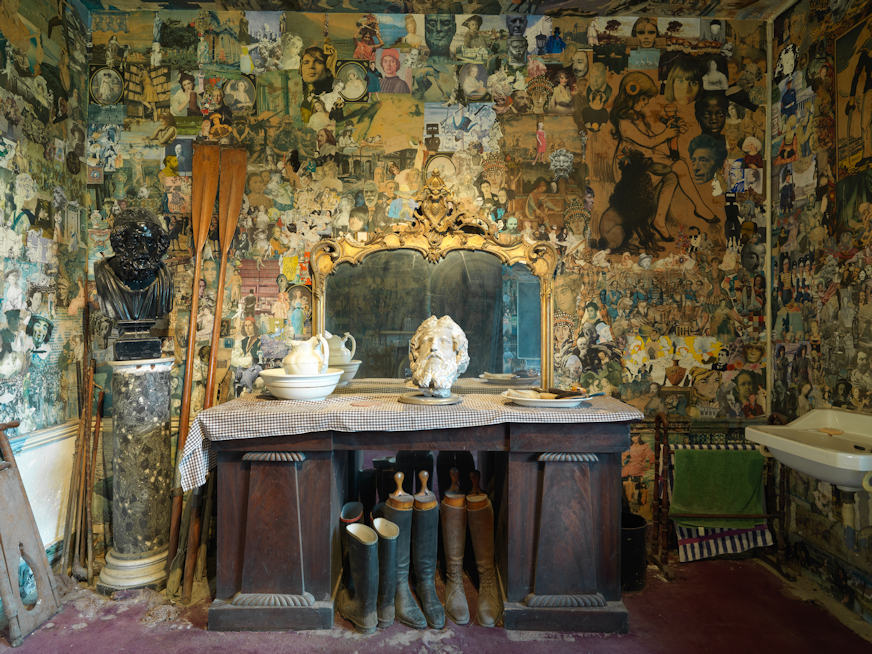
Our priority was to make a record for posterity, as good as possible, of the collage, and to provide it to researchers and enthusiasts. We have done that. The first recipient was Hilary Spurling, when she was covering that part of AP’s life in her forthcoming biography. Other uses will doubtless follow.
As well as the two images mentioned Hugh has produced an automatically rotating view (also controllable with your mouse) which can be accessed by clicking here.
All images © Copyright Hugh Gilbert, 2016.


Website by Beachshore