

Conference 2013
Seventh Anthony Powell Conference, 2013
Friday 27 to Sunday 29 September 2013
Eton College, Windsor, UK
Conference Report
by Clemence Schultze
We knew we were back at school as Keith Marshall tapped the gavel and told us sternly not to sit at the back. It was a science lecture auditorium – at least, so suggested the sinks and gas taps on the podium’s bench but the luxuriously upholstered seats befitted a comfortable studio theatre. Keith tahanked Eton College and Michael Meredith, the Derek Hill Foundation, and the Trustees of the Anthony Powell Society for supporting this, the seventh conference.
Michael Meredith mused on AP as an Old Etonian. The writer was interested in the differences between OEs, and presents no stereotypical Etonians. He was also concerned for the continuing history of alumni, as recorded in the school’s published register. Thanks to his ‘charm offensive’, 500 years’ worth of computerised records will soon go online, free to all for genealogical and historical researches. Patric Dickinson then welcomed us to the second Society conference to be held at Eton.
In his keynote address, DJ Taylor considered the literary politics of the 1930s, with its ideological divide between the Left-inclined and the lingering 1920s aesthetes, and asked where AP had stood. Taste predominated over politics in forming AP’s views: he might be described (like TS Eliot) as a right-wing modernist, and he combined an interest in Bohemia with living a perfectly normal life. The books well reflect contemporary attitudes, ranging from Quiggin’s fellow-travelling, via St John Clarke’s Hugh Walpole-ish keeping up, to Hugo Tolland, who wished he had lived in the 1920s.
Peter Berthoud (self-described as ‘a London obsessive’ who was unavoidably absent due to serious illness) provided an abundance of images of London in AP’s time which were presented by Keith Marshall. These reminded us how much the city has changed, not only through the losses of war but from redevelopment, population shifts, increasing wealth, traffic and tourism. Most evocative were a shabby secondhand shop in Charlotte Street – one of a kind that simply no longer exists and the actual coffee stall at Hyde Park Corner.
Next came a new-old publication: Bernard Stacey had ventured to think himself into the persona of X Trapnel and to ‘distil the essence of Maida Vale canal water into a book’. Bernard sketched what we know of the writer’s life and career, and pointed out the appositeness of his novel’s title to Dadaism, particularly the string collages of Picabia, evoked on the cover. There was a rush to buy copies of the work – and some lucky members acquired one of the few adorned by X’s very own signature.
The evening reception was a delight: pianist and radio presenter Paul Guinery took us from Ted Jeavons’ wartime tunes via the Huntercombes’ ball to the song Sergeant Gwilt sang to Maureen: ‘Arm in Arm – Just You and Me’. Some melodies hovered at the fringes of memory; others were completely new to us. His wonderful playing and voice (which, with needless modesty, he compared to Max Pilgrim’s ‘tremulous quavering’) presented many lost gems: ‘If you’re Going to Piccadilly, Billy, pick a Nice Little One for Me’. He elucidated some puzzling allusions: ‘Molly the Marchioness’ comes from the 1902 musical ‘A Country Girl’, and a revue by Andre Charlot at the end of World War I provided ‘Buzz Buzz’ – thus appropriately to be heard on the ‘Braddock alias Thorne’ walk. The occasion was enhanced by the setting: the Election Hall with its beamed ceiling and huge bird’s-eye-view painting of Venice. And among the portraits of Eton notables in the corridor hung one by Colin Spencer of AP.
Saturday’s first session was entitled ‘Aspects of Dance‘. Constantine Sandis addressed manifestations of philosophy of action in the work. In a paper which touched briefly on writers from Homer to Wesley to Nietzsche, he identified Chaucer’s poetics of suffering as the opposing pole to Spenser’s of action. In the novel Widmerpool represents the will, with Nick as the figure of passivity and patiency.
Robin Bynoe used painting to illustrate the meaning of naturalism: Frith’s ‘Derby Day’, teeming with detail and ostensibly a representation of an actual event, is in fact just as selective and suggestive as a work by Manet or Renoir. He proposed that, unlike Thackeray and Trollope, AP just did not ‘get’ business, and was unable to represent it. Instead, he drew on specific details (the very small and specialised area of non-ferrous metal dealing) to evoke the business activities – and the power of Sir Magnus Donners and his associates. While this lack of verisimilitude regarding Donners Brebner was a blemish on the work, it was scarcely a serious one.
During World War II, AP was engaged on John Aubrey and his Friends. Ivan Hutnik regarded this as pivotal in his development as a novelist. Aubrey’s sceptical and yet engaged presence affected the mode in which Dance is composed. AP’s style, narrative voice and perspective are all transformed from the manner of his prewar modernist works. Sentences become long and clausular; only Nick is allowed inner musings. Gossip is at the heart of the work, and claims to insight rely only on what characters say. The multiple perspectives entail an historical and all-embracing view of the present. ‘Dance is a thoroughly modern novel, albeit one with a pre-Enlightenment world view’.
The second keynote speech was given by Patric Dickinson on Varda, a woman well described as ‘strife-torn and causing strife’. It is impossible to summarise all that Patric has discovered about Dorothy Farrer Stewart: we await his account of his researches. A woman of striking beauty, actress, dancer, mannequin (for Chanel, no less), she had aspirations as a writer and translator, and her High Holborn bookshop was a venue for the avant garde in the late 1920s. Her three marriages were all troubled, and she died of an overdose. Often mentioned in memoirs of the period, and appearing too in fiction, she nevertheless remains elusive: comments of ‘peevish’ and ‘dissatisfied’ suggest the difficulties of her personality; her wit, charm and funniness are harder to convey. AP’s allusions to her in his memoirs are discreet, but surviving letters reveal that Varda was the keener of the two on a relationship and perhaps wished to marry him.
Lord Gowrie’s celebratory address began with what he termed ‘the best depiction of Eton in literature’. He stressed the ‘counter-Brideshead-ism’ of the portrayal of school and university, especially the eternities of boredom and melancholy to be endured: no Arcadia here, as Grey Gowrie himself experienced in 1955. A couple of years later, he met AP for the first time, and thereafter had a standing order at his bookseller for the novels of just two authors: AP and Ian Fleming. He recalled the incongruity of AP’s “huntin’, shootin’, fishin'” mode of speech when applied to books: ‘Extraordinary thing, that feller Turgenev …’ Dance, for him, is ‘suffused with poetry’, and the work repays many re-readings. It was his own regret that AP’s papers had gone to the British Library instead of Eton College Library; it was his hope that AP’s status as one of Eton’s two great twentieth-century writers would be celebrated by a statue at the College.
In a session on ‘Powell’s People’, Jeff Manley offered multiple perspectives on Eton from the writings of John Heygate and Henry Green, as well as the little-known Julian Henry Hall (The Senior Commoner, 1933). He pointed out the differences in treatment of the school in AP’s essay ‘The Wat’ry Glade’ (1934, reprinted 1984) compared with Infants of the Spring. Overall, Heygate emerged as a complex character who deserves more attention.
Winston Churchill is not perhaps exactly a Widmerpudlian politician but Nick Birns made out a case for similarities in the opportunism of the two careers, one of the Right, the other of the Left. He saw more resemblance between Churchill and AP (both British patriots, both unparochial, both celebrating the USA), though admitting that they differed in age, celebrity and style. For him, AP’s roman fleuve and Churchill’s war narrative sequence are ‘liberal epics’.
Jonathan Black demonstrated how Venusberg is a composite of Helsingfors and Reval, visited by AP as a young man. Finnish hero Baron Mannerheim impressed as an authentic representative of that nineteenth-century officer class which fascinated AP both in life and literature, and certainly contributed to the portrait of Kuno in the novel. The introduction to an area influenced (but not dominated) by Russian culture was one element in AP’s complex awareness of Russia.
From Baltic to Pacific: the final paper, by Frank Peterson, sketched the Powells’ 1937 visit to Hollywood. A career as a scriptwriter did not eventuate, which AP attributed to his own lack of histrionic ability in putting over a proposal; another factor (mentioned by John Powell in the question session) was the death of AP’s agent. But some cocktails were drunk and some parties were visited in ‘a special two months’.
Patric Dickinson closed the proceedings, and Michael Meredith showed us the impressive Eton College Library, where he had mounted a Powell-related display. The day concluded with an excellent dinner at Bekynton – all the meals and refreshments were most enjoyable.
This guest has nothing but praise for an occasion where surroundings, company and content combined to make a feast indeed.
-

A motley collection of conference delegates
Photo Mike Jay -
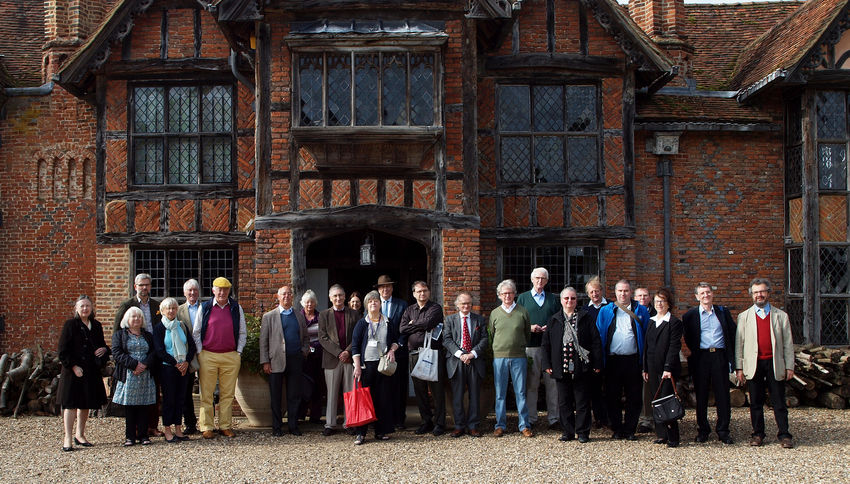
Some delegates gather outside Dorney Court
which they visited on the Sunday morning
Photo Keith Marshall -
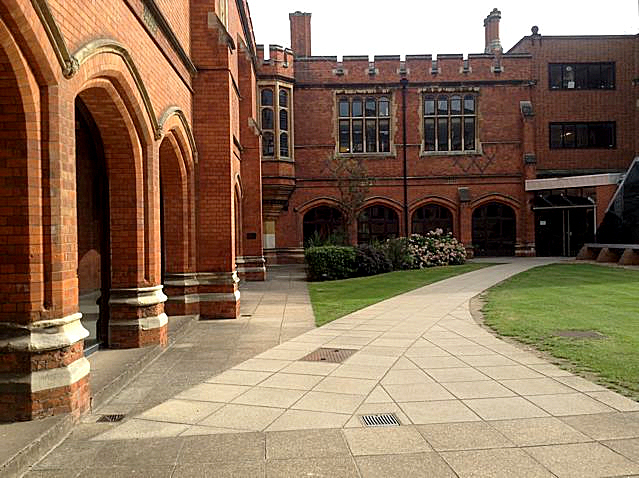
Eton College Science Schools, venue for the conference
Photo Jeanne Reed 
-
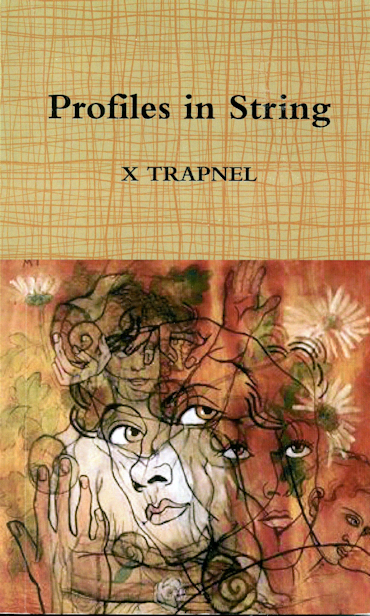
X Trapnel’s recreated novel Profiles in String


Website by Beachshore